
Introduction
Around 65, a thick envelope shows up and you're told to pick: Original Medicare or Medicare Advantage. Most people guess. Fair enough, since the differences don't show until you're sick, and by then it's late. More than half of people now go with Advantage. It doesn’t mean it’s the best choice for you. Many intelligent families can wind up on the opposite side, and they have valid reasons.
Here is what will be different about 2026: the cost of each one, the method of dealing with the gigantic bill, and how to know which fits you and your physicians best. No insurance background needed. Just two options, side by side.
Original Medicare: Parts A and B Explained
Start with Original Medicare. Medicare is divided into two different parts. Medicare part A covers the cost of hospitalization, nursing care, and hospice care. Medicare part B covers the cost of visiting a physician's office and outpatient services. Part A comes for free to many people because of Medicare taxes they paid on their salaries. Part B isn't. The standard premium is $202.90 a month in 2026, and there's a $283 deductible every year before it starts paying.
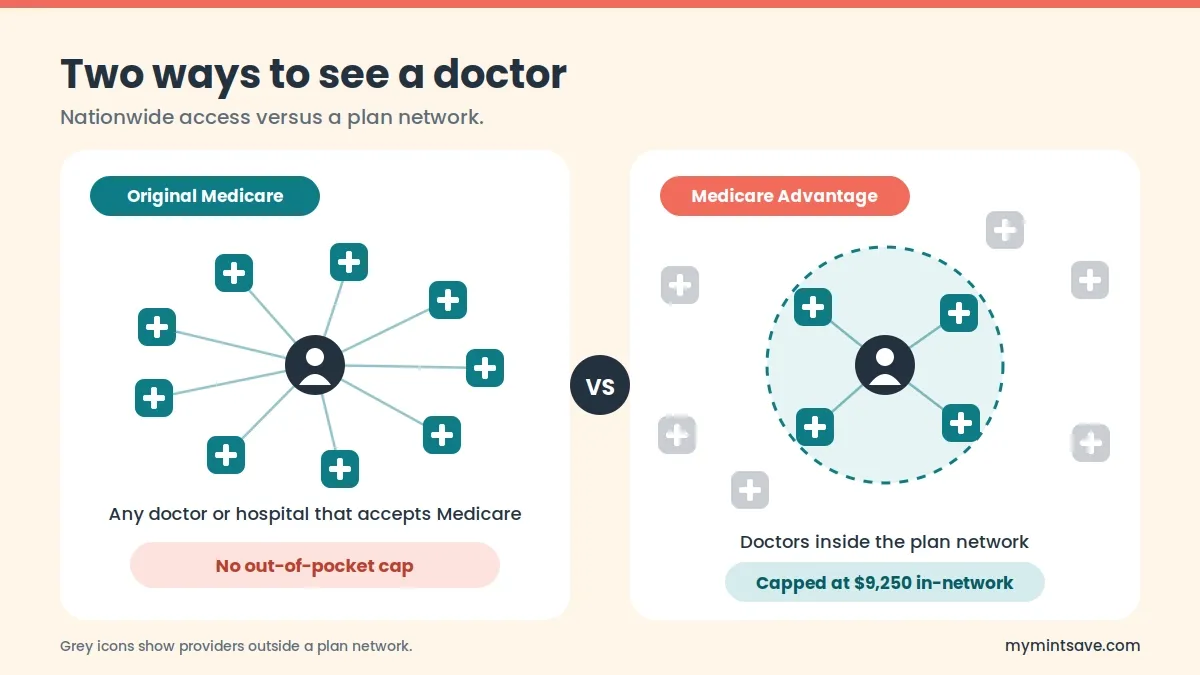
What people love about it is the freedom. Any doctor or hospital in the country that takes Medicare, no network, no referral to see a specialist. Done. Now the part that bites. There's no yearly cap on what you spend. After the deductibles you pay 20% of most Part B services, and that 20% keeps coming for as long as the treatment does. Picture a bad cancer year or a long recovery. Thousands of dollars, and nothing that says stop.
Medicare Advantage: Part C Explained
Medicare Advantage, also called Part C, is the other route. Private insurance companies run these plans, with Medicare's approval. They have to cover everything Original Medicare covers. Most throw in drug coverage too, and lots add dental, vision and hearing, which Original Medicare skips entirely.
The monthly cost sits on top of your Part B premium and runs from $0 to $150 or more. Plenty of plans charge nothing extra. So what's the catch? A network. Same idea as an HMO or PPO at work: cheaper and more perks, but a shorter list of doctors and hospitals than Original Medicare's nationwide reach.
The Biggest Difference: Out-of-Pocket Protection
| Feature | Original Medicare | Medicare Advantage |
|---|---|---|
| Annual out-of-pocket maximum | None, unlimited exposure | Capped, up to $9,250 in-network (2026) |
| Provider network | Any provider accepting Medicare, nationwide | Plan-specific network, often regional |
| Referrals needed | No | Often yes, depending on plan type |
| Dental, vision, hearing | Not included | Often included |
| Medigap eligible | Yes | No |
This is the big one. Original Medicare has no cap, so most people who pick it buy a separate Medigap policy to cover the holes. Skip that and a major illness has no financial floor under it. Advantage plans come with the protection built in. In 2026, the federal maximum for out-of-pocket costs within the network is $9,250, while the average plan is much lower, at $5,400.
Medigap: The Supplement Option for Original Medicare
Medigap or Medicare Supplement is a different insurance that covers those portions not paid by the Original Medicare, which include copayments, coinsurance, and deductibles. The monthly premium you pay for it ranges between $100 and $300 based on your chosen plan. The fullest Medigap plans cover almost all of that cost sharing, so you end up protected about as well as an Advantage plan would protect you. Stack a standalone Part D drug plan on top and the monthly total often lands higher than an Advantage plan. You get a wider choice of doctors for that money. Work out the gap early and treat it like any other bill that repeats every month. If you already have a broader savings plan going, adding this number to it before you turn 65 takes most of the stress out.
Something to know years before you need it. You're guaranteed a Medigap policy only in a set window around your 65th birthday. After that, insurers can look at your health history and say no, or charge you way more. So say you take Advantage now, develop a health condition at 70, and want to go back to Original Medicare. That affordable Medigap plan could be gone right when you'd want it.
Part D: Prescription Drug Coverage
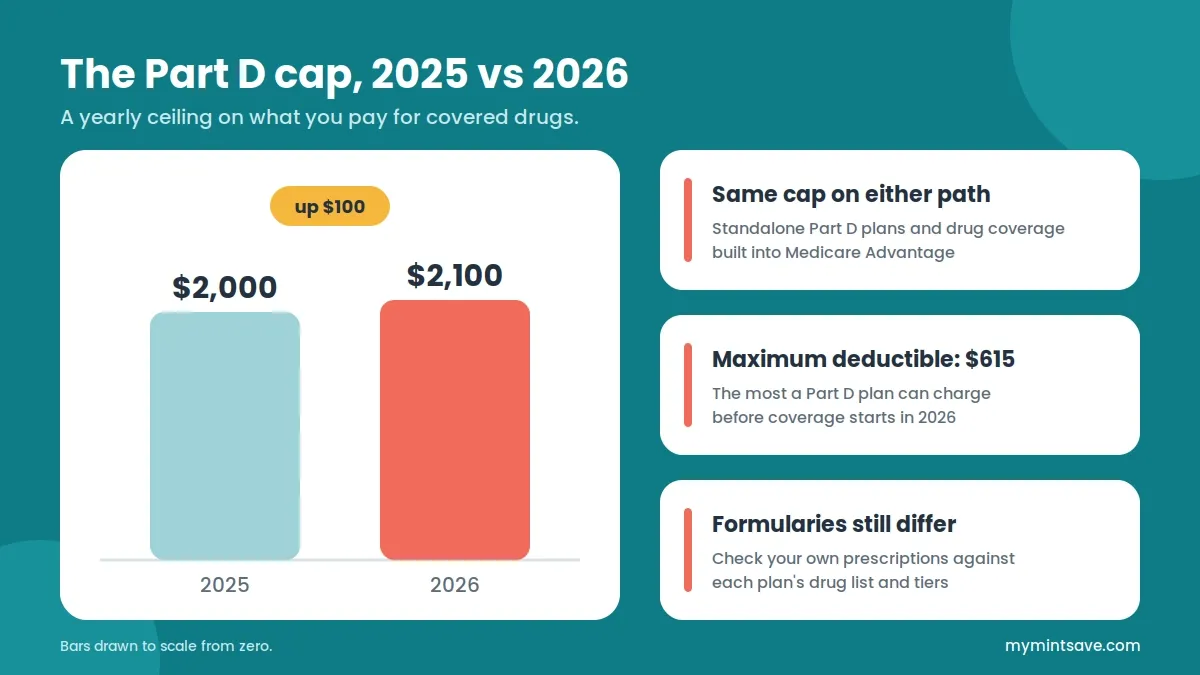
Most Advantage plans include Part D drug coverage. With Original Medicare you have to buy a standalone Part D plan if you want drugs covered at all. In 2026 Part D has a top deductible of $615 and a hard yearly cap of $2,100 on what you pay for covered drugs. The cap is fairly new, phased in over the last couple of years. It limits your prescription spending in any one year, whichever path you took.
And it's the same cap either way. Drugs bundled in an Advantage plan or a standalone plan next to Original Medicare, same ceiling. So drug protection isn't a reason to choose one over the other anymore. What is different is the formulary the list of covered medications and the tier that each medication is on. Take a look at this list compared to the medications you take. Honestly, that matters more than the cap.
Network Access and Provider Choice
Travel a lot? Spend winters in another state? Want to see any specialist without first checking whether they're in network? Original Medicare wins that one easily. Advantage plans usually tie you to a service area and a network. Spend months away from it and you could have thin coverage, or none, for anything that isn't an emergency.
It matters most if you already have doctors you like. Before you sign up for an Advantage plan, check that each of your doctors is in the network, just like you would with an HMO or PPO from an employer. Getting bumped to a new doctor in the middle of treatment is miserable, and you can dodge it with ten minutes of checking.
Medicare Advantage Plan Types: HMO, PPO, and SNP
Advantage isn't a single type of plan. It comes in several types, each adopting the HMO and PPO standards that you have come across in employment. The HMO type requires you to choose a primary care physician who will refer you to specialists. Premiums run lowest and the network is smallest. A PPO style plan lets you go out of network for a higher price and doesn't ask for referrals. That's closer to the freedom of Original Medicare, though you're still working inside a network.
And then there are the Special Needs Plans, or SNPs. They cater to particular types of individuals, such as those with certain diseases or those who qualify for Medicare as well as Medicaid or individuals residing in institutions like nursing homes. Everything about the networks and the benefits offered revolves around these particular kinds of individuals. If you fit one of those groups, ask about them. For the situations they're made for, the difference can be big.
Star Ratings: A Quick Quality Check
CMS rates every Advantage and Part D plan once a year, one to five stars. The score comes from member satisfaction, customer service and clinical quality. It's public, and you can look it up in Medicare's plan finder. Most people don't, which is a shame.
A plan with a rating of 2 stars or less may be flawed by poor customer service, denied claims, or care coordination issues despite its low premium. Looking at the stars next to the premium and the network takes maybe two minutes. And it tells you something a monthly price can't.
Who Is Eligible and When to Enroll
The age of eligibility is generally 65. The time for your initial enrollment period spans for seven months: three months prior to your birth month, birth month, and three months thereafter. Sign up inside that stretch and you skip the Part B late penalty. Miss the deadline, and your consequence will be a permanent increase in your insurance rate, every year you should have had coverage but did not.
There are also cases where one may qualify for Medicare even before age 65, due to special diseases such as End-Stage Renal Disease, among others. In such a case, you need to adjust the rules according to the circumstances, and therefore contact either Social Security or Medicare.
Still working past 65 with coverage through your employer? That adds a twist. Whether your business is large or small, it may be possible to delay Part B enrollment without being penalized since you will have been covered through a qualified health insurance group plan. Make a mistake in the timing of this, by terminating the plan or enrolling too soon, and you have just done one of the more costly things in the entire process. Talk to your benefits administrator before making any decisions one phone call.
Switching Between Them: What to Know
During the annual open enrollment window, which runs from October 15 until December 7, this is your opportunity to change back and forth between Original Medicare and an Advantage plan, or even between Advantage plans or Part D prescription drug plans. Failure to do so means that most often, you have to wait for a year, except under special circumstances. Give it the same attention you'd give a retirement investment account when you review it once a year. Both drift if nobody looks.
Switching from Advantage back to Original Medicare later in the year is possible. But then the Medigap problem from earlier shows up. If your health has changed since your first enrollment window, a Medigap insurer in most states doesn't have to accept you at regular rates, or at all. Joining Advantage is easy. Leaving is not easy. You should consider this before signing and not after.
How to Decide Which Is Right for You
- Pretty healthy, watching costs, fine with a network? Advantage's low premiums and built-in cap often make it the cheaper pick.
- Got specialists you refuse to lose, or you're on the road a lot? Universal coverage in Original Medicare does away with concerns about networks, especially when paired with a Medigap insurance plan.
- Need dental, vision and hearing insurance without purchasing individual plans? Advantage often includes them at no extra charge. Original Medicare doesn't touch them.
- Living with a serious chronic condition? Run the real math on both, Medigap premium included if you lean toward Original Medicare. It comes down to how much care you'll probably use.
No matter which option you go with, put away money for either the deductible amount or the Medigap plan premium. A cash cushion in something easy to reach, like a high-yield savings account, takes the worry out of either choice because the cost is already covered.
Conclusion
Neither option wins across the board. They swap things for each other: you choose freedom without any limit on costs, or limitations but with financial protection. It all depends on your physical state, your frequency of travel, your most trusted doctors, and whether your budget is large enough for paying for insurance and for surprises. Take your time during your first enrollment window. And don't just take whatever plan the loudest mailer pushes that year.