Introduction
When a guest slips on front steps and ends up with a lifelong back injury it can be a shock. When a teenager you have never met is seriously hurt in an accident involving your car the pain can be even greater. When an offhand comment on social media turns into a defamation lawsuit the worry grows. None of these situations are common. Each can produce a legal judgment that is far larger, than what a standard home or auto policies liability limit would cover. That gap is exactly what umbrella insurance is meant to close.
Despite costing less than most people spend on streaming each month umbrella insurance is one of the noticed policies, in a typical homes insurance plan. This guide explains how it works what it covers that your home and auto policies don't how much it will cost in 2026 and how to decide if your situation needs it. No legal or insurance knowledge is needed.
How Umbrella Insurance Actually Works
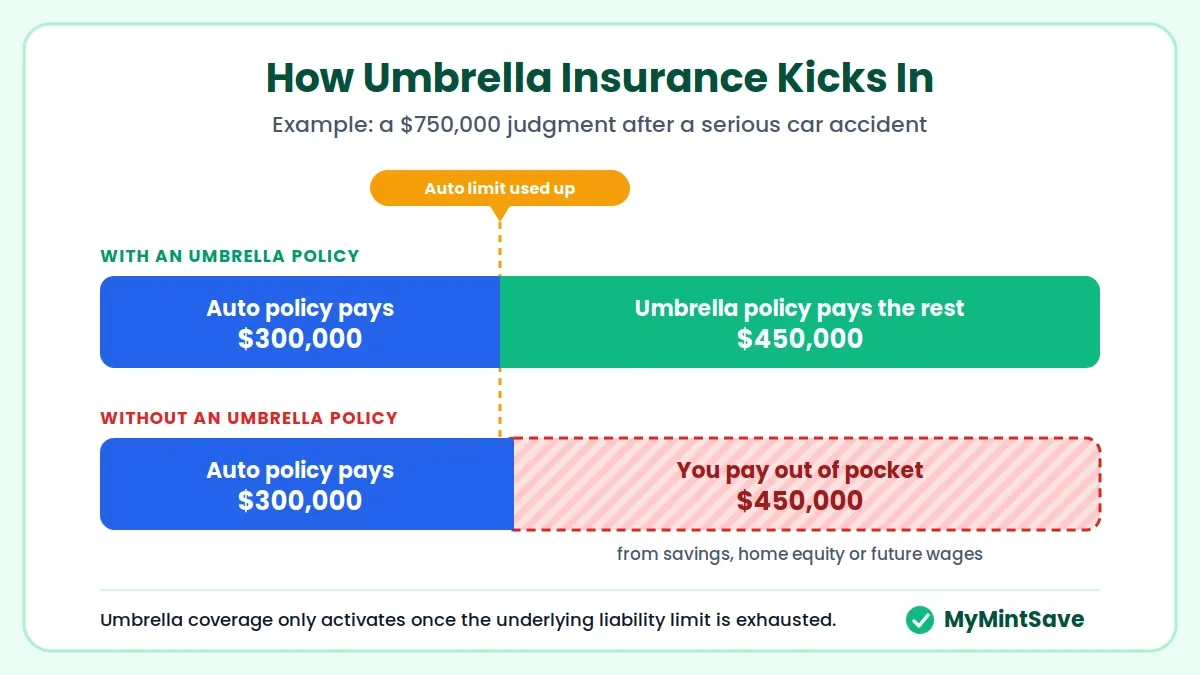
An umbrella policy is a kind of liability insurance that gives liability protection for your home insurance your car insurance and sometimes also covers boat insurance or RV insurance. This umbrella insurance does not work on its own. Starts to help when the liability coverage on one of those policies has been completely used. The umbrella insurance begins to cover the type of liability up, to one million dollars or more based on the limit you choose to buy.
A concrete example helps you see it better: imagine you are found responsible for a $750,000 judgment, after a car crash. Your auto policy may only cover $300,000. In that case the umbrella policy must cover the remaining $450,000 if you have purchased at that amount of umbrella coverage. Without the umbrella policy that $450,000 gap would have to come out of your savings, your home equity or future wages that could be seized through a garnished judgment.
This kind of gap exists more than people think. Higher medical costs and bigger jury awards sometimes called verdicts in the insurance industry have made serious liability judgments much larger in recent years. At the time many families basic auto and home liability limits have not increased. A $300,000 liability limit that seemed good ten years ago can now be much less, than what a single serious injury claim costs. This is the gap that umbrella insurance is meant to fill.
What Umbrella Insurance Covers Beyond Home and Auto
- Personal injury claims: libel, slander, false arrest, and defamation claims, categories most standard home and auto policies don't cover at all
- Worldwide coverage: protection for covered incidents that happen anywhere in the world, not just at home or in your home state
- Rental property liability: extends beyond a standard landlord policy's limit if you own rental property and a tenant or visitor is injured
- Liability involving your children: this includes situations where a child you depend on is found responsible, for an injury or damage a scenario many parents do not plan for.
- Defense costs: Legal defense costs cover the money needed to defend a lawsuit. Legal defense costs can reach tens of thousands of dollars even before a judgment is reached.
Umbrella insurance is not simply an auto policy. Its broader scope is what makes umbrella insurance genuinely distinct. Umbrella insurance picks up categories of risk that standard liability coverage was never built to handle such, as injury claims and legal defense costs. That is why comparing umbrella insurance to " a bigger auto policy" undervalues what umbrella insurance actually does.
Underlying Policy Requirements
An umbrella insurer doesn't offer this coverage alone. They need your auto policy and your home policy to have at least a certain amount of liability coverage before the umbrella policy can come into play. These minimums are there on purpose. They make sure the umbrella only deals, with big problems, not the small accidents that your main policies should already take care of.
|
Underlying
Policy |
Typical
Minimum Required |
|
Auto liability |
$250,000 per person / $500,000 per accident |
|
Homeowners or renter’s liability |
$300,000, sometimes $500,000 |
|
Boat or watercraft liability (if applicable) |
$100,000 to $300,000, depending on size and horsepower |
If your current liability limits are below these thresholds, you will usually need to increase them before an umbrella policy can be issued. It’s an idea to check this ahead of time instead of finding out during the application process. Raising your auto or home liability coverage to meet the minimums often doesn’t cost much. Can be a smart upgrade, on its own, regardless of whether you decide to add an umbrella policy later.
What Umbrella Insurance Costs in 2026
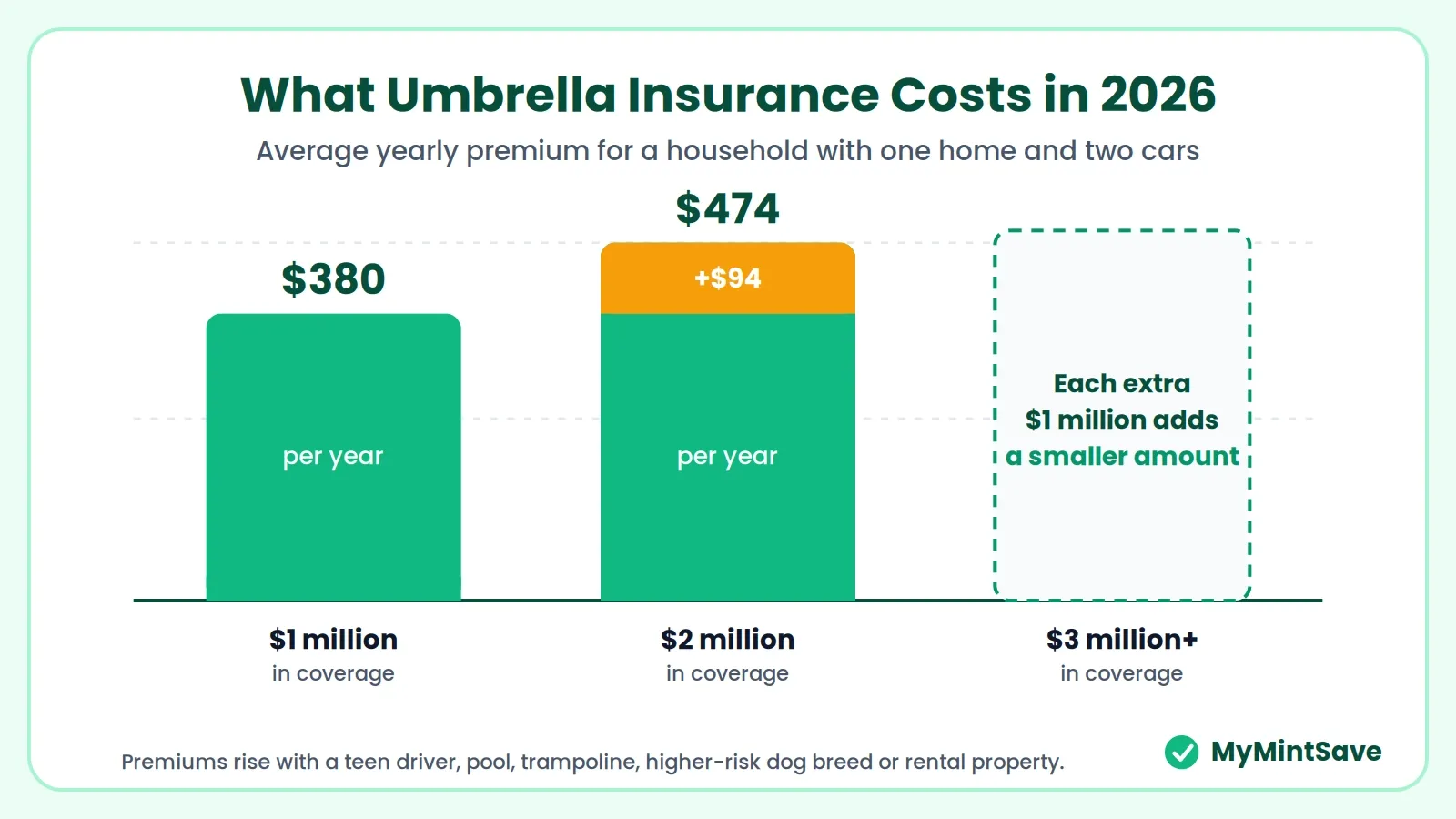
The cost is genuinely low relative to the protection it provides. A $1 million umbrella policy for a typical household with one home and two cars runs around $380 a year, with $2 million in coverage costing closer to $474 a year, and additional million-dollar increments typically adding a smaller amount each. Pricing climbs somewhat for households with higher-risk factors, a teenage driver, a swimming pool, a trampoline, a dog breed considered higher-risk by insurers, or a rental property.
Carriers have been tightening underlying requirements and watching claim severity closely heading into 2026, with some raising their minimum underlying auto liability requirements to as high as $500,000 to $1 million for households with elevated risk factors. None of these changes the value proposition though. For households umbrella coverage still costs a few hundred dollars a year. That cost gives a multiple of extra protection. It is worth comparing that cost with what a modest legal judgment could cost if you do not have umbrella coverage. Budgeting for umbrella coverage as a fixed line item just like any other recurring cost, in a household budget, makes the premium feel predictable at renewal.
What Umbrella Insurance Doesn't Cover
- Your injuries or property damage: umbrella insurance is liability coverage only. It does not pay to repair your home or car. Does it cover your own medical bills.
- Intentional or criminal acts: umbrella insurance is built for accidents and negligence claims. It does not cover harm.
- Business-related liability: I think a personal umbrella policy does not extend to conduct or a business you own which means you need separate commercial coverage.
- Liability: Obligations you have agreed to in a contract generally fall outside what a personal umbrella policy is built to cover.
Understanding these exclusions is equally important because umbrella insurance is a type of liability insurance, which protects you against only specific claims, not against all possible claims that may potentially arise for a family.
The Risks Insurers Watch Most Closely
A few specific liability risks cause a large part of umbrella claims and insurance companies set their prices and decisions around these risks. Swimming pools and trampolines are at the top of the list. Both are seen as nuisances in most states. This means a property owner can be responsible, for injuries even if the child who got hurt was not supposed to be. The reason is that the danger was something that could easily attract a child.
Certain dog breeds also face added underwriting scrutiny, as liability claims for dog bites are common enough that insurers will review applications more closely based on the breed of the dog. Having a high-risk dog breed does not necessarily preclude you from getting umbrella coverage, but you may need to answer additional questions and may face slightly higher premiums. None of this is a reason to skip the coverage, if anything, these specific risk factors are exactly the kind of exposure umbrella insurance was built to address.
How Umbrella Claims Actually Work
When a liability claim is filed, it goes first against the relevant underlying policy, your auto or homeowner’s insurer handles the claim and pays up to that policy's limit. Only once that limit is reached does the umbrella insurer step in to cover the remaining judgment, up to the umbrella policy's own limit. This sequencing means the underlying insurer typically manages the legal defense initially, with the umbrella carrier becoming involved once the claim's value approaches or exceeds the underlying limit.
This structure is part of why maintaining adequate underlying limits matters even with an umbrella policy in place, a complete lapse or cancellation of an underlying policy can jeopardize the umbrella coverage built on top of it. Keeping all of these policies, auto policy, home policy and umbrella policy with an understanding of how they work together rather than looking at them as completely separate purchases is worth thinking about again every time they come up for renewal.
Shopping for an Umbrella Policy
Umbrella insurance is usually the affordable and easiest to get when you buy it from the same company that covers your car and your home. Many insurance companies give a discount when you bundle umbrella insurance with your auto and home policies. That’s a thing. It’s still smart to check a quote from at least one other insurer. Why? Because even though umbrella insurance is pretty standard prices and rules can be quite different from one company, to another. It doesn’t take time to compare but it could save you money.
Before you buy, run through this checklist: make sure your auto and home liability limits meet the insurer’s minimums. Be honest about higher-risk factors like a pool, a trampoline or a specific dog breed, during underwriting. Pick a coverage amount that fits your household’s assets and future earning potential not the option you can find. A quick call with an agent can show you coverage options and requirements that a simple quote tool might miss.
Who Actually Needs It
- Homeowners with equity or savings: umbrella insurance protects homeowners with substantial equity or savings from any possible lawsuit that might go very large.
- Anyone, with a driver: a teenage driver carries increased risk of an accident, and a teenage driver also increases the risk of a liability claim that exceeds the limits of your auto policy.
- Landlords and rental property owners: tenant and visitor injury claims are an important source of liability in addition to what a standard landlord policy cover.
- Anyone who has a pool or a trampoline or a dog: these are some of the most common reasons for big liability problems, against homeowners
- High-income earners: wages are garnish able after a judgment, which makes umbrella coverage relevant even for renters without significant home equity
If your net worth, savings and future earning potential together are higher than your auto and home liability limits then you have a real gap that an umbrella policy can close. Anyone who is actively building long-term investment accounts or retirement savings has by definition more to protect than someone who is just starting out. That is why umbrella coverage becomes more relevant, as a household’s net worth grows, not less.
Common Mistakes to Avoid
- Assuming that net worth has to be high to need coverage: wage garnishment after a judgment means even moderate earners, without savings have exposure.
- Forgetting to update coverage after making a purchase: buying a property or a boat without informing the umbrella carrier can leave that particular asset or that specific activity, without protection. It’s easy to overlook. Those new things need to be covered too.
- Letting underlying policy limits lapse below the required minimum: if a home or auto policy's liability limit drops below the umbrella's required threshold, the umbrella coverage itself can be jeopardized
- Assuming homeowners or auto insurance alone is enough: standard liability limits are routinely exceeded by serious injury judgments, which is the entire reason umbrella coverage exists
None of these mistakes are anything to spend a lot of time worrying about, just adjust your policy accordingly and you'll be fine. On the other hand, if you feel that having to maintain your prized possessions is a top priority, a cursory look at both your underlying policies and your umbrella coverage should only take a few minutes.
Conclusion
Umbrella insurance covers a very specific, narrow liability risk: the possibility that a judgment against you will greatly exceed the liability limits in your homeowners or automobile policy (or both). It does so, by the way, at a very small cost for the degree of protection it affords. If you have a sizable amount of savings, own a home, have a teenage driver in the family, or rent out a property, you should definitely consider an umbrella policy. The annual premium for this kind of coverage would be a small price to pay to avoid a far greater liability judgment. If you are saving money for an emergency fund, plus saving for retirement and other essential needs, buying umbrella insurance makes set sense.