Introduction
Americans owe about $1.26
trillion on their credit cards now according to the New York Feds latest
household debt report and the typical credit card is charging more than 21
percent interest, on whatever balance is carried over. Those two facts go hand
in hand. Credit cards are one of the useful money tools that most people will
ever own but they also become very expensive when credit cards are used
automatically.
Here is what nobody explains
when you get your card. Card is not money and card is not a trap. Card is a
short-term loan that also comes with fraud protection, rewards and a way to
build the credit history you need for an apartment, a car loan or a mortgage
later. Pay the statement in full each month and card work for you. Carry a
balance. You start working for the bank.
This guide shows the picture in
plain English. It explains how cards really work. It shows how interest and
fees will cost you in 2026. It shows how rewards compare. It shows how your
credit score will react to what you do. It shows how you can get out of card
debt if you are already in it. If your monthly numbers are still a bit fuzzy
start with our complete budgeting guide for beginners. A card
only works well when you know what is coming in and what is going out.
How Credit Cards Actually Work
When you swipe a credit card,
you aren't spending your own money. The bank pays the store, and you owe the
bank. That one idea sits underneath everything else, the interest, the rewards,
and the effect on your credit score. The full breakdown of how credit cards
work, from APR to billing cycles, is something we'll unpack in more detail, but
the basics fit in a few paragraphs.
Your card follows a billing
cycle that lasts, around thirty days. Your card adds every purchase that you
make during that window and when the cycle ends the issuer sends a statement
that shows what you owe and the payment that you must make. Federal law requires
that the statement reach you least twenty-one days before your payment is due
so you always have a fair window to pay.
The grace period is where most
people run into trouble. If you pay your statement balance by the due date you
will not pay any interest, on your purchases at all. That's the real superpower
of a credit card. But the grace period disappears the moment you carry part of
the balance forward, and from then on new purchases start collecting interest
from the day you make them.
The minimum payment is the
trap. It's usually a small slice of the balance, often about 1% plus the
interest, with a floor somewhere around $25 to $40. Paying only the minimum
keeps the account in good standing while keeping you in debt for years. Take a
$3,000 balance at 22% interest. Using a common minimum formula of 1% of the
balance plus interest, you'd be paying for about 12 years and handing over
roughly $4,000 in interest, which is more than the original purchase. Pay a
flat $250 a month instead and the balance is gone in about 14 months, with
around $420 in interest.
What Interest Really Costs in 2026
Credit card interest is shown
as an APR, which stands for percentage rate. The Federal Reserve’s recent
numbers show that the average is around 21.19% across all accounts. It is
22.36% on accounts that have a balance. New credit card offers are currently
between 22% and 24% depending on the data source you believe. The average, on
offers has gone up for three months in a row as we approach October.
Most credit card companies
figure out interest every day. That’s why your balance can grow a bit faster
than what basic math would tell you. The interest rate you get depends a lot on
your credit score. If your credit is really good you might get a rate around
17%. If your credit is just fair you could be looking at 27% or even higher.
Store cards are the worst. They usually charge, over 33%. So even if that
checkout deal looks nice think twice before signing up.
It helps to turn those
percentages into dollars. With a $5,000 balance the difference between a 17%
card and a 27% card is $500 each year, in interest. That's why shopping the APR
matters if you ever carry a balance, even if the rewards on the higher-rate
card look more exciting on paper.
You may have heard about a proposed 10 percent cap on credit
card interest. After that idea was shared publicly this year it has been
debated in Congress but as of mid-October 2026 it is not yet law and the bills
are still in committee, with no vote scheduled. The sensible move is to plan
around the credit card interest rates you actually have not the credit card
interest rates you might get someday.
The Main Types of Credit Cards
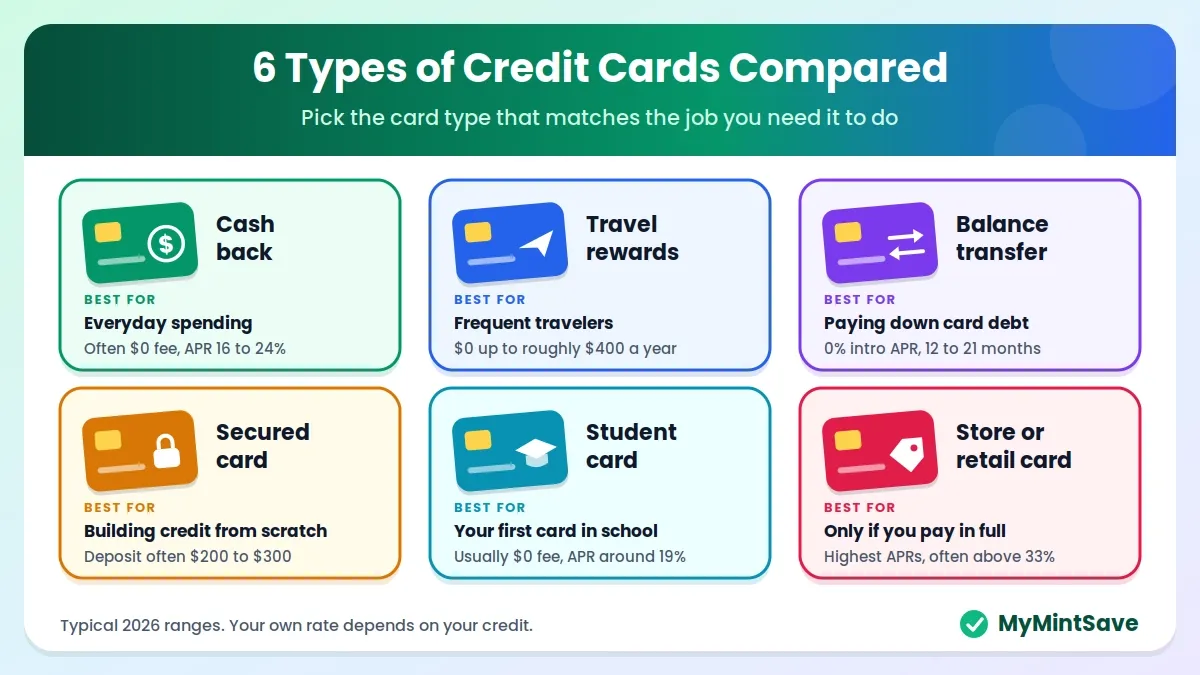
Not every card is built for the
same job, and picking the wrong type is one of the quieter ways people lose
money. Here's how the main categories stack up.
|
Card
Type |
Typical
Cost |
Best
For |
Watch
Out For |
|
Cash back |
Often $0 annual fee, APR roughly 16% to 24% |
Everyday spending and simple rewards |
Bonus categories that rotate or hit a cap |
|
Travel rewards |
$0 up to roughly $400 on premium cards |
Frequent travelers who use the perks |
Annual fee can erase the value if you travel rarely |
|
Balance transfer |
0% intro APR for about 12 to 21 months, 3% to 5% transfer
fee |
Paying down existing card debt |
The rate jumps once the intro period ends |
|
Secured |
Refundable deposit, often $200 to $300 |
Building credit from scratch |
Low limits, and not every issuer reports to all three
bureaus |
|
Student |
Usually $0 annual fee, APR around 19% |
First card while in school |
Small limits and modest rewards |
|
Store or retail |
Often $0 fee, but the highest APRs around |
Only if you'd pay in full and love the discount |
Sky-high rates and deferred interest traps |
Your first card also doesn't
have to be your forever card. Plenty of people start with a no-fee secured or
student card, build a solid record, and move up to a better rewards card a year
or two later. Think of the early cards as a stepping stone, not a commitment.
If you're a student getting
your first card, our student budget guide shows how a card fits
into a tight monthly plan without turning into debt.
Cash Back vs. Travel Rewards
Rewards are the reason most
people pick one card instead of another so it’s important to be clear about how
they function. Here is the 2026 view according to WalletHub recent analysis.
The average cash back card gives 1.18% at the basic level, which is why a card
that offers 2% is a significant improvement. Sign-up bonuses have also gone up
slightly with the average cash back bonus increasing by 3% compared to last year
and points and miles bonuses rising by about 6%. No one is giving away amounts,
for free but the deals are not getting any worse either.
Cash back is a choice. A
flat-rate card that gives around 2% on all purchases doesn’t require any
effort. A category card that offers 3% to 5%, on groceries, gas or dining can
outperform it, if you’re spending actually fits those categories. For people
groceries are the largest spending area. So if that’s your situation matching
the card to your habits can make a big difference. Check our guide on saving money on groceries for tips that fit
your lifestyle. The comparison between cash back vs travel rewards cards get
deeper than most people expect, and it comes down to how you spend.
Travel rewards can be worth
more per dollar especially when points transfer to airline and hotel partners.
The value of travel rewards only shows up if you redeem them well. Premium
cards can charge to $400 a year in exchange for credits and lounge access. That
is a deal only if you would have bought those things anyway. If you travel a
lot our travel savings guide pairs, with whatever card
you choose.
Sign‑up bonuses deserve a word too. Sign‑up bonuses can be
worth hundreds of dollars. They usually require spending a few thousand dollars
within three months. If you had to buy things you do not need to hit the
minimum the bonus is not really a bonus.
One rule beats every rewards strategy: rewards are worthless
if you carry a balance. At 22% interest you pay 1.8% a month. So, a 2% reward
gets erased by five weeks of interest. Pay in first then optimize.
Credit Card Fees to Watch
● Annual fee: The average card now
charges about twenty‑eight to thirty dollars each year which's about a nineteen
percent increase, from a year earlier. Still many great cards charge nothing
all. Deciding whether to pay fees is, about whether you use the perks that make
those annual fees worthwhile.
● Late fee: about $30 to $34 for the
slip and $41 to $43 for a repeat all within six billing cycles. The $8 cap that
the CFPB finalized in 2024 was struck down in April 2025. The agency signaled
in July 2026 that it may try again. Nothing has changed yet.
● Foreign transaction fee: The
average is 1.6 percent. Many travel cards do not charge a fee. This is more
important, than the points when you travel abroad frequently.
● Balance transfer fee: about three
percent, to five percent of the amount you move.
● Cash advance fee: usually 3% to
5%, plus a higher APR that starts the same day with no grace period. Avoid it
unless there's truly no alternative.
● Penalty APR: after you're about 60
days late, many issuers raise your rate, and the average penalty APR is now
about 27%, with some running close to 40%.
Cards aren't the only place
fees hide. Checking accounts have their own list, which we break down in our
guide to bank fees and how to avoid them, and if you've
ever been hit by one, our piece on overdraft protection explains why a card isn't
a smart workaround for a thin checking balance.
Credit Cards and Your Credit Score
Your credit score decides which
cards you qualify for and what rate you're offered. The national average FICO
score is 714, according to FICO's fall 2026 report, which counts as good. It
has dropped a point in the last year the first real decrease in, over ten years
mainly because of student loan defaults and bigger credit card balances.
Here's how a FICO score works.
It's worth remembering because it shows you exactly where to pay attention:
● Payment history, about 35%: paying
on time is the single biggest lever you have
● Amounts owed 30%: mostly credit
utilization, the share of credit utilization limits you are using.
● Length of credit history 15%: older
accounts help, which is why closing your oldest card is usually a mistake.
● New credit, 10%: each new credit
application brings a hard inquiry, which can lower your score a bit for a short
time
● Credit mix, about 10%: having both
credit card debt and installment loans can help a little but you shouldn't take
on debt just to improve this factor
Utilization is the part people
can fix fastest. Experian data shows people scoring 800 or higher use only
about 6% of their available limits on average, while the national average sits
near 28%. The common advice is to stay under 30%, but lower really is better,
and understanding credit utilization is the quickest way to move a score. The
average American also holds about 3.7 cards, though there's no magic number for
how many credit cards you should have. One card you manage well beats five you
don't.
Your credit follows you beyond
lending, too. In most states, insurers use a credit-based insurance score when
pricing auto and home policies, so a stronger credit profile can lower what you
pay. We cover that in our complete guide to insurance.
How Issuers Decide Whether to Approve You
Applying for a credit card
isn't like flipping a coin even though it can feel like that. Credit card
companies check a thing: your credit score and credit history your income, how
much debt you already have compared to how much you make and how many applications
you have made recently. A high credit score doesn't always mean you will be
approved and a lower one doesn't always mean you won't be. A person with a
credit score, in the 600s who has a steady income and not much debt can be
approved for a credit card that turns down a person with an 800-credit score
and a lot of recent applications.
Standards have tightened
somewhat this year. The Federal Reserve’s latest bank lending survey found that
banks pulled back on credit card approvals while remaining steady on auto loans
and home equity lines. In practice this means it is wiser to apply for a card
that's realistically likely to be approved rather than to aim for the fanciest
card and gather many hard inquiries along the way. Use the -qualification tools
that most issuers offer first. Pre-qualification tools show offers using a soft
check so pre-qualification tools do not affect your score.
If you get denied you are entitled to a notice explaining
why. It is genuinely useful It tells you whether the problem was your score
your income too many inquiries or too little history Fix that one thing wait a
few months and try again.
How to Build Credit from Scratch
No credit history is it’s kind
of problem. You can't get approved because you have no history and you can't
build history without being approved. A few reliable ways, around it:
● A secured credit card: You pay a
deposit, $200 to $300 and that is your limit. Use the deposit carefully; pay
the deposit and many companies will move the deposit to a card after months of
good habits.
● A student card: designed for
people with little or no history, usually with no annual fee and a small limit.
● Becoming an authorized user: A
family member adds you to a long‑standing well‑managed card and the family
member’s history can show up on your credit report. Make sure the family
member’s habits stay good because the family member’s mistakes can also appear
on your report.
● A credit-builder loan: a small
loan held in a locked account that you repay over time, with the payments
reported to the bureaus.
Most secured credit cards need
the deposit to come from a bank account. If you don’t have a bank account yet
our step-by-step guide on how to open a bank account shows you what to
do. The best banking apps of 2026 help you set up
alerts, for every card payment so you never miss a transaction. No matter which
way you go just add one recurring bill to the card set it to autopay and let
time take care of the rest. Building credit with a secured credit card takes
time. It’s a steady and reliable path.
Balance Transfers and Paying Off Card Debt
If you're already carrying a
balance, the math works against you every single day. Delinquencies are still
elevated across the country, with about 7% of card balances moving into serious
delinquency over the past year according to the New York Fed. So, if you're
behind, you're far from alone, and there are real ways out.
A balance transfer card is the
first tool to look at. These cards offer a 0% introductory APR on moved
balances, and in 2026 issuers are competing on them harder than on new
purchases, with intro periods averaging about 13 months, a touch longer than a
year ago, and the best offers reaching 21 months. The catch is the transfer
fee, which averages just under 3% and often runs up to 5%, and the regular APR
that kicks in afterward, which averages around 21%. Whether balance transfer
credit cards are worth it comes down to one question: can you pay it off before
the promo ends?
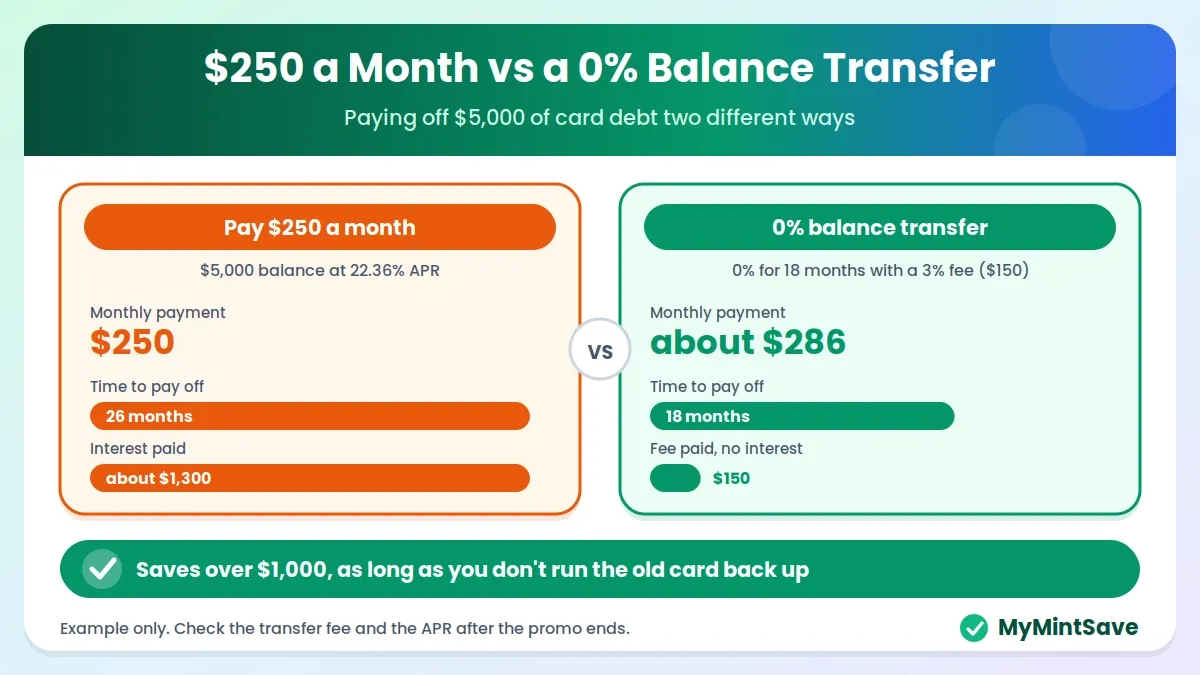
Here's an example. Say you have
$5,000 sitting at 22.36%. Pay $250 a month and it takes about 26 months and
roughly $1,300 in interest. Move it to a card with 0% for 18 months and a 3%
fee, which is $150, and pay about $286 a month, and you're done in 18 months
having paid just the $150 fee. That's more than a thousand dollars saved, as
long as you don't run the old card back up.
If a transfer is not available
to you choose a payoff method. Stay with it. The avalanche method attacks the
balance with the interest first and saves the most money. The snowball method
clears the balance first and builds momentum. The debate over avalanche versus
snowball is largely, about psychology because the best avalanche method is the
one you will actually finish with the snowball method.
Free up cash wherever you can.
A zero-based budget gives every dollar a job.
That means you can put cash toward extra payments. Our list of common budgeting mistakes can show you where
money leaks. Build a starter emergency fund alongside the cash. That way a
car repair will not land back on the card. If you are stuck call your issuer.
Ask about a hardship program. Talk to a nonprofit credit counselor.
And one honest note about
investing. Paying off a card charging 22% is a guaranteed return that no
investment can promise. Once the high-interest debt is gone, our investing for beginners guide and the
walkthrough on starting with just $100 are the natural next
step.
Your Protections as a Cardholder
One reason people like credit
cards is how well the law protects credit cards. The Fair Credit Billing Act
limits your liability for credit card charges to fifty dollars. Many credit
card issuers go further and provide zero liability. Credit card holders usually
have sixty days, from the statement date to dispute a charge. Therefore, it is
worth reading credit card statements of simply paying them.
The CARD Act adds guardrails. The CARD Act says issuers must
give you forty‑five days’ notice before rate increases. They cannot charge
over‑limit fees unless you choose to opt in. Any payment that is above the
minimum must go first toward your balance that has the rate. Using a credit
card online or abroad is also safer, than using a debit card. When you use a
credit card you are safer. A fraudster spends the banks money, not your money
while the dispute is being sorted out.
How to Read Your Credit Card Statement
Most people just glance at the
date. The minimum payment and then move on. If you take a closer look at your
statement you’ll find a lot of useful information. Here’s what to watch for in
the statement.
● Statement vs. current
balance: The statement balance is what you owed when the billing cycle ended.
If you pay that amount in full you keep your grace period active. The current
balance includes all the things you’ve bought since then.
● Minimum payment and due date: set
autopay for, at least the Minimum payment so that a late fee can never sneak up
on you then pay the rest yourself.
● Interest charged: if this line is not zero you are paying for keeping a
balance and the Interest charged number should be targeted first.
● The minimum payment warning box:
federal rules require every statement to show how long it would take to pay off
your balance with only minimum payments, and what you'd need to pay each month
to clear it in three years. Read it at least once. It can be a wake-up call.
● Transactions: check, for charges
you do not recognize because you usually have 60 days to dispute them
Checking each statement against
your plan also makes it obvious when spending is drifting. Our guide on how to make a monthly budget shows a simple
way to set that up so the card never becomes a surprise.
Buy Now, Pay Later vs. Credit Cards
Buy now pay plans have become a popular alternative
splitting a purchase into a few installments that often carry no interest. Buy
now pay later can work fine for a one‑off purchase you have planned. Buy now
pay later makes it very easy to stack up small payments that you lose track of.
Buy now pay later also does not usually build credit the way a credit card
does. Comparing Buy now pay later against credit cards is a question than it
looks so treat Buy now pay later like any other loan and make sure Buy now pay
later fits your budget before you click.
How to Choose the Right Card
● No credit history: begin with a
student card. Focus, on building a credit history.
● Carry a balance: pay attention to
the Annual Percentage Rate or the 0% transfer offer. Do not worry about rewards
until the balance is paid off.
● Pay, in full every month: a
flat-rate cash back card or a category card that fits the way you spend money
works perfectly fine.
● Travel often: check travel cards.
Compare travel cards annual fee and travel cards foreign transaction fee with
what you will actually use.
● Chasing a sign‑up bonus: pursue
sign‑up bonus only if sign‑up bonus spending requirement already matches your
budget.
Before you apply for a credit card take a look, at the APR,
fee rewards structure and the exact terms of any offer. A lot of card issuers
let you pre-qualify with a credit check. This kind of check doesn’t hurt your
credit score. It lets you see what offers you might get before you make a
decision and do a hard inquiry.
Habits That Keep a Card Working for You
The people who get the most out
of credit cards aren't smarter than everyone else. They just have a few boring
habits that run on their own.
● Set up autopay for the statement
balance from your checking account. Make sure you keep money in that account to
cover the payment. This way the payment never bounces.
● Spend two minutes each week
looking over your transactions. The app, on your phone makes this easy. Many
tools can also point out subscriptions you forgot about.
● Put recurring bills on one card: It
lets you see how much you spend. That card also gets healthy activity.
● Turn on alerts for every purchase
over a set amount: Alerts help you catch fraud quickly. It also make you pause
before you spend.
● Ask for a credit limit increase,
after six to twelve months of making payments on time: a higher limit reduces
your utilization long as your spending remains the same though it is smart to
find out if the request uses a soft check.
● Keep your credit card open: a
small purchase every few months is enough to prevent an issuer from closing it
because of inactivity.
None of this takes much effort
once it's set up, which is the point. If you're not sure how much cash to keep
in checking to cover autopay, our breakdown of checking vs. savings accounts covers it. And
habits like these work the same way automating your savings does, a theme that
runs through our best money saving apps roundup and the whole saving money guide.
Common Credit Card Mistakes
● Paying only the minimum: it
protects your account, not your wallet
● Maxing out the card: High
utilization lowers your score quickly even if you always pay on time
● Applying for credit cards at once:
A group of applications can hurt your credit score and show lenders that you
might be risky
● Missing a date: Even one payment
that’s thirty days late can drop your credit score by a big amount. That late
mark can stay on your credit report for seven years.
● Using cash advances: High fees and
instant interest make this type of borrowing one of the expensive ways to
borrow money.
● Treating the limit like income: a
limit is how much the bank will lend you, not how much you can afford
Most of these are similar, to
the saving mistakes that people make without
realizing it. The solutions are usually the same. You need to set up habits.
Check your accounts often. Don't ignore a problem.
Key Takeaways
● Credit card debt is 1.26 trillion
dollars and average APRs are more, than 21 percent so having a balance is
costly
● Paying your statement in full
keeps you in the grace period. Means you never pay interest, on purchases
● The average FICO score is 714 and
payment history and utilization together drive two-thirds of it
● Late fees still run $30 to $43
because the $8 cap was struck down, and the proposed 10% rate cap is not law
● A zero percent balance transfer
can save than a thousand dollars on a five-thousand-dollar balance if you pay
it off before the special offer ends
● Rewards only matter when you pay
the full amount so develop the habit of paying in full before trying to get the
points
Conclusion
A credit card is a tool. Like
any tool a credit card does what you ask of it. If you use a credit card
carefully a credit card can earn rewards keep a credit card user from fraud and
build credit that helps you reach big goals at lower cost. Using a credit card
without thinking can turn it into one of the costly ways to borrow money. The
real difference lies in a simple habit. Pay on time. Pay in full when you are
able. Keep your card balances low. Make sure you understand what your credit card
actually charges. These small actions can make a difference, in how much you
end up paying. Once you have those habits in place the savings that you free up
will have a place to go. That could be a high-yield savings account, your emergency
fund or the next step in our complete guide to saving money. Pick one
action from this guide to try this week. Maybe set up autopay. Finally read
your last statement. The rest will follow naturally.