
Introduction
People have been searching a
lot for "using life insurance to build wealth" in the year. This is
mostly because of media posts that talk about a method called infinite banking
or being your own banker. The idea sounds nice: put money into a kind of life
insurance policy let it grow then take a loan from it without paying taxes
whenever you need money. The policy still keeps growing in the background. Just
like most financial plans that seem too good to be true the actual situation is
more complicated, than what a short video can show.
This guide explains what this strategy involves. It shows
how cash value life insurance actually works, the advantages of cash value life
insurance the true costs of cash value life insurance and who this approach
really fits. It does not dismiss cash value life insurance. Oversell it, unlike
much of the content that drives these searches.
What This Strategy Actually Refers To
"Using life insurance to
build wealth" is shorthand for a strategy built around permanent life
insurance, policies that last your entire life and accumulate a cash value
component, as opposed to term life insurance, which provides pure death benefit
protection for a set number of years with no savings element at all. The cash
value inside a permanent policy grows over time, and once it's built up enough,
a policyholder can borrow against it.
The formal version of this
idea, popularized decades ago by insurance agent and author Nelson Nash in his
book Becoming Your Own Banker, is often called the Infinite Banking Concept.
The core idea: rather than borrowing from a bank for a major purchase and
paying that bank interest, you borrow against your own policy's cash value,
effectively becoming your own lender, while the full cash value continues
compounding even while a loan against it is outstanding.
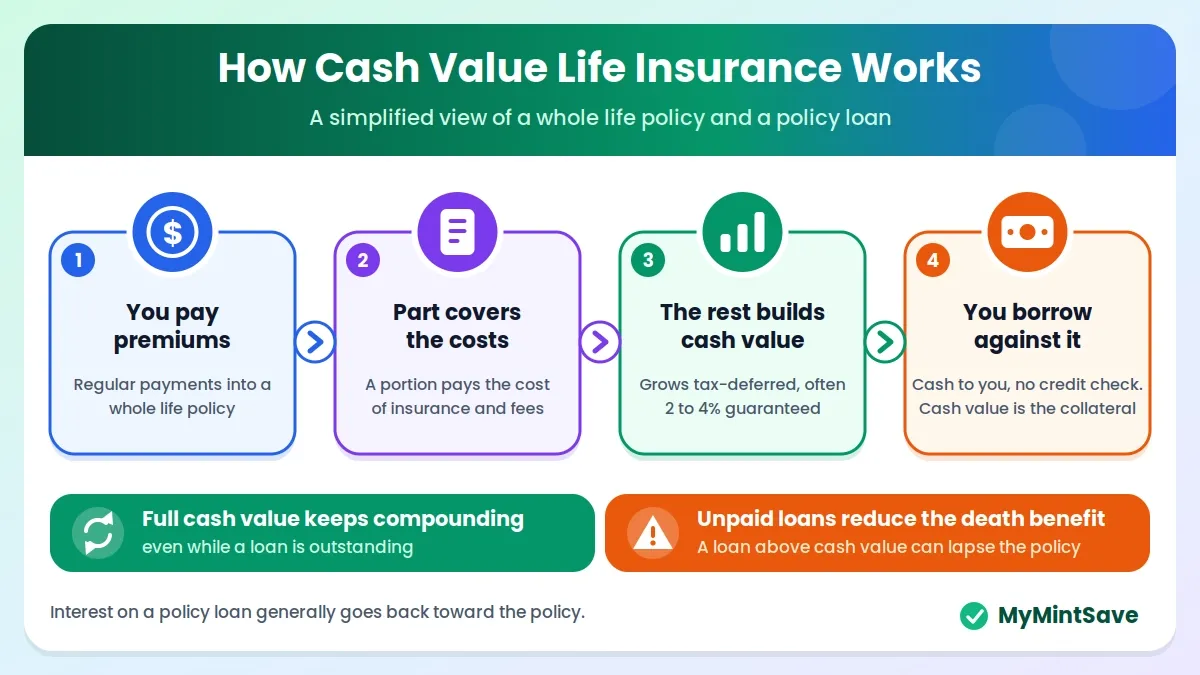
How Cash Value Life Insurance Actually Works
Each premium payment for a
policy partly pays the real cost of insurance and fees. The rest builds cash
value, a savings part that grows on a tax‑deferred basis. Whole life insurance
gives a guaranteed growth of cash value that the insurer sets. It usually
ranges from 2 to 4% guaranteed. Sometimes it also adds dividends on policies
that participate. Indexed universal life or IUL links cash value growth to a
market index such as the S&P 500. It has a cap on the gains often 10 to 12%
and a floor often 0% that guards against a bad year, in the market.
Once meaningful cash value has
built up, typically after several years, a policyholder can take a loan against
it. These loans aren't subject to the credit check or approval process of a
traditional loan, and the interest paid generally goes back toward the policy
rather than to an outside bank. Unpaid loan balances do reduce the death
benefit if not repaid, and a loan that grows larger than the policy's cash
value can cause the policy to lapse, with real tax consequences if that
happens.
Whole Life vs. IUL for This Strategy
|
Feature |
Whole
Life |
Indexed
Universal Life (IUL) |
|
Cash value growth |
Guaranteed, steady, insurer-set rate |
Tied to a market index, capped and floored |
|
Predictability |
High, same growth rate regardless of markets |
Lower, growth varies year to year |
|
Premiums |
Fixed, never increase |
Can be flexible, but costs may rise over time |
|
Best suited for |
Stability-focused, long-term banking strategy |
Growth-focused buyers comfortable with variability |
Most practitioners of this
strategy, and most financial professionals who specialize in it, favor whole
life as the more reliable foundation specifically because its guaranteed,
predictable growth matters more for a strategy built around consistent access
to cash than IUL's higher but less certain upside.
The Case for This Strategy
● Tax-advantaged Growth: Tax-advantaged growth means that the cash value of the policy grows in a tax‑deferred manner. It also means that loans taken from the policy are usually not considered income, which's different, from taking money out of a traditional investment account.
● Uninterrupted compounding: Unlike
a 401(k) loan, which pulls money out of the market while it is borrowed a life
insurance loan allows the cash value to keep growing even while a life
insurance loan is outstanding.
● Asset protection: Cash value in a
life insurance policy is protected from creditors in states. It offers a
benefit, for business owners or anyone who has significant liability exposure.
● No credit check or approval delay: Policy loans are available on demand once sufficient cash value exists, without
the underwriting process of a bank loan.
● A death benefit alongside the
savings: Unlike a pure investment account, the policy still provides life
insurance protection for beneficiaries throughout.
The Case Against This Strategy
● High cost: permanent life
insurance costs far more than term life for the same death benefit, often five
to ten times more, with a large share of early premiums going toward fees and
the cost of insurance rather than cash value
● Slow to build: cash value
typically takes seven to ten years or more to accumulate enough for the
strategy to become genuinely useful, making it a poor fit for anyone with a
shorter time horizon
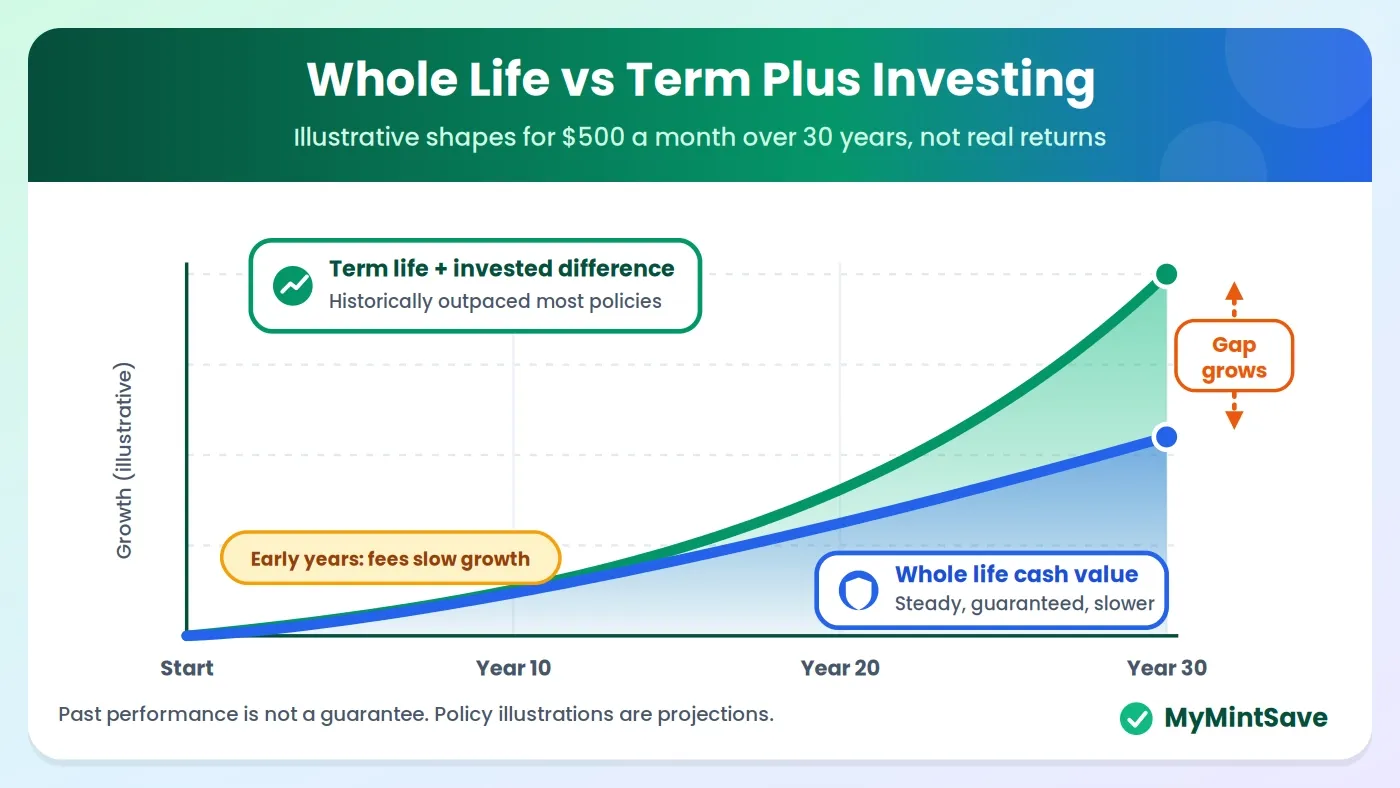
● Opportunity cost: the classic
"buy term and invest the difference" approach, putting the premium
savings from term life into a diversified investment account, has historically
outperformed the returns inside most permanent policies over long-time horizons
● Complexity: properly structuring a
policy for this strategy, minimizing the death benefit while maximizing cash
value, requires specialized knowledge, and a poorly designed policy can
underperform significantly
● Surrender charges and MEC risk:
canceling a policy early can cause surrender charges. Overfunding a policy
aggressively can make the policy a Modified Endowment Contract, which can
remove many tax advantages.
Independent reviewers,
including major personal finance publications have been notably cautious, about
recommending the strategy broadly. Independent reviewers generally conclude
that insurance is built primarily to provide a death benefit not to serve as an
investment vehicle. The strategy only makes sense for a narrow set of
circumstances. This is worth weighing seriously against the enthusiasm of
content specifically designed to sell a policy, since a diversified investment account remains the
more straightforward wealth-building tool for most people's actual goals.
Why This Topic Is Trending Right Now
The sharp rise in searches, for
banking follows a wave of social media posts. These posts usually come from
insurance agents or affiliate marketers. They show banking as a way to leave
traditional banks behind or to beat the stock market with guaranteed returns.
Some of this content is truly educational. Many shares are too simple. They
ignore the tradeoffs. They show the best policy examples as if they are normal.
They also hide how much of the premiums go to fees instead of building cash
value.
This doesn't mean the basic plan is not okay insurance
experts have done things for many years but it does mean looking at online
money posts with the same doubt you would use for any other money offer that
says it will give really good sure results. A document showing years of
expected growth is just a guess, not a promise, especially for the parts of a
whole life insurance policy that don't come with a guarantee or, for the
index-related returns of an IUL policy.
Understanding Modified Endowment Contract Rules
The IRS sets a limit on how a
life insurance policy can be funded compared to its death benefit before it
loses its good tax treatment and is reclassified as a Modified Endowment
Contract or MEC. When a policy passes this limit, which people often call the
seven‑pay test any withdrawals or loans are taxed as income and if you take a
loan before you reach age 59 and a half you may also face an extra penalty,
similar, to what happens when you pull money out of an early retirement
account.
This is precisely why
aggressive strategies aimed at maximizing early cash value require careful
structuring by someone who genuinely understands these rules. A policy designed
without this in mind can inadvertently become a MEC, eliminating much of the tax
advantage that made the strategy appealing in the first place. Anyone seriously
considering this approach should confirm directly with their agent or a
fee-only financial advisor that the proposed policy design stays within
seven-pay test limits.
How Policy Loans Actually Work in Practice
A policy loan isn't really a
withdrawal. It's a loan taken from the insurance company. The loan uses the
cash value of the policy, as security. That’s why it’s not treated as income
unlike a 401(k) withdrawal would be. The insurance company charges interest, on
the loan between 5% and 8%. Some policies give back a similar rate or offset
the interest using the cash value. This helps keep the cash value growing,
which is what people mean when they talk about " compounding."
The real-world result depends
heavily on the specific policy's loan provisions, a direct recognition loan
versus a non-direct recognition loan structure, and these details vary enough
between insurers that two policies marketed identically for this strategy can
perform quite differently once a loan is actually taken. This is the kind of
print that is important to read very carefully or to get someone who doesn't
work for the company to look at it before thinking that what they are being
told is exactly what the policy says.
A Realistic Example
Consider two people in their
30s. Each person can put $500 a month toward either a life policy structured
for cash value growth. Each person can choose a term life policy. The term life
policy is paired with the remaining difference. That remaining difference is
invested in a portfolio. The term-plus-invest approach usually costs a fraction
of that $500, for the insurance component. The rest is left to compound in the
market over decades. The whole life approach puts the full $500 toward the
policy, with a meaningful share of early premiums covering fees and the
policy's cost of insurance before cash value meaningfully accumulates.
Over a twenty-to-thirty-year
horizon the difference in the approach has historically grown far faster than
the cash value inside a comparable whole life policy even after we look at the
tax treatment advantages of the insurance strategy. This does not make
permanent life insurance a product. It makes it a different tool a tool built
around guaranteed, tax‑advantaged access to capital than a tool for maximizing
long‑term growth. It is worth being honest about which of those two goals
matters more for your situation before you decide to put a large portion of
your monthly budget toward one approach, versus the
other.
Who This Strategy Might Actually Fit
● Business owners with creditor
exposure who want asset protection alongside a savings vehicle
● High-income earners who have
already maxed out other tax-advantaged accounts and are looking for additional
tax-deferred growth options
● Anyone who specifically values
guaranteed, predictable access to capital over maximizing long-term returns
● People with a genuine permanent life insurance need, estate planning, a special needs dependent, who view the cash value as a secondary benefit of coverage they'd want regardless
For people especially those
still setting up a basic financial base, a term life insurance policy along
with a fully filled emergency fund and regular savings into
retirement and investment accounts gets the same main results, safety and
growth over time in a better way and, for less money.
Red Flags to Watch For
● A pitch that sounds like
"guaranteed returns, then the stock market”: permanent life insurance
returns are generally modest and should not be marketed as guaranteed returns
that beat diversified long-term investing.
● Pressure to buy before you have
built an emergency fund or cleared high‑interest debt: this strategy is a
long‑term, illiquid commitment, not a starting point, for buying
● An agent who does not want to
explain fees does not want to explain surrender charges does not want to
explain how the policy is structured: being open and honest should be the
standard, not something extra
● Advice about putting too much
money into the policy that could cause it to become a Modified Endowment
Contract: getting a second opinion from a qualified and independent person is
important, before deciding to put a lot of money into the policy
Conclusion
Using life insurance to build
wealth is not a scam. It is not a secret either. It is a narrow strategy that
fits a specific set of circumstances. It works best for earners whose other
accounts are maxed out for business owners who want asset protection and for
people who have a real permanent insurance need. This strategy is far better
than a wealth‑building recommendation for most households. If you are still
building your foundation, a term policy, a solid savings plan, and and consistent investing in
diversified accounts will likely get you further more simply and at a lower
cost, than an overfunded permanent life insurance policy ever will.