
Introduction
Most people's insurance premiums quietly climb a little every year at renewal, and most people never notice, because the increase is small enough to not trigger a second look. Add that up over five or ten years without ever shopping around or revisiting a policy, and the gap between what you're paying and what you could be paying becomes real money, often hundreds of dollars a year across a household's full set of policies. None of the ten strategies below require giving up real protection, they're about removing the padding that builds up when a policy sits untouched, the same instinct behind any good household budget review.
1. Bundle Your Policies with One Insurer
Combining auto and home or renters’ insurance with the same company remains one of the single biggest and easiest discounts available. Bundling saves an average of $542 a year, with some insurers offering as much as 25% off each policy, though the discount varies considerably by company, some offer a more modest 5 to 6%. The catch worth checking: a bundled rate isn't automatically the cheapest option, it's worth comparing the bundled total against separate quotes from different insurers before assuming bundling wins by default.
2. Raise Your Deductible
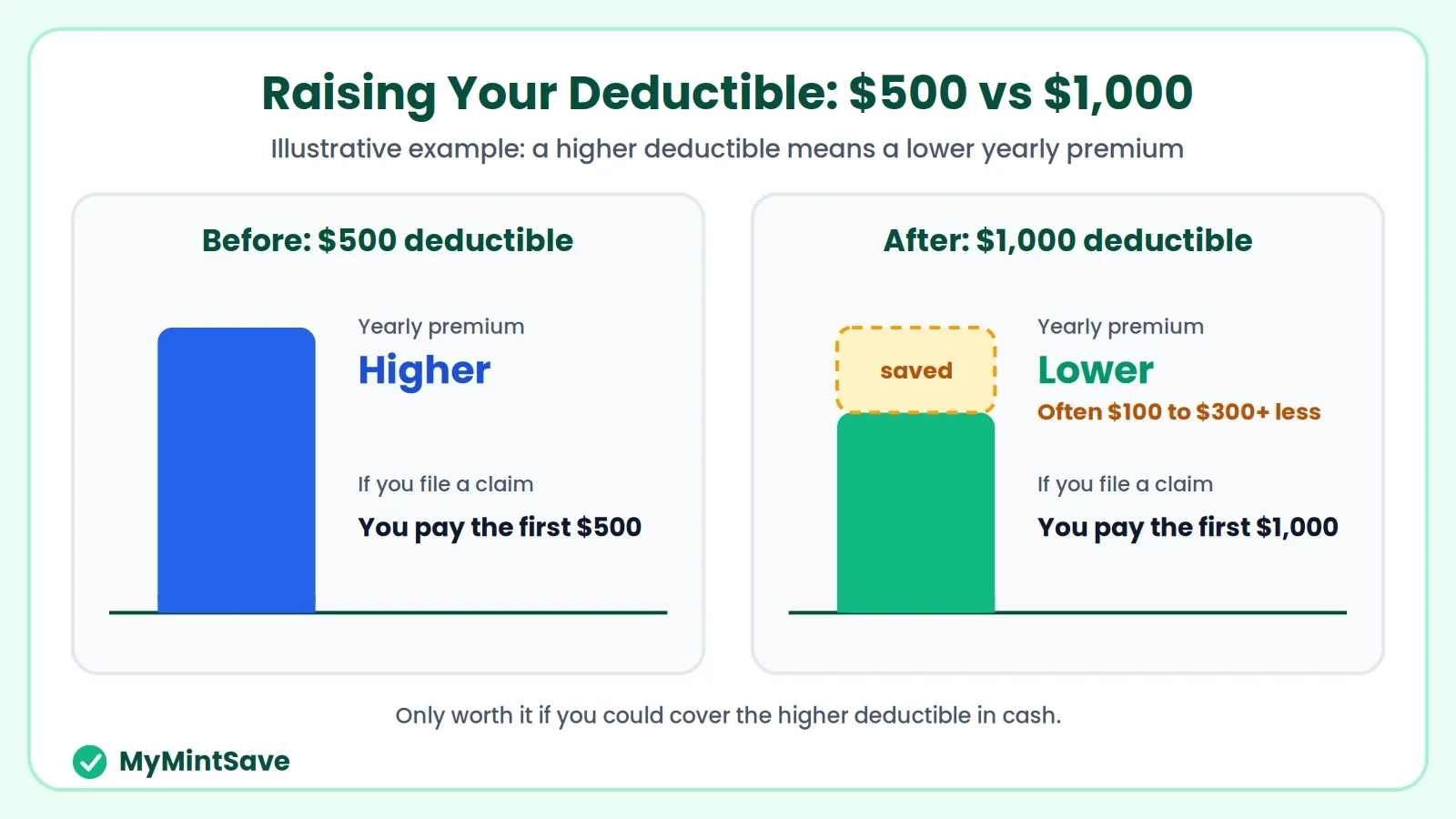
Moving from a $500 deductible to a $1,000 deductible, on auto insurance or home insurance usually lowers the premium every year. This makes sense only if you actually have that higher deductible available in cash if you need to file a claim. This is where an emergency fund becomes part of the insurance strategy. It is not just a savings goal sitting off to the side. Part of the insurance strategy, not just a separate savings goal sitting off to the side.
3. Shop Quotes Every Renewal, Not Just at Signup
Insurance loyalty doesn't usually lead to rates over time. Insurers know most people don't compare quotes again after the purchase. Getting two or three competing quotes every time you renew takes less than an hour. Even if you decide to stay with your insurer the process often reveals a better rate, for the same coverage. Sometimes it's just because another company is focusing on growing in your risk category. It's a step that can save you money.
4. Consider a Telematics or Usage-Based Program
Usage‑based insurance programs watch how you drive how far you go how hard you brake. When you drive. They collect this data with a phone app or a plug‑in device. Then they set part of your premium from that data. Drivers who are safe and drive miles can save, between ten percent and thirty percent which often means $169 to $324 less each year if they sign up. It's worth knowing this is a real tradeoff though, several major carriers, including some of the largest in the country, can raise your rate based on risky driving data rather than only lowering it, and roughly one in five users of at least one major program has reportedly seen an increase rather than a discount.
Before you sign up make sure to check if the program you are looking at only rewards driving or if it also penalizes risky driving. That one detail decides whether it’s a one-way discount or a real two-way bet on your driving habits. Pay-, per-mile programs, which are a specific kind of usage-based insurance take it a step further. They base the majority of your premium on the number of miles you drive. This kind of plan usually works better for people who work from home or drive little compared to someone who commutes every day.
5. Ask About Every Available Discount
- Safe driver and accident-free discounts: Often applied automatically. It is worth confirming that you are actually receiving them.
- Good student discounts: Many insurers offer these discounts to drivers who keep a GPA and the savings can be quite significant.
- Vehicle safety feature discounts: Anti-lock brakes, lane departure warnings and anti-theft devices can each trigger a discount.
- Driving course completion: Many insurance companies give a discount when you finish a course approved by the state. Insurance companies usually make this discount last, for years.
- Loyalty and -vehicle discounts: when you insure more, than one car or when you keep the same insurer for a long time you can get discounts that are not shown right away.
Discounts are not always given automatically in every case. Insurance companies often do not let you know about every discount that you could qualify for. A direct phone call asking "What discounts am I eligible, for that I am not currently getting?" is a underused question. This question uncovers savings.
Professional and alumni group discounts are another category that people often miss. Many insurance companies work with companies, credit unions or school groups to give a small extra discount. This discount usually doesn't appear unless you tell them about the connection when you get a quote. It doesn't cost anything to check if your company, union or school has a connection, with your insurance company. The answer is often yes so, it's worth asking every time you get an insurance quote.
6. Improve Your Credit-Based Insurance Score
In some states insurers may use a modified version of your credit history to help calculate auto and home insurance premiums. This is because data shows a link, between credit history and how often people file claims. If you pay your bills on time keep your credit card balances low compared to your limits and avoid inquiries you can slowly raise your credit history score. A higher credit history score can then lower your premium when you renew even if you never file a claim or change any coverage limits. Some states, such, as California, Massachusetts and Hawaii ban this practice completely so this lever does not apply there; I recommend checking before you assume it matters for your policy.
7. Drop Unnecessary Coverage on Older Assets
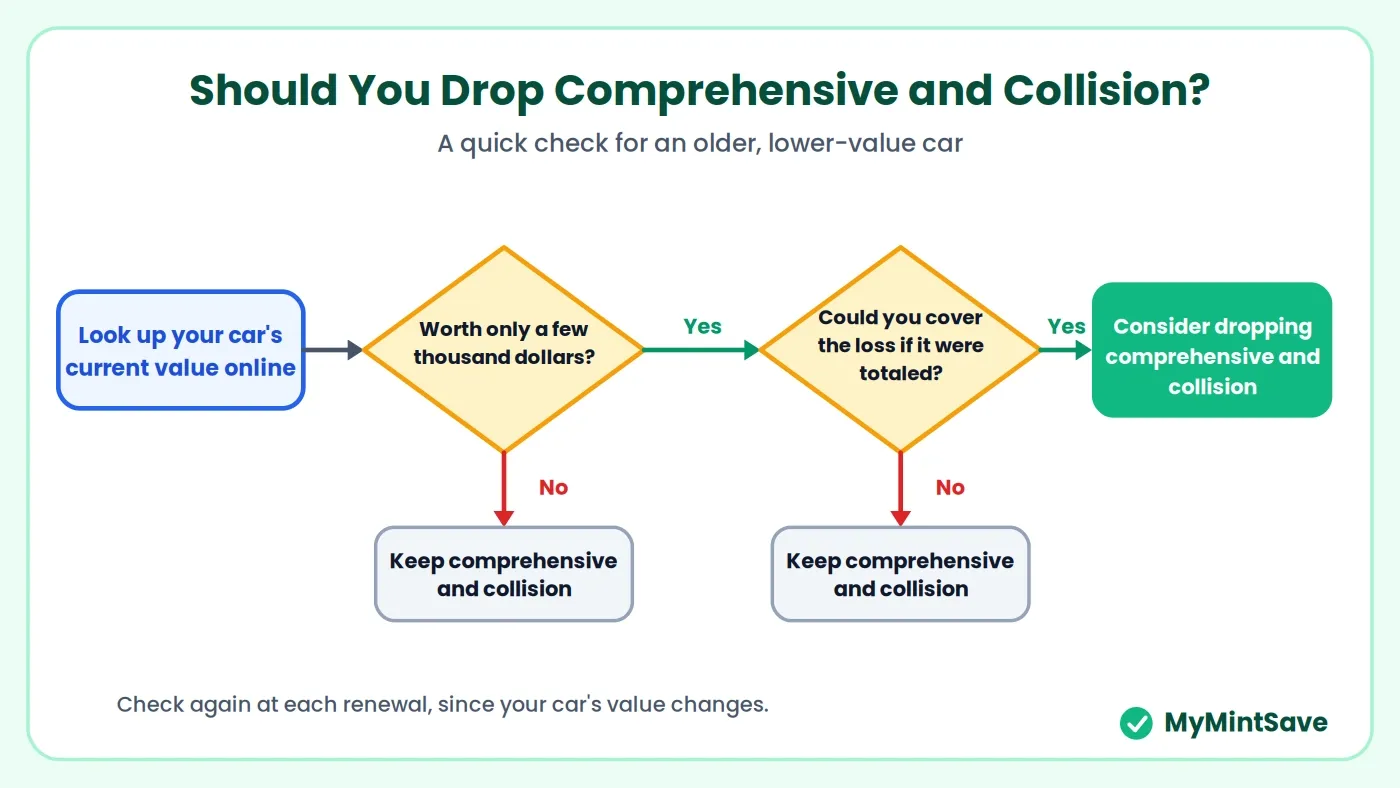
Full coverage and collision on a car that's worth a few thousand dollars often cost more each year in premium than the insurer would ever actually pay out on a total loss claim. Checking the math on the cars value against what you pay for coverage using a quick online valuation tool can show that dropping coverage on an older lower-value car is a good way to lower premium, without significantly increasing your real financial risk.
The same logic applies to home insurance personal property riders on items you no longer own or jewelry you have sold and to renters insurance coverage limits that are set higher than what you need to replace. A policy review is not about finding new discounts; it is also, about noticing home insurance personal property riders and renters’ insurance coverage limits that have been carried forward quietly for years for something that no longer fits your current life.
8. Pay Annually Instead of Monthly
Many insurers add an installment fee, for monthly billing. Sometimes the fee is a few dollars each month. Yet over a year the fee grows into a cost If you can pay the premium in one lump sum you avoid those fees completely. Sometimes insurers even give a discount when you pay the premium in full. This happen when cash flow allows for it.
The best way to handle this is to plan instead of scrambling at renewal time. By setting one twelfth of the annual premium each month into a dedicated savings account the lump sum is already, in place when the bill arrives. This turns a stressful large payment into a calm well‑prepared expense that you have quietly saved for months.
9. Reassess Coverage After Major Life Changes
A new job that requires a commute can help pay off a car loan. A kid moving out or a home renovation that lowers fire risk can all change the coverage you really need. The coverage you need may change. Most policies just auto-renew, without anyone checking the basic assumptions. Making a policy review a habit just like you would review a broader savings plan, will catch these changes before another year of paying for coverage that no longer fits your real situation goes by unnoticed.
10. Maintain a Clean Claims History Where It Makes Sense
Filing a claim for a loss that you could cover yourself can raise your premium at renewal by more than the claim amount. Insurers keep track of claims history closely. A rough guideline many agents suggest is to reserve claims for losses that're significantly above the deductible rather than filing a claim, for every minor incident that qualifies. Let the deductible and a modest cash cushion absorb the claims instead.
Lowering Health Insurance Premiums Specifically
Health insurance works differently than auto or home insurance. The main idea is the same. You should look at your choices of just going with what you already have. Every time there's an enrollment period you should check a marketplace plan, against your employer’s coverage. Don't think that the choice you made year is still the cheapest. This can really affect your premium. That's because the subsidies you qualify for and the prices of the plans can change each year.
A high‑deductible health plan combined with a Health Savings Account reduces the premium a lot for people who are generally healthy. The Health Savings Account also gives a tax‑advantaged way to save for the higher out‑of‑pocket costs that a high‑deductible health plan brings. This is not the choice for everyone especially, for anyone who has a chronic condition and needs frequent care. However, for the household a high‑deductible health plan and Health Savings Account offer one of the biggest premium cuts that health coverage can give.
How to Actually Compare Quotes Effectively
Shopping quotes only works if you are looking at policies that're truly the same. It is not enough to look at the total price. Before you ask for quotes write down what your current policy covers. Make sure to include the limits the deductibles and any extra parts of the policy. Then check that every new quote has the details. A quote that seems to save $200 but has protection or a higher deductible is not better. It is a policy, with less coverage but a lower price.
Independent insurance agents, who work with carriers instead of only one can be a truly efficient way for me to compare several quotes in one single conversation rather than asking each company to send a quote separately. It's agents are paid by the insurer not by me so using them typically costs nothing while saving real time during the comparison process.
A Quick Reality Check on Savings
|
Strategy |
Typical
Annual Savings |
Effort
Required |
|
Bundling policies |
$542 average |
Low, one phone call or quote comparison |
|
Telematics / usage-based program |
$169 to $324 for safe drivers |
Medium, requires enrollment and ongoing monitoring |
|
Raising deductible |
Varies, often $100 to $300+ |
Low, requires having cash available for the higher
deductible |
|
Shopping quotes at renewal |
Varies, sometimes significant |
Low, about an hour each renewal period |
Common Mistakes When Trying to Save
- Chasing the cheapest premium without checking the insurer's claims-paying reputation: a low price from a company with a poor track record of paying claims isn't actually a good deal
- Dropping coverage entirely instead of right-sizing it: the goal is removing unnecessary coverage, not leaving a genuine gap in protection
- Enrolling in telematics without knowing the penalty risk can backfire. Many people think every telematics program is, about discounts. That assumption can hurt with carriers. So, check the penalty risk before enrolling.
- Never revisiting a policy after the first year is a mistake. The biggest reason people overpay is inertia. It is not because discounts are missing.
These errors happen again and again in every part of a budget not in insurance. People focus on a number. Don't look at everything that goes along, with it. Our guide to common saving mistakes covers this same pattern in more detail if it sounds familiar.
Conclusion
None of these ten strategies require sacrificing real coverage, they're about removing the inefficiency that quietly builds up in a policy nobody has reviewed in years. Choose two or three options from this list that match your situation starting with bundling and a renewal-time quote comparison is an idea for most families and the savings, from just a few of these can add up to real money in a year. Whatever you save, putting it in a high-yield savings account or adding it to your emergency fund turns a lower premium into something that actually grows over time instead of just disappearing back into regular expenses.