
Introduction
Ask five people how much life insurance they carry and most will shrug. Three of them will say it's whatever came with the job, usually one or two times their salary. Now ask how much their family would need if the paycheck stopped tomorrow. Almost nobody has a number. That gap is common, and it's also one of the easier ones to fix.
You've probably heard the advice to buy 10 times your income. It isn't wrong. It's a rough average that people repeat like a rule, and it ignores your debt, your savings, your kids and how long your family would really need the money. So here are two ways to land on an actual number, the DIME method and the income multiplier. Choose whatever you like.
Why the Default Number Is Usually Wrong
Employer provided group term life insurance, when there is any, typically maxes out at one to two times your salary. Others give a fixed lump sum of $50,000 regardless of what you earn. Picture a household with young kids, a mortgage and one income. That payout covers a few months of bills. It doesn't cover the years of support a family like that needs.
The 10 times rule does better, but it's still a blunt average. It doesn’t know how much you owe in debt, how many years before your kids are grown, or how much you’ve saved up. Two individuals earning an income of $80,000, one owns his home outright and has a working spouse. The other has a new mortgage, three kids and a spouse at home. Same salary, very different needs, so one multiplier can't be right for both.
There's a portability problem too, and most people don't think about it until it bites. Insurance coverage while at work generally comes to an end with your employment, either voluntary or involuntary. And the insurance that could have provided security for your family at this uncertain time has now ended and you will not want to be seeking new insurance coverage at this time.
The DIME Method: A More Precise Calculation
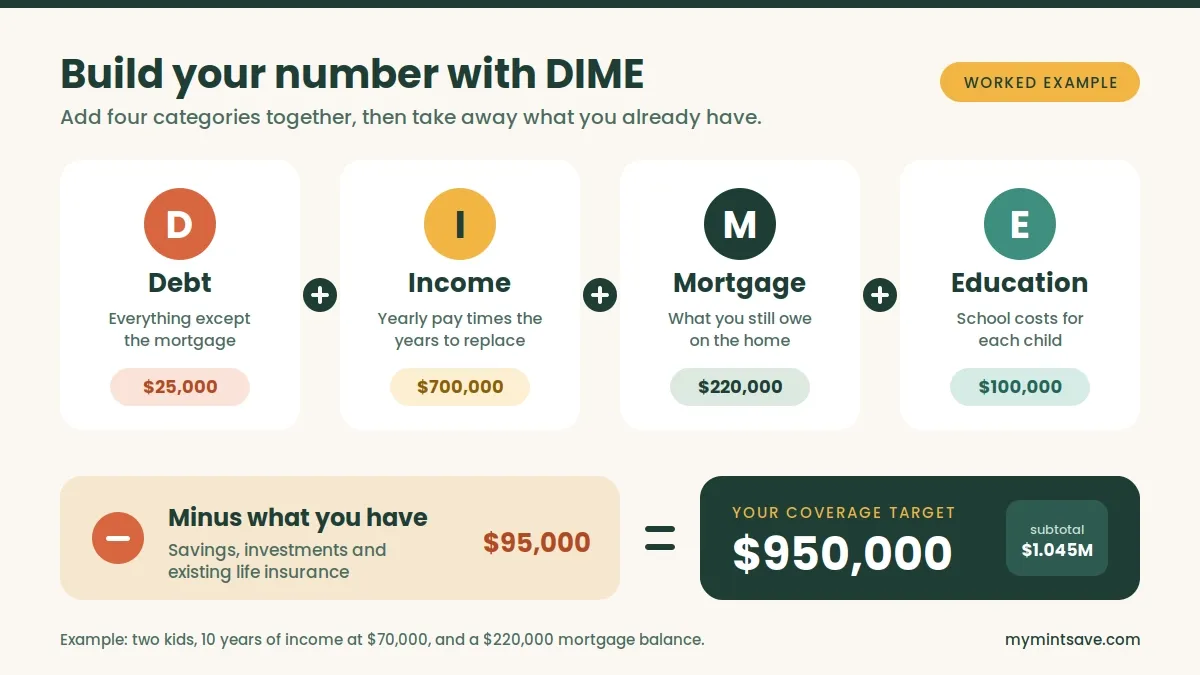
DIME stands for Debt, Income, Mortgage and Education. Add the four together and you get a number that's tailored to your life, which a flat multiple of your pay can't do.
- Debt: everything you owe apart from the mortgage. Credit cards, car loans, student loans, anything that wouldn't vanish if you did.
- Income comes next. Take the annual salary, then multiply it by the number of years that will be required to have enough money for the family, which ranges from 10 to 20 years.
- Then the mortgage. Use the balance you still owe, so the house doesn't have to be sold just to keep the family afloat.
- Last is education. The estimates can range between $25,000 and $100,000 per student at different institutes.
Now, total them up, and deduct your savings, investments, and even life insurance. What's left is your coverage target, built from your real numbers instead of a multiple of your paycheck.
A Worked Example
| Category | Amount |
| Non-mortgage debt (car loan, credit cards) | $25,000 |
| Income replacement (10 years x $70,000) | $700,000 |
| Remaining mortgage balance | $220,000 |
| Education costs (two kids x $50,000) | $100,000 |
| Subtotal | $1,045,000 |
| Minus existing savings and coverage | -$95,000 |
| Estimated coverage need | $950,000 |
That lands close to a $1 million policy. A flat 10 times rule on a $70,000 salary would have said $700,000, so the DIME answer is noticeably higher. All of it is borrowed from this one family’s debts, mortgage, and children, and that is the entire idea. If some of the categories feel fuzzy, start with a full household budget, because it makes the debt and income figures much easier to pin down.
The Income Multiplier Method: A Simpler Shortcut
If you'd rather skip the detail and get a quick estimate, the income multiplier method works off your age. The older you are, the fewer working years are left to replace, so the multiple shrinks.
- Ages 25 to 35: 15 to 20 times your annual income
- Ages 36 to 45: 12 to 15 times
- Ages 46 to 55: 8 to 12 times
- Age 56 and up: 5 to 8 times, and any retirement savings you already have often cover part of that
It's quick, and it's fine for a ballpark quote. But it won't catch an unusual debt load, a big family or a spouse who earns little. The DIME method costs you maybe fifteen extra minutes, and if your situation isn't average it's worth them. Once you look closely, most households aren't average.
What to Subtract from Your Number?
Whichever method you pick, don't stop at the raw total. Take off what your family could already lean on without a new policy: retirement accounts, investment balances, and any life insurance from work or an old policy. New coverage shouldn't pay for the same thing twice. It only has to close the gap between what they'd have and what they'd need.
This is where life insurance meets the rest of your financial plan. A household with solid investment accounts already growing toward retirement needs a lot less life insurance than one that's just starting to save, because those assets do part of the income replacement job. The requirement will decrease because of the accumulation of savings and investments. For this reason, it is necessary to keep recalculating it on a regular basis, and not just once.
Coverage for a Stay-at-Home Parent
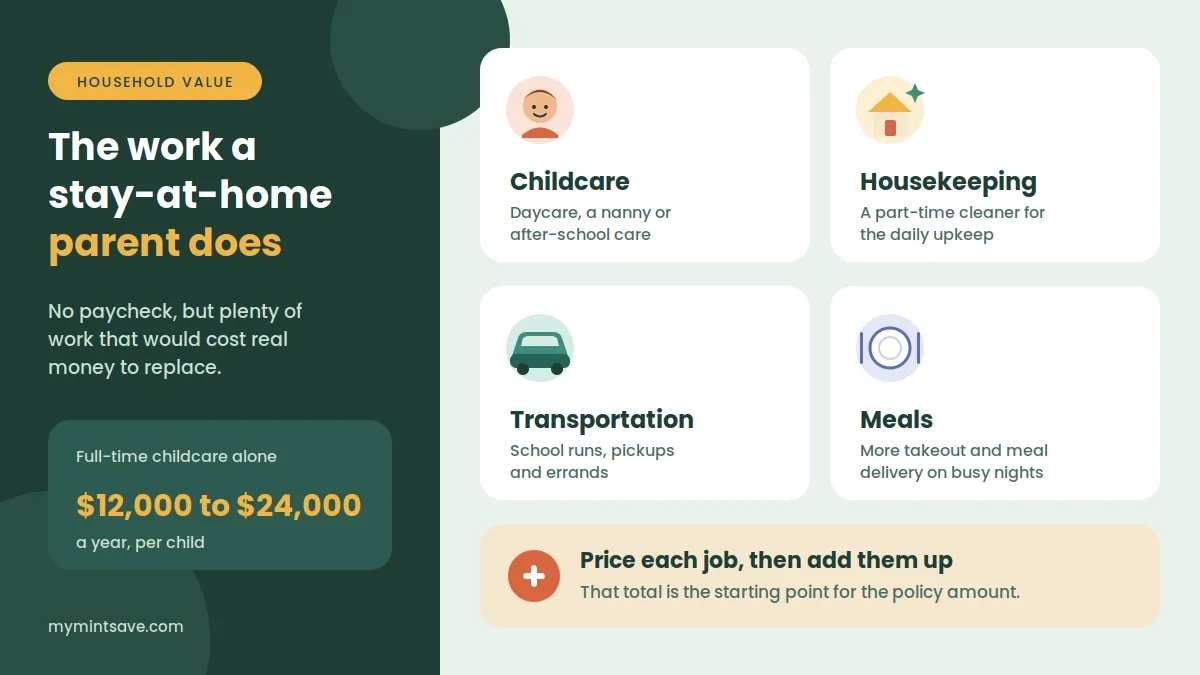
The most frequent misconception in this regard is considering the non-wage earning spouse not to be in need of coverage due to the lack of salary. This person performs numerous duties which cost money from the very first day he/she is not around anymore childcare, cleaning, transportation, managing the household.
A single task of full-time childcare costs an average of $12,000-$24,000 yearly per each child. And this is without any other listed activities. The more logical approach would be to calculate the cost of performing each of these duties by a third party. Childcare, part-time maid service, ordering takeout food etc. Add those up and use the total, instead of defaulting to zero because there's no salary to multiply.
Who Genuinely Doesn't Need Much Life Insurance
- Single, no dependents. Nobody relies on your income, so income replacement mostly doesn't apply, and final expenses are about all you'd need to cover.
- Already financially independent. If your assets are large enough, then they may become an alternative income source to you.
- Retired, mortgage paid off, no dependents. Categories of DIME will not apply anymore, thus the necessity will reduce to nothing at all except for the final cost.
Point worth making clear: life insurance covers one particular need – the person dependent on your income or services When that problem goes away, paying for a big policy is just a cost, not responsible planning.
Business Owners and Key Person Considerations
Business owners get a second layer. There's the personal coverage for your family, and often a separate policy for the business. An important person plan will protect the company in case of loss of some important individual such as owners or key employees. It could be used for compensation in case of income losses during the time of recruitment.
Partners' buy-sell arrangements can also involve life insurance. When one partner dies, the policy pays for buying their share from the estate. This preserves the business for the surviving partners and prevents either a forced sale of the business or having to negotiate with the grieving family members. For co-owned businesses, take into account the business insurance separately from family insurance. The two protect completely different financial relationships.
How Your Number Changes Over Time?
- A new baby pushes your number up. There's another dependent, and the education costs stretch over a longer period.
- Paying off the mortgage brings it down a lot, since one of the four DIME pieces is gone.
- When the kids become financially independent, it drops again, because income replacement no longer has to stretch as many years.
- Pay off a car loan or a credit card and the debt part shrinks right along with it.
- With an increase in the amount of your retirement or investment accounts, you can easily plug the majority of the income replacement needs.
A lot of people calculate how much insurance they need only once and buy it without considering it ever again. That is one of the mistakes people make in a properly constructed financial plan. Assume that a family pays off the mortgage and saves real money for ten years. They may need much less coverage than they started with, but they're still paying for a policy sized for their most exposed years.
Term Length and Coverage Amount Work Together
However, knowing how much coverage one needs is not everything. The other part is how long one needs it, and both go hand in hand. For example, if a $1 million policy suits a 30-year-old person who has a new mortgage and toddlers. That full amount doesn't need to last 30 years. The mortgage balance shrinks, the kids grow up and savings pile up long before the term ends.
That's the idea behind laddering. Instead of one big policy sized for your longest obligation, you buy two or three smaller ones with different term lengths. A household might hold a 15-year policy for the mortgage and early childcare years, plus a 25-year policy to replace income until the kids are grown. Full coverage reduces automatically as liabilities reduce. This is contrasted to paying $1 million flat rate for thirty years whereas the actual liability declines progressively from the tenth or fifteenth year onwards.
A Simple Worksheet You Can Actually Use
If DIME still feels abstract, grab a pen. By carrying out the calculation using pen and paper with your own numbers, the equation will be solved in fifteen minutes.
- Step 1: Add up all your debt except that of mortgage and obtain the total.
- Step 2: Multiply your annual income by the number of years before you retire. This is usually when your children attain age 18 or 22.
- Step 3: Obtain the actual amount remaining in your mortgage from the last statement.
- Step 4: Estimate the cost of education for every child according to your plan to enroll them in a private or government institution.
- Step 5: Total all four figures, and subtract your retirement and investment accounts and insurance coverage.
Whatever is left after those five steps is a number you can defend. You could explain it to a spouse or an insurance agent in one sentence, which beats a vague feeling that you should have "some" coverage. And once you know the number, most term life quotes take just a few minutes.
Conclusion
There's no single right number for everyone. There is one for your household, though, and it takes about twenty minutes to find. That beats defaulting to whatever your employer gave you or a rule of thumb. Add up your debt, the years of income to replace, the mortgage and the education costs, then subtract what you've saved. That's your target for the next quote. And if you haven't built an emergency fund yet, do it alongside this. One covers the small, likely setbacks, the other the big, unlikely one.