Introduction
Health
insurance premiums went up 21 to 26% on average this year. Auto insurance is
sitting near $2,256 a year for full coverage. And yet most of us still buy
insurance the lazy way. The agent or the HR department hands us something, we
sign, and that's that for ten years. The more you think about it, the more
peculiar it sounds. You pay your premiums monthly, but ask anyone what his/her
insurance provides and whether he/she could get it cheaper elsewhere, and you
will receive shrugs as an answer. Many people simply overpay for the coverage
they don't need and overlook the coverage they need.
That
is why this guide is written. We will discuss types of insurance policies most
families need in 2026: health insurance, car insurance, home and renter's
insurance, life insurance, umbrella insurance and disability insurance. You
will find out how much each of them costs now, what kind of coverage it
provides, and where overpaying occurs. No insurance license needed. Just plain
English and no policy jargon.
If
you haven't read them yet, our complete budgeting guide for beginners and our
emergency fund guide go nicely with this one.
Think of insurance and savings as two sides of the same job. Insurance takes
the big hit that rarely happens. Your savings take the small ones that happen
all the time.
Why Insurance Actually Matters
Insurance
is basically a trade. There's a risk you can't afford to carry on your own, so
you pay a company a steady monthly or yearly amount and let them carry it. A
bad car accident, a house fire or a cancer diagnosis can cost way more than
most households could ever pay out of pocket. That's the stuff insurance is meant
for.
Where
people go wrong is treating every policy like something to get as cheap as
possible. Cheap isn't the point. The point is the right size. Carry too little
dwelling coverage on your house, or too little liability on your car, and one
bad day can wipe out years of savings. Carry too much, say full comprehensive
on a beat-up old car, and you're quietly burning money every month. So it's not
about more insurance or less insurance. It's about matching coverage to the
risk you really have.
Try
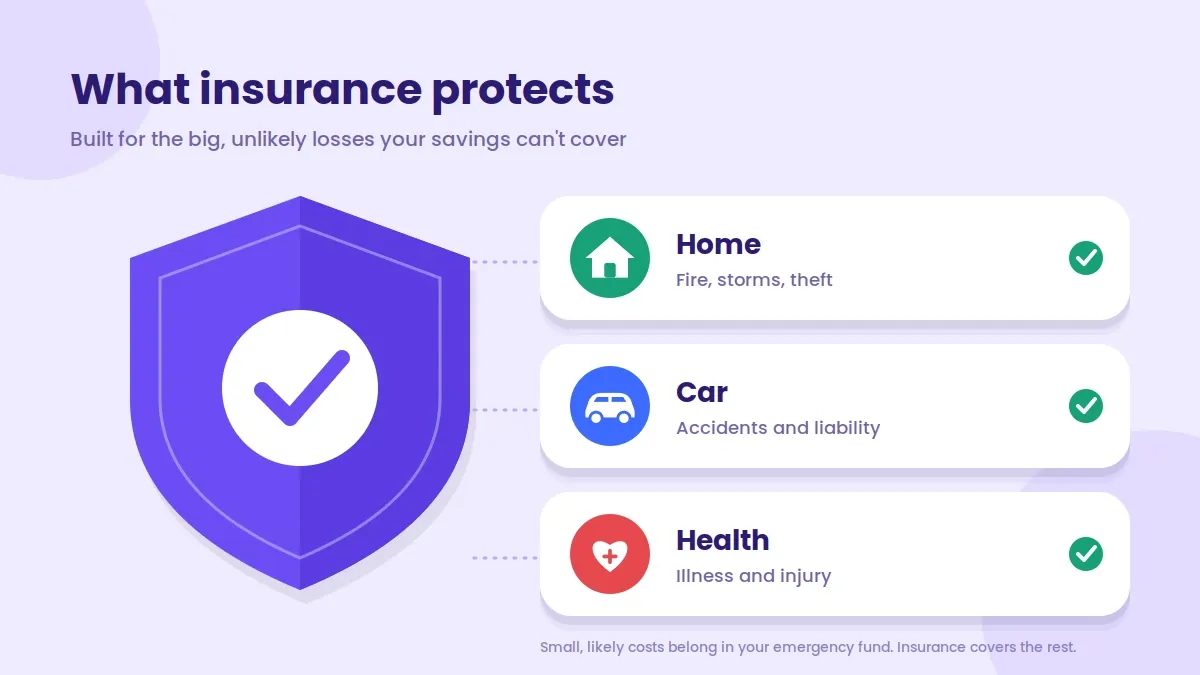
this. Put every possible loss into one of three buckets. The first is small and
likely, and your emergency fund should swallow those. The second is large and
unlikely, and that's the one insurance is actually for. The third is small and
unlikely, and honestly you can often just live with it. Most insurance mistakes
come from mixing up the buckets. People pay a monthly premium to cover
something they could easily pay out of savings, while the truly catastrophic
stuff sits underinsured or not covered at all.
Health Insurance in 2026
Health
insurance got a lot more expensive in 2026. It's the biggest jump since 2010.
If you're 40 and buying a benchmark Silver plan on the Affordable Care Act
marketplace without a subsidy, you're looking at roughly $625 to $687 a month
on average. That's up about 21 to 26% from 2025, depending on whose analysis
you trust. The good news is that premium tax credits knock that down a lot for
plenty of people. For those who qualify, the lowest-priced plan is projected to
cost around $50 a month on average.
Job-based
coverage is still the cheaper deal for you, because your employer pays a big
chunk. The average worker with single coverage pays about $120 a month from
their own paycheck. For family coverage, the employee's share is closer to $571
a month, according to the latest employer benefits data. Now here's the number
most people never see. Add up what the employer and the employee pay together
and the total premium averages closer to $735 a month for single coverage at a
mid-size employer. That's what your health insurance really costs. The
deduction on your pay stub is only part of it.
Where
you live matters a lot. Maryland, Hawaii, Minnesota, New Hampshire and Michigan
are among the cheapest states for marketplace plans, with benchmark premiums
between $480 and $580 a month. Vermont is at the other end at $1,224 a month.
If your state lets you, line up a marketplace plan against your employer's plan
every open enrollment. Don't just roll over the same plan year after year. It's
one of the few health insurance moves that can really change your monthly bill.
The
type of plan counts as much as the price. HMOs usually cost less, but you have
to pick a primary care doctor and get a referral before you see a specialist.
PPOs cost more, and in return you can see any provider you like, in network or
out, with no referral. Then there's the high-deductible plan paired with a health
savings account. The premium is lower, but you pay more out of pocket before
coverage starts. It tends to work for healthy people who'd rather invest the
savings. If you've got an ongoing condition and a lot of appointments, it's
usually a bad fit.
Auto Insurance Explained
Full-coverage
auto insurance in the U.S. averages about $2,256 a year in 2026. That's only 1
to 3% more than last year, which is a relief after the bigger jumps from 2022
to 2024. Still, the average hides a big spread. People in cheaper states like
Idaho, Iowa and Vermont often pay closer to $1,200 a year. In Michigan you can
pay more than double that.
●
Liability
pays for the injury or damage you cause to somebody else. Every state requires
it except New Hampshire, and most states set a legal minimum.
●
Collision
is the insurance that covers your car for any damage or repair caused by an
accident and irrespective of the cause of the accident. You are likely to be
forced to purchase collision insurance when you have a leased or financed vehicle.
●
Comprehensive
insurance will cover all risks except those of accidents. Lenders usually
require this one too.
●
This
covers any losses that you incur in case the other party’s vehicle is uninsured
or has insufficient insurance. That happens more than you'd think in several
states.
Another
tip: coverage that has only liability insurance is usually going to cost you
anywhere from $400-$800 annually. Coverage with collision and comprehensive
insurance will cost somewhere between $1,200-$2,600 annually, based on the
state, make and model of the car, and driving history. Dropping collision and
comprehensive for someone who owns an older car that's worth a couple thousand
dollars is another surefire way to save money. A total loss wouldn't pay out
much anyway.
But
don't stop at the state minimum. Those limits are often lower than what a
serious accident really costs. Plenty of states still set minimum bodily injury
limits around $25,000 to $30,000 per person. One hospital stay after a bad
crash can eat that up on its own. Higher limits of $100,000 for each person and
$300,000 for an accident add just a bit more than the bare minimum. They cover
the potential hole that might allow your savings, your income, or even other
assets to be exposed to lawsuit after you cause a major accident.
Homeowners vs. Renters Insurance
People
mix these two up all the time. They figure renters insurance is just a mini
homeowners policy. It's not. Homeowner’s insurance covers the structure, as
well as your possessions and liability. Renter’s insurance will cover just your
possessions and your liability since the landlord will have his own insurance
to cover the structure.
|
Type |
Average
Annual Cost (2026) |
What It
Covers |
Who Needs
It |
|
Homeowners |
$2,490
($208/mo) |
Structure,
belongings, liability, often required by mortgage lenders |
Anyone who
owns the home they live in |
|
Renters |
$148 to $244
($12 to $20/mo) |
Belongings
and liability only, not the building itself |
Anyone
renting an apartment, house, or room |
How
much homeowner’s insurance will cost depends hugely on which state you live in.
The national average is around $2,490 a year for a $400,000 home. In Florida,
thanks to hurricanes, the average is closer to $5,400 to $9,449 a year.
Louisiana and Oklahoma also come in well above the national average because of
floods and tornadoes. Renters insurance, on the other hand, is cheap almost
everywhere. And still only about 37% of renters have it. That means most
renters have nothing if a fire, a theft or a burst pipe wrecks their belongings.
Renting
while you save up for a house? Keep the renters premium small and put what you
save into a high-yield savings account for your down
payment. Treat the two goals as connected and not as separate lines in the
budget.
Life Insurance: Term vs. Whole Life
Term
Life Insurance will provide cover for a particular period such as 10, 20, or 30
years. If you die during that time, it pays a death benefit. If you outlive the
term, it pays nothing. Whole life lasts your whole life and builds up cash
value you can borrow against. But it costs a lot more for the same death
benefit, often five to ten times what an equivalent term policy costs.
Here
are some numbers. Suppose that you're a nonsmoking person who is 40 years old.
It will cost you about $47 per month to purchase a 20-year life insurance
policy with coverage worth $500,000. Men will have to pay an extra $12 per
month. Stretch it to 30 years and it's closer to $82 for women and $104 for
men, since the insurer is taking on risk for longer. Now the same $500,000 in
whole life for a 40-year-old runs roughly $6,480 to $6,888 a year. That's more
than ten times the term price.
Term
insurance is usually the preferred option, as there will be a reduced need for
coverage after some time. Consider the case of a 30-year-old parent who has
children and owns a home. That person has a huge gap to cover. Now imagine
someone who is 55 years old with children that have moved out of their house. The
gap is a lot smaller. Term is built for exactly that stretch in the middle.
Whole life makes more sense for particular estate planning or business
succession needs. It's not a good default for replacing income.
The
big selling point of whole life is the cash value. It grows over time and you
can borrow against it. On paper that sounds like two products for the price of
one, insurance plus savings. In real life, a large part of your premium in the
early years goes to fees and commissions, not to cash value. And the return
inside the policy is usually well below what you'd earn by investing the
difference between a term premium and a whole life premium yourself. That's why
the old advice, buy term and invest the difference, tends to win for most
buyers. With term, more of your money goes to actual investing and less to
insurance overhead.
How Insurance Companies Actually Set Your Rate
Every
insurer runs on the same basic idea. Aggregate the risk associated with
thousands or millions of customers and then price the coverage that you sell to
each individual based upon his or her own riskiness to the overall pool of
risk. There are certain features that tend to recur across different insurance
products.
●
This
is because if there have been previous claims either by you or on the property,
then the insurer sees the likelihood of another claim increasing.
●
Your
ZIP code matters. It affects auto theft and accident rates, how exposed your
home is to weather and crime, and even health insurance prices in states that
price by area.
●
Age
and experience count. The premiums are higher for young people and those who
want to get insured for their life and health because the risk increases with
age.
●
In
most states, the insurance company is also allowed to use your modified credit
record that is known as the credit-based insurance score in regard to
automobile and homeowners' policies. Statistics prove that there is a
correlation between your credit history and the number of claims.
●
Lastly,
larger insurance limits and smaller deductibles increase your premium because
the insurance company bears the risk if anything happens.
Why
is all this useful? It allows you to understand what you can do. You can't make
yourself younger. You can raise a deductible, work on your credit over time, or
shop around, since insurers weigh these factors a little differently. Two
companies looking at the exact same person can come back with very different
prices. That's why checking quotes once in a while pays off more than most
people expect.
Making Sure Your Insurance Company Is Financially Stable
A
policy is only worth something if the company can pay your claim. So check out
the insurer’s financial strength before signing on, not after something has gone
wrong. The independent agencies that rate insurers include AM Best, Moody’s,
and S&P, among others. For a personal policy, AM Best's A++ through A-
range is usually seen as the safe zone.
There's
also a safety net. All states have guaranty associations which will cover you
in case the insurer licensed in that state fails to operate properly. The
guaranty association will cover all claims up to state limits which generally
range from $300,000 to $500,000 for most personal policies. It has operated for
many years without much fanfare similar to FDIC protection which covers your
bank account. But different states have different levels of protection for
different types of insurance policies. So instead of taking a chance on buying
an insurance policy from some company whose AM Best rating is not known and may
not even be licensed in your state, spend five minutes doing a little research
first. How Much Life Insurance Do You Actually Need
A
decent starting point is 10 times your annual income. Adjust it up or down for
debt, dependents and how much of the household income you bring in. If you want
a sharper number, add up what your family would really need: what's left on the
mortgage, other debts, future childcare and education costs, and a few years of
replaced income. Then take away whatever savings and existing coverage you
already have.
●
Start
with the mortgage and any big debts, since those would need to be paid off
right away.
●
Add
income replacement. That's often 5 to 10 years of your salary, depending on
your family's age and needs.
●
Think
about future education costs. A rough figure per child is fine if college is
the plan.
●
Don't
forget final expenses. Funeral and estate settlement costs usually run $10,000
to $15,000.
●
Then
subtract what you already have in savings, retirement accounts and any life
insurance from your employer.
No
emergency fund yet? Build that before you buy a big life insurance policy. A
funded emergency fund covers the smaller, far more common shocks that show up
long before anyone would collect a death benefit. Our emergency fund guide shows how much to set
aside and where to keep it.
Umbrella Insurance: Extra Protection Worth Knowing About
umbrella
insurance is an additional liability policy that exists over your homeowners
and automobile insurance. It starts paying once their liability limits run out.
For instance, if you are sued for damages after an accident that leads to
damage to your vehicle and the compensation exceeds your home and automobile
coverage limits, the difference will be covered by the umbrella policy, up to
its own limits that may range from $1 million upwards.
It's
cheap for what you get. A $1 million umbrella policy for a household with one
home, two cars and two drivers runs around $380 a year. Go to $2 million and
it's closer to $474 a year. About 13% of personal injury settlements are over
$1 million, and an estimated one in five people with real assets to protect
still have no umbrella coverage. So if you own a home, have decent savings, or
have anything a lawsuit could reach, this is one of the most underused policies
around.
Disability Insurance: The Coverage Most People Skip
Disability
Insurance: The One Coverage Everyone Skips
This
insurance covers the loss of your earnings due to an illness or injury to you,
replacing 50 to 70 percent of it. Very few people take out such coverage, and
here are some startling statistics. A quarter of current 20-year-old Americans
will become disabled before their retirement age. Yet about 65% of private
sector employees do not have any long-term disability coverage besides Social
Security.
Social
Security Disability Insurance serves as a safety net, yet very small one. On
average, the benefit payment for a disabled worker is about $1,634, which is a
far cry from the typical earnings of a professional. Long-term disability
insurance on a private market typically costs 1 to 3% of your annual salary.
For example, in case of earnings of $100,000, it will be $83 to $250 per month
for a very valuable coverage. Group disability insurance offered by employers
is 15% cheaper than individual disability insurance. Apply for group coverage
during enrollment period even if you never expect to use it.
Short-term
disability and long-term disability are not one and the same thing, and it is
therefore necessary to examine them separately. Short-term disability normally
runs for a period of six months and is designed to cover about 60 percent of
income. It is useful for those times when you are recuperating from surgery,
illness, or a pregnancy. Long-term disability covers a far longer period
sometimes as long as five years or until the age of retirement. A full plan
usually has both. When you depend solely on your long-term plan, you may find
yourself with a coverage gap during the first few months of your coverage
period.
Medicare and Insurance for Older Adults
Going
to turn 65 soon? Medicare brings another level of insurance choices to add to
all of those listed above. Original Medicare Part B comes with an established
monthly premium in 2026 set at $202.90. Medicare Advantage is the privatized
version of this program which includes Parts A, B, and D together and carries
an average premium of just $14 per month. This is another point within an
ongoing trend of Medicare Advantage premiums declining while attracting more
insured people.
Nowadays,
more than half of the eligible individuals, about 55%, have chosen Medicare
Advantage as opposed to Original Medicare. One of the main reasons for this is
that such health plans include dental, vision, and hearing coverage that the
Original Medicare does not offer, often without any increase in the premium
cost. But one will need to deal with less provider network and more
preauthorization required by the plan compared to Original Medicare with
Medigap plan.
If
one is getting closer to the Medicare eligibility age, it is necessary to
choose the plan type during the first enrollment period. Otherwise, one should
compare both options offered during Medicare Open Enrollment that happens each
year between October 15 and December 7. Miss it and you usually wait until next
year, apart from a few special situations. Once you or someone in your family
is Medicare-eligible, put the date on your calendar every fall. It's a small
habit worth keeping.
How to Lower Your Insurance Premiums?
●
Bundle
your policies. When you put your home or renters insurance together with your
car insurance with one insurance firm, you will end up saving about 10% to 25%
on your premiums.
●
Increasing
your deductible to $1,000 from $500 on your home or car insurance will be
helpful in reducing your premiums if only you do actually have those extra
funds.
●
Comparison
shopping should be done every year or two years. Being loyal to an insurance
firm won’t reduce your premiums, but comparison shopping certainly will.
●
Ask
about every discount. Safe driver, good student, home security system, smoke
detectors and multi-policy discounts often don't get applied on their own. You
have to ask.
●
Look
again at coverage on older, low-value stuff. Eliminating comprehensive and
collision coverage from your car, which is worth only a couple of thousands, or
reducing your personal property limits on your renters insurance will reduce
your premiums for something that you would hardly ever utilize.
●
In
case your state allows insurers to base insurance premium on credit rating, try
improving your credit score.
None
of this means giving up real protection. You're just trimming the padding that
builds up in a policy nobody has looked at in years. And if you want to cut
other recurring costs too, our complete guide to saving money takes the same
approach to every kind of spending, not only insurance.
Common Insurance Mistakes to Avoid
●
Buying
on price alone. Cheap insurance companies will always be those that have a bad
history when it comes to meeting their obligations of paying claims. And you
will only get to know about them when you need to claim your losses.
●
Homeowners’
dwellings coverage is the easiest to underinsure. The cost of rebuilding has
increased due to the high cost of building materials.
● Skipping renters insurance because it feels optional. With an average cost of $12 to $20 per month, it's one of the most affordable ways to protect yourself against a catastrophic loss.
●
Thinking
employer life or disability coverage is enough. Employer life insurance is
often just one or two times your salary, far less than a family really needs,
and employer disability coverage often caps out lower than people expect.
This
problem originates from the same source. Insurance is established once and is
never reviewed while income, assets, and the family itself continue to change
over time. Make a review of your policies a routine just as it should be with
budgets or savings plans and you will avoid most of these problems.
In
addition, having one folder for all of the active policies with their
expiration dates and coverage limits will help. Many families find themselves
with uncovered policies only when a claim is rejected or partially paid that's when it is least affordable for them to be surprised. Just spend a few minutes
once a year reviewing your actual insurance rather than assuming its
sufficiency. It's cheap insurance against your insurance letting you down.
Insurance for Different Life Stages
Since
what is important will vary depending on what stage of life you are at, here is
an overview of how everything fits together.
●
Young
and renting? Let’s start with renters insurance and, if needed, a small term
life policy. The biggest priority when it comes to health care would be to
obtain coverage, either through employment or the marketplace.
●
Own
a home and have young kids? This is usually when enough term life insurance,
higher auto liability limits and a first look at umbrella coverage start to
matter.
●
Once
your career is established and your assets are bigger, umbrella insurance
becomes a lot more relevant, because there's more to lose if a lawsuit goes
past your standard policy limits.
●
Approaching
or retired? The time has come for you to make key Medicare choices, and term
life insurance requirements become less important as your obligations are
settled and dependents grow up.
Key Takeaways
●
Health
insurance premiums increased by 21% to 26% in 2026 on the marketplace under the
ACA, and so it would be important to compare employer insurance to marketplace
insurance every year during open enrollment.
●
Term
life insurance is much cheaper than whole life insurance for the same amount of
coverage, and this also follows the pattern where most families require less
life insurance over time.
●
Renter's
insurance is as expensive as streaming services, but only one-third of renters
get it.
●
Umbrella
insurance is one of the least used and cheapest insurance policies to help
protect your actual assets from lawsuits.
●
Disability
insurance is still the most overlooked coverage, even though roughly a quarter
of today's 20-year-olds will face a disability before retirement age.
Conclusion
Insurance
isn't the exciting part of a financial plan. But it's the part that keeps one
bad event from wiping out everything else. A health crisis, a house fire, a
lawsuit or a disability can undo years of careful saving and investing in a few
months Whether it is an emergency involving health care, a fire, a lawsuit, or
a disability, it could all come crashing down on you in a matter of months if
you do not have the proper protection. Once you have ensured your insurance
properly reflects the dangers to which you are actually exposed, then the rest
of your financial planning can take place with peace of mind. If you haven't
built up the saving and investing side yet, our complete guide to saving money and our investing for beginners guide are the natural
next steps.