
Introduction
0.38%. That's what the national average
traditional savings account paid as of September 2026, according to FDIC data.
The average interest bearing checking account paid just 0.07%. Meanwhile top
high yield savings accounts were sitting around 4.10% to 4.21%, roughly ten
times the national savings average. Line those three numbers up next to each
other and you can already see why the checking versus savings question actually
matters. It was never really about which account to open. It's about where each
dollar should actually live.
This guide breaks down what each account
type is genuinely built for, how they stack up on interest, access, and fees
using current 2026 numbers, what actually happened to the old six withdrawal
rule everyone half remembers, and a practical way to decide how much to keep in
each.
None of this requires switching banks
entirely or rethinking how you handle money day to day. Getting it right, for
most people, means opening one additional account and moving a chunk of an
existing balance, a twenty-minute task that then just quietly works in the
background for years.
This article is part of our larger complete guide to banking in 2026, and it
pairs well with our complete guide to saving money if you're
working on the savings side specifically.
What a Checking Account Is Built For
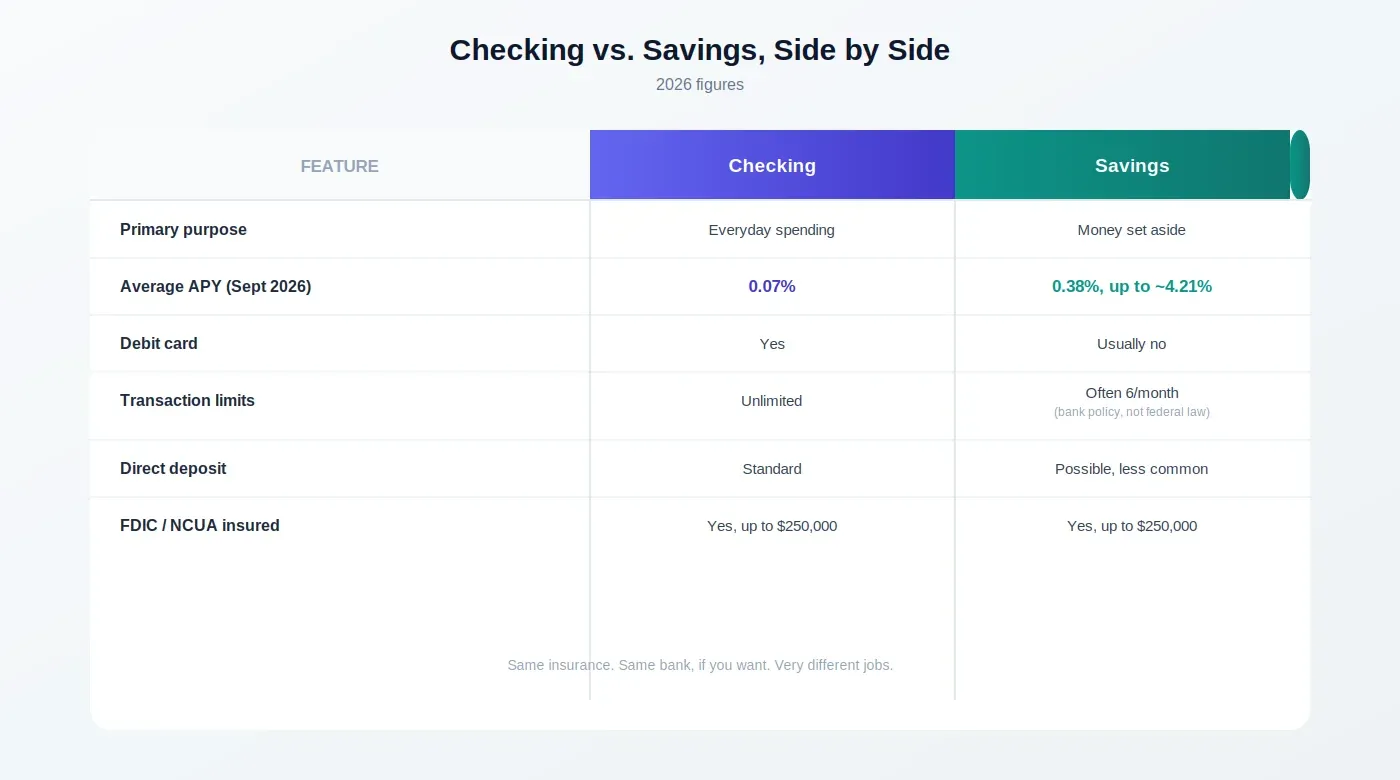
A checking account is built around
movement. Money comes in through direct deposit, then goes right back out
through debit card purchases, bill payments, transfers, and withdrawals,
sometimes dozens of times a month. Everything about how the account works
exists to support that constant flow.
●
Unlimited
transactions. There's generally no cap on how many times you can spend,
withdraw, or transfer from a checking account in a given month.
●
Debit
card access. Nearly every checking account comes with one, for in person and
online purchases, plus ATM access for cash.
●
Direct
deposit compatible. Paychecks, tax refunds, benefits payments, all typically
routed to checking, and plenty of banks now release direct deposit funds up to
two days early.
●
Low
or no interest, historically. The average interest checking account paid just
0.07% APY as of September 2026, and a lot of standard checking accounts pay
nothing at all.
That last point is really the tradeoff.
A checking account buys you complete, frictionless access to your money, and
the price of that convenience has traditionally been earning next to nothing on
whatever balance sits there.
It's worth understanding why banks
structure things this way rather than just assuming it's arbitrary. A checking
balance is genuinely unpredictable from the bank's side, money could leave at
any moment, in any amount, which limits what the bank can actually do with
those deposits. Savings balances tend to be more stable and predictable, which
lets the bank lend or invest that money with a lot more confidence, and the
higher interest rate is essentially compensation for that predictability. The
rate gap isn't a penalty for using checking. It reflects a real difference in
how the money functions once it's sitting at the institution holding it.
What a Savings Account Is Built For
A savings account runs on the opposite
principle: staying put. The money's meant to accumulate rather than circulate,
and the account is built around that, a little more friction to access it,
meaningfully more interest in return.
●
Higher
interest rates. The national average sits at 0.38% APY, but top high yield
savings accounts from online banks were paying around 4.10% to 4.21% as of
September 2026.
●
No
debit card, usually. Most savings accounts skip the card entirely, requiring a
transfer to checking before the money can actually be spent, which functions as
a feature rather than a limitation.
●
Possible
withdrawal limits. More on this below, but plenty of banks still enforce their
own transfer caps even though the federal requirement is gone.
●
Same
federal insurance. FDIC or NCUA insurance is equal between savings and checking
accounts at a maximum of $250,000 per depositor per institution.
●
It's
important to remember that the savings account interest rate environment is
different from what it was just a few years ago. Online banks drove the APY on
savings accounts over 4% and even 5% during 2023 and 2024. Following six
interest rate reductions by the Federal Reserve during 2024 and 2025, they
dropped back down, but with no change in Federal Reserve rates through 2026 so
far, savings rates have also stabilized. In other words, while the current best
APY of 4.10% to 4.21% is below the recent high, it is still much higher than
the national average, and better than watching and waiting for a rate increase.
Side by Side Comparison
What Happened to the Six Withdrawal Rule?
This is one of the most common points of
confusion out there, and the answer has genuinely changed. Federal Regulation D
used to limit savings account holders to six certain types of withdrawals or
transfers per month. The Federal Reserve suspended that limit in April 2020,
and as of 2026 it hasn't come back, with the Fed signaling no plans to reimpose
it.
Here's the catch, though: a lot of banks
still enforce their own six transaction policies internally, even though
nothing federal requires it anymore. Go past a bank's internal limit and you'll
typically trigger a fee somewhere in the $5 to $15 range per excess
transaction, and repeated violations can sometimes get the account converted
from savings to checking, which usually means losing the higher rate entirely.
●
What
this means practically: check your specific bank's policy rather than assuming
either that the limit is gone everywhere or that it still applies everywhere.
It genuinely varies by institution now.
●
If
you regularly need more transfers: consider opening multiple savings accounts
at the same bank, each carrying its own limit, or look at a money market
account or a competitive interest bearing checking account instead.
Also worth knowing which transactions
typically count toward these limits and which don't. Bank policies generally
count electronic transfers, online or mobile transfers to another account,
automatic transfers, and check or debit card transactions drawn directly from
savings. What usually doesn't count: ATM withdrawals, in person withdrawals at
a branch teller, and transfers made by phone if a check gets mailed. That
distinction means someone bumping against a limit can often just shift a
transfer to an ATM withdrawal instead, though confirming the specific bank's
policy is worth the two minutes it takes.
How Much Should You Keep in Each?
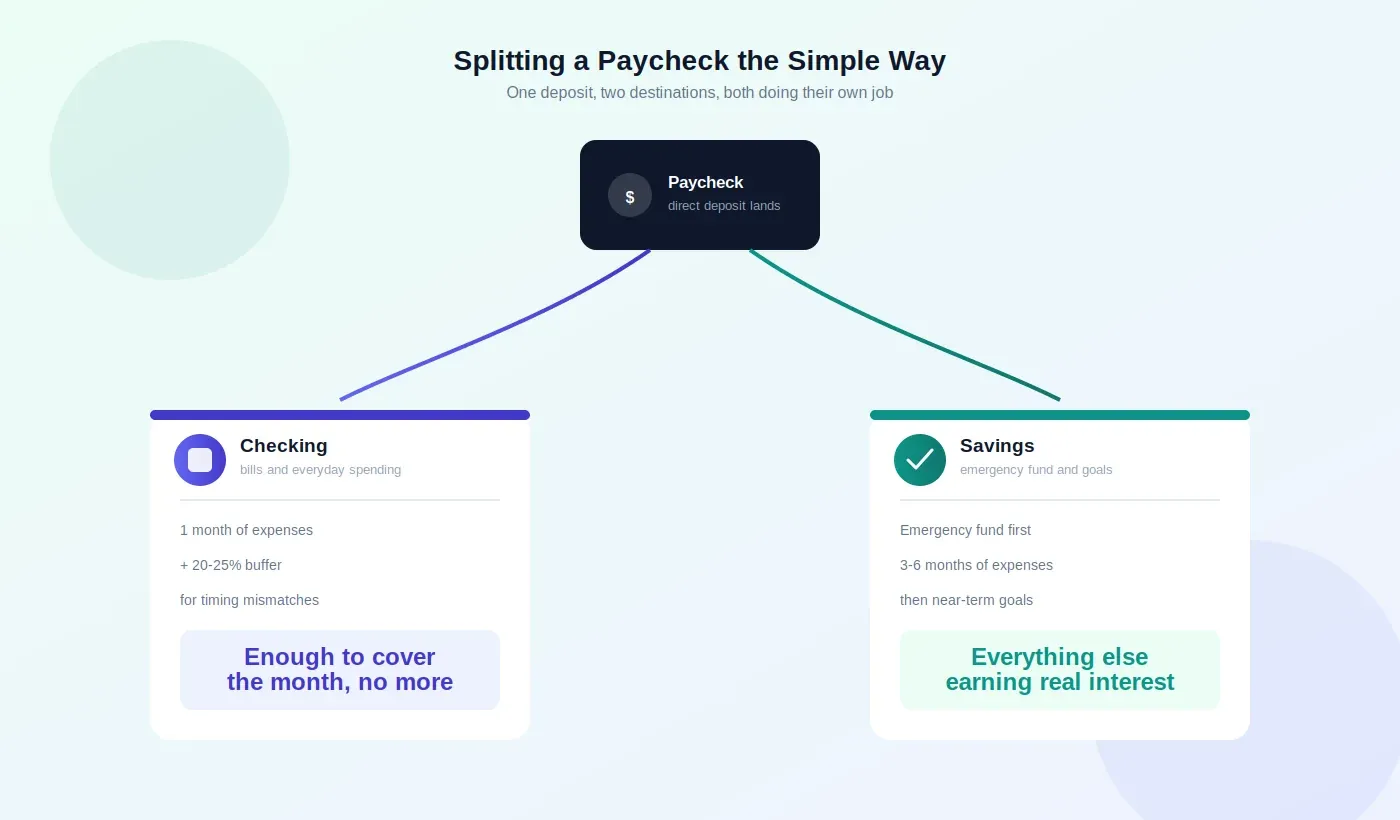
There's no universal formula here, but a
practical framework gets most households somewhere reasonable.
●
In
checking: enough to
cover one month of regular expenses, plus a buffer of roughly 20% to 25% for
timing mismatches and unexpected charges. This prevents overdrafts without
leaving a large amount earning close to nothing.
●
In
savings: emergency fund
first, a starter goal of $500 to $1,000, building toward 3 to 6 months of
essential expenses over time, plus anything set aside for specific goals within
the next few years.
●
Beyond
that: money that won't
be needed for five or more years generally belongs somewhere with more long
term growth potential than a savings account, which is where investing comes
in.
●
A
useful sanity checks: if
your checking balance has sat well above one month of expenses for several
months running, that excess is a good candidate to move into savings, where it
earns meaningfully more without touching day to day access at all.
The buffer in checking matters more than
people tend to expect. Roughly 11% to 12% of Americans paid at least one
overdraft fee in a given year, and those fees run $26.77 to $35 per incident. A
small cushion in checking is genuinely cheaper than the cost of occasionally
running short.
For a full walkthrough on building the
savings side, see our emergency fund guide, and for where longer
term money belongs, our investing for beginners guide covers the next
step.
Do You Need Both Accounts?
For almost everyone, yes. The two
accounts solve genuinely different problems, and trying to make one do both
jobs tends to work poorly in both directions.
●
Using
only checking: means
earning close to 0% on money that could be earning 4%+ in a high yield savings
account, and it removes the psychological separation that actually helps
savings stay saved.
●
Using
only savings: means
dealing with transfer delays and possible transaction limits every time a bill
needs paying, plus no debit card for everyday purchases.
The standard setup, checking for the
money moving through each month, savings for the money staying put, is standard
specifically because it works. Some people take this further with multiple
savings accounts, each labeled for a specific goal, which makes progress easier
to track without adding much real complexity.
One practical detail that makes this
setup work smoothly: the two accounts don't need to live at the same bank. A
high yield savings account at an online bank can link to a checking account at
a completely different institution, with transfers typically clearing within
one to three business days. A lot of people end up with exactly this
arrangement, keeping a long standing checking relationship at a local bank or
credit union while moving savings to wherever the rate is genuinely
competitive, getting the benefits of both without fully switching institutions.
A Note on Interest Bearing Checking Accounts
A newer wrinkle worth knowing about:
some checking accounts now pay genuinely competitive interest, a real shift
from the traditional 0%. A handful of online banks offered checking rates in
the 1.75% to 3.75% range in 2026, sometimes tied to requirements like a
qualifying direct deposit or a minimum number of monthly debit card
transactions.
These can be worth considering,
particularly for anyone who finds juggling two accounts cumbersome, or who
needs more transaction flexibility than a savings account allows. That said,
top high yield savings rates still generally beat the best checking rates, so
for money genuinely being set aside rather than spent, a dedicated savings
account typically still wins on pure rate.
Money market accounts sit in a similar
middle ground worth mentioning. They typically pay rates closer to a savings
account while sometimes offering check writing ability or a debit card,
blending features from both account types. Some banks have also loosened up
money market transaction limits in 2026 compared to traditional savings
accounts. For anyone who wants savings level interest with somewhat easier
access, comparing money market rates alongside high yield savings rates is
worth the extra few minutes.
Common Mistakes People Make with These Accounts
●
Leaving
a large balance in checking indefinitely. Money beyond a one-month buffer
earning 0.07% instead of 4%+ is a quiet, ongoing cost that compounds over
years.
●
Assuming
the six withdrawal limit no longer exists anywhere. The federal rule is gone,
but plenty of individual banks still enforce it with fees of $5 to $15 per
excess transaction.
●
Keeping
savings at the same low rate bank purely out of convenience. A high yield
savings account at a different institution can still link to an existing
checking account for easy transfers.
●
Not
checking the overdraft policy on the checking account. Some accounts decline
transactions instead of charging a fee, a difference worth confirming before it
actually matters.
●
Treating
savings as a second checking account. Frequently pulling money back out for non-emergency
spending defeats the separation that makes the whole setup work, and can
trigger excess transaction fees at banks still enforcing internal limits.
Key Takeaways
●
Checking
accounts are built for frequent transactions, paying an average of just 0.07%
on interest bearing versions as of September 2026.
●
Savings
accounts are built for money staying put, with a 0.38% national average but top
high yield options paying around 4.10% to 4.21%.
●
The
federal six withdrawal rule was removed in 2020 and hasn't returned, but plenty
of banks still enforce their own limits with $5 to $15 fees.
● The sensible ratio is one month’s worth of expenses plus 20% to 25% cushion in the checking account, while the emergency fund and short-term goals are in the savings account.
● The two accounts have the same FDIC or NCUA protection up to $250,000 per depositor, per bank.
Conclusion
The checking versus savings question was
never really an either or decision. It's a question of which job each dollar is
doing. Money moving through your budget each month belongs in checking, where
access matters more than yield. Money staying put belongs in savings, where a
high yield account turns an otherwise idle balance into a few hundred dollars a
year on a meaningful balance. Setting both up correctly, once, takes about
twenty minutes, and then it just quietly works in the background indefinitely.
For the full picture on choosing the
right bank for both accounts, read our complete guide to banking in 2026.