Introduction
$30.82. That's the average overdraft fee
per occurrence in 2026, according to the MoneyRates annual survey. Down
slightly from prior years, competition from fee free banks keeps pushing the
industry lower, which is genuinely good news. It doesn't mean fees are gone,
though. Between monthly maintenance charges, overdraft fees, ATM costs, and
wire transfer charges, a typical customer at a traditional bank can still lose
real money every year, almost all of it avoidable with the right account and a
little awareness.
This guide breaks down every common bank
fee, what it actually costs in 2026, why banks charge it, and exactly how to
avoid it. Nothing here requires exotic financial knowledge. Most fixes come
down to either choosing a different account or adjusting one habit.
Worth separating two categories before
going further Some costs will simply be structural and built in the design of
the specific account and will need to be resolved through changing accounts,
whereas other costs will be behavioral, resulting from the use of a wrong
service, for example, and these will usually be avoidable without having to
change your account at all. Knowing which bucket a given fee falls into decides
whether the fix takes five minutes in an app or a genuine account switch.
This article is part of our larger complete guide to banking
in 2026, and it pairs
well with our best online banks of 2026
guide if you're looking
to switch to a fee free option.
Overdraft Fees
An overdraft fee gets charged when a
bank covers a transaction that exceeds your available balance, letting the
account go negative rather than declining the purchase outright. The average
overdraft fee was $30.82 in 2026 according to MoneyRates, while Bankrate's most
recent Checking Account and ATM Fee Study put the figure closer to $26.77, both
notably lower than a few years back.
●
Who
charges the most: roughly
67% of large banks still charge fees in the $35 to $38 range per occurrence,
and fees can stack if multiple transactions overdraw the account on the same
day.
●
Who
charges nothing: Capital
One and Bank of America have eliminated overdraft fees entirely, and a growing
number of online banks, including Chime and Discover, either skip them or offer
a fee free buffer through a feature like Chime's SpotMe.
●
How
to avoid it: choose an
account that declines transactions instead of covering them, opt into a fee
free overdraft buffer where available, or set up low balance alerts through
your banking app so you can transfer funds before a transaction posts.
Americans paid an estimated $12.1
billion in combined overdraft and NSF fees in 2024, and credit unions accounted
for roughly 45% of that total, a larger share than a lot of people assume,
worth knowing since credit unions get thought of as the lower fee option across
the board, which isn't quite the full picture.
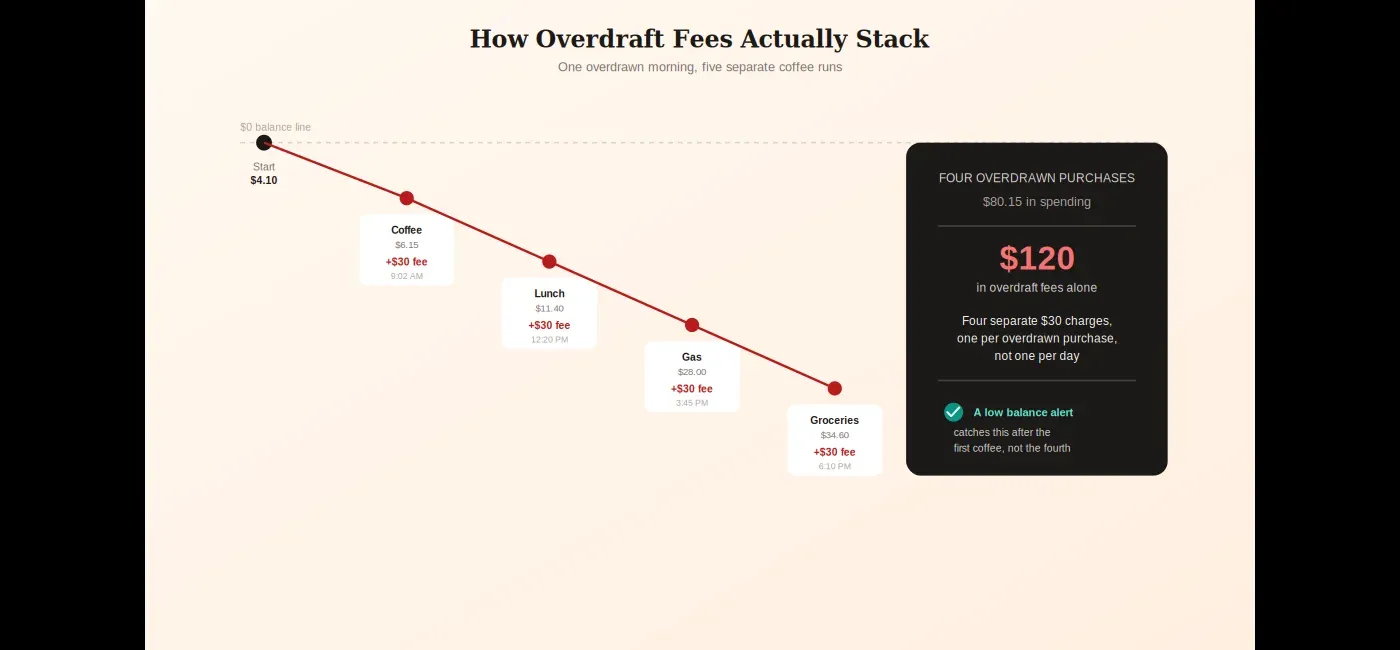
It's worth understanding how overdraft
fees can stack within a single day, since that's where the real financial
damage tends to happen. If several small transactions post the same day and the
account's already negative, some banks charge a separate overdraft fee for each
one, not just once for the day. A handful of $6 coffee purchases hitting an
already overdrawn account can theoretically trigger several $30 fees within
hours, turning a genuinely small shortfall into a much bigger one. That's
exactly the scenario a low balance alert is built to prevent, catching the
problem after the first transaction instead of the fifth.
Non-Sufficient Funds (NSF) Fees
NSF fees apply in situations where there
is no money in the account because the payment is declined and sent back,
unlike in an overdraft where the bank takes care of the difference. NSF fees
have traditionally been between $15 and $35.
●
Most
big banks do not charge this fee anymore: Capital One, Wells Fargo, Citi, Bank of America, Chase, and
PNC got rid of the NSF fees between 2022 and 2024; although there are community
banks and credit unions that charge this fee.
●
The
new government regulations limit these remaining fees: as of March 12, 2026, NSF fees will be
limited to $10 on personal deposit accounts in most institutions, banks will be
allowed to charge one NSF fee in a 2-day period, and there will be no NSF fee
for accounts that have less than $10 overdraft.
●
Expected
impact: regulators
project banks will lose roughly $619 million in NSF revenue following the new
cap, with about 1.9 million fewer NSF transactions occurring as a result.
Worth checking your specific bank's
current policy directly, since most large banks doesn't mean all of them, and
community banks and credit unions are more likely to still charge this fee than
the biggest national institutions.
Monthly Maintenance Fees
Maintenance charges apply for simply
maintaining an account open irrespective of the way the account is used.
According to the Money Rates survey, the average monthly maintenance fee for 2026
was $13.95 which comes to around $170 per year.
●
Availability
of free checking has increased: More
than 37% of checking accounts come without any maintenance charges at all,
which is a marked change from the past ten years of increased fees.
●
Waiver
requirements vary: plenty
of accounts that do charge a fee will waive it for a qualifying direct deposit,
a minimum daily balance, or a minimum number of debit transactions each month.
●
How
to avoid it: choose a
genuinely free checking account from the start. Several top online banks charge
no monthly fee under any circumstances, removing the need to track a waiver
requirement at all.
ATM Fees
ATM fees come in two layers that can
both apply on the same withdrawal. Your own bank may charge a fee for using an
out of network machine, and the ATM's owner may charge a separate surcharge on
top of that. Combined, these can run $5 to $7 per withdrawal, meaningful on a
smaller cash withdrawal.
●
How
to avoid it: use your
bank's in network ATMs whenever possible. Many online banks partner with large
ATM networks like Allpoint or MoneyPass, offering tens of thousands of fee free
locations, and some accounts reimburse out of network fees up to a monthly
limit.
●
Plan
ahead for cash needs: getting
cash back during a debit purchase at a grocery store or pharmacy is typically
free and skips ATM fees entirely, worth using when a fee free ATM isn't nearby.
Wire Transfer Fees
Wire transfers move money quickly, often
the same business day, but they're also among the more expensive ways to send
funds. Most banks charge $20 to $35 for a domestic outgoing wire, with
international wires typically costing more.
●
Incoming
wires sometimes cost less or nothing: plenty
of banks don't charge for receiving a wire, or charge a smaller fee than for sending
one, worth confirming with your specific bank.
●
How
to avoid it: For those
that aren’t considered urgent, an average ACH transfer or peer-to-peer payment
through an app such as Zelle usually is free and takes between one to three
business days. Wires make sense mainly when same day certainty genuinely
matters.
Foreign Transaction Fees
A foreign transaction fee applies to
purchases made in a foreign currency or processed through a foreign bank,
typically running 1% to 3% of the purchase amount. For frequent international
travelers, this adds up quickly.
●
How
to avoid it: several
checking and debit accounts waive foreign transaction fees entirely, worth
checking before international travel specifically, since the savings on a multi
week trip can be substantial.
Travel credit cards frequently waive
this fee too, worth comparing against a debit card specifically if a trip's
coming up, since carrying both a no foreign fee debit card and a no foreign fee
credit card gives you a useful backup if one gets lost or declined while
abroad.
Which Fees Get Waived, and Which Don't
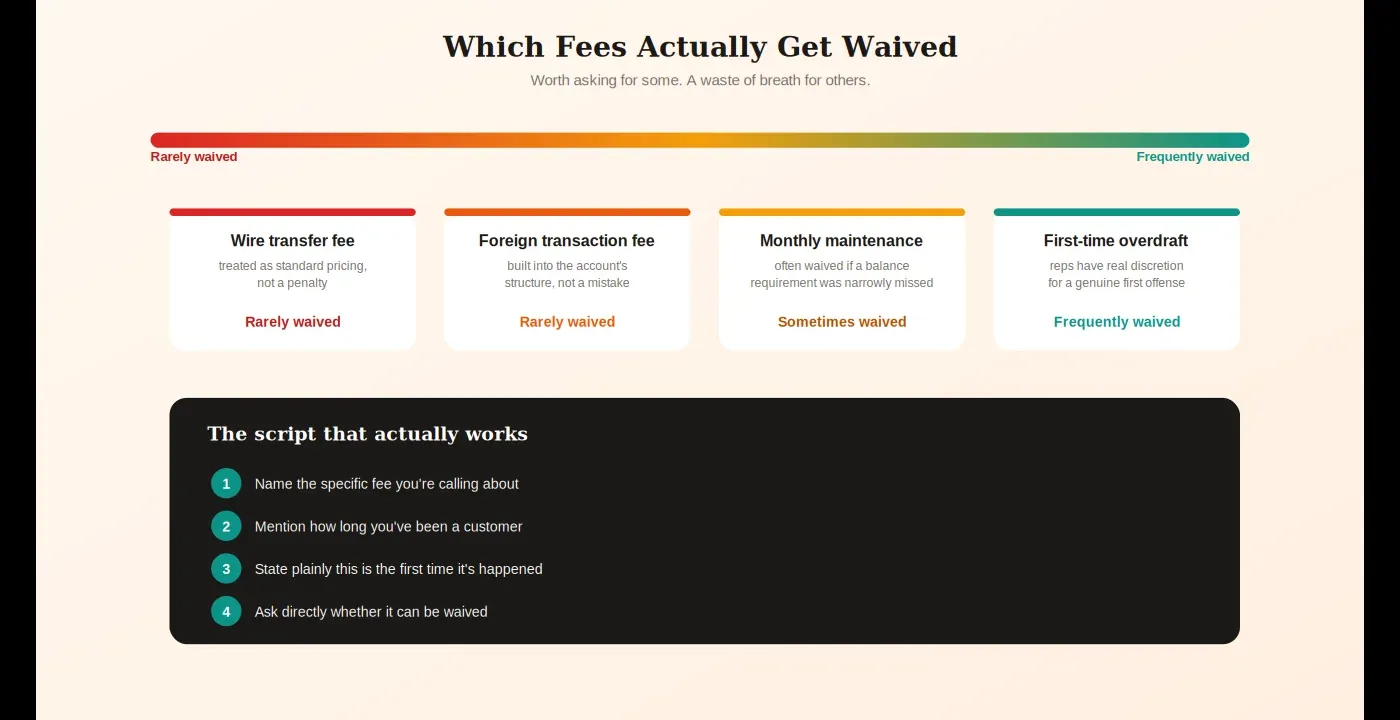
Not every fee is equally negotiable.
Knowing which ones a bank will realistically waive, especially on a first
offense, saves the frustration of asking for something that was never going to
happen.
●
Frequently
waived: overdraft fees,
particularly a first time occurrence, out of network ATM fees when used by
genuine mistake, and monthly maintenance fees when a balance requirement was
narrowly missed.
●
Rarely
waived after the fact: wire
transfer fees, foreign transaction fees, and paper statement fees. These are
more often considered standard charges and not penalties, so they have a lower
chance of being refunded.
●
How
to ask for that: call
customer service, mention your length of relationship as a customer, state it’s
the first time this charge occurs, and ask about waiving it. This works often
enough to be worth the phone call, particularly for overdraft and ATM fees.
A useful script for this exact call:
mention the specific fee type, note how long you've been a customer, and state
plainly that this is the first time the issue has come up. Representatives
generally have some discretion to waive a first occurrence specifically, and
framing the request this way, rather than simply asking to have a fee removed
with no context, tends to improve the odds.
What Bank Fees Really Cost Over Time
For example, a customer that pays a
maintenance fee of $13.95 per month, and other additional charges such as overdrafts
and ATM fees, can easily pay over $200 in charges each year that he wouldn't
incur if he used a different account. This means $2,000 over a period of ten
years, but the actual amount is actually even higher than that figure.
The money spent on unnecessary charges
is money that doesn't get a chance to grow. For example, if one had invested
the $2,000 in an index fund, earning an average annual interest rate of 7%, it
would have grown to approximately $2,900 in the same period of time.
For more on how compounding works over
time, see our investing for beginners
guide.
Why People Stay at Fee-Charging Banks Anyway
If fee free accounts are this widely
available, it's worth asking why so many people still pay them. Survey data on
why customers stay loyal to their current bank offers a clue: low or no fees
gets cited by only 18.4% of respondents as their reason for staying, nearly
tied with simply having a long standing account history at 18.2%. Customer
service satisfaction keeps 16.3% of people from switching, and convenient
branch or ATM access accounts for another 13.2%.
In other words, inertia and familiarity,
not satisfaction with the fee structure itself, are what keep a lot of people
at accounts that charge more than necessary. Switching does take some effort,
updating direct deposit, moving recurring payments, but the fee savings alone
often justify that one time cost within the first year.
Common Fee Mistakes to Avoid
●
Not
knowing your own bank's fee schedule. A quick review of your account's fee
disclosure, usually available in the app or online, reveals exactly what
triggers a charge before it happens.
●
Assuming
all banks still charge NSF fees. Most large banks eliminated this fee between
2022 and 2024, if your bank still charges it, a fee free alternative is likely
available.
●
Ignoring
low balance alerts. Most banking apps let you set a custom alert well before a
balance actually reaches zero, giving time to transfer funds before an
overdraft happens at all.
●
Paying
for paper statements out of habit. Switching to electronic statements is
usually free and instant, eliminating a small but entirely unnecessary
recurring charge.
●
Treating
every fee as equally worth fighting. It is seldom worth the effort to waste
time arguing about the one-dollar fee on paper statements, since it does not
amount to much money; rather, concentrate on fees that have an impact.
Key Takeaways
●
Overdraft
charges decreased to $30.82 on an average basis in 2026, although about
two-thirds of the big banks continue to charge between $35 to $38 per
overdraft.
●
New
federal rules cap NSF fees at $10 starting March 12, 2026, for personal deposit
accounts at many institutions, and most large banks had already eliminated the
fee entirely.
●
More
than 37% of checking accounts now charge no monthly maintenance fee, making
genuinely free checking easier to find than it used to be.
●
Fees
that seem small individually can cost hundreds of dollars a year, and the
compounding cost of money that never got invested runs even higher over time.
●
Overdraft
and ATM fees are the most likely to be waived on request, wire and foreign
transaction fees rarely are.
Conclusion
Bank fees are genuinely trending
downward in 2026, but they haven't disappeared, and the gap between a fee heavy
account and a genuinely free one still adds up to real money every year.
Reviewing your own account's fee schedule, switching to a fee free option if
needed, and asking directly when a fee does occur covers nearly every scenario
in this guide. None of it takes much effort, and the payoff compounds for as
long as the better account stays open.
For the full picture on choosing the
right account from the start, read our complete guide to banking
in 2026.