
Introduction
5.5%. That's how far the average equity
investor fell behind the S&P 500 in 2023, according to DALBAR's 2024
research. Not bad luck. Not missing information. Mostly just behavior. A
separate, longer-running study by Barber and Odean, published in the Journal of
Finance, puts the average individual investor's underperformance at roughly
1.5% a year, and not just in one rough year either, consistently, across long
stretches of time.
Nobody's careless here. Nobody's
unintelligent. What's actually going on is a handful of very human reactions,
panic when things drop, excitement when they climb, a reluctance to put money
anywhere unfamiliar, slowly wearing down returns year after year without anyone
really noticing until the numbers get added up. This guide covers the ten
errors that occur most frequently, the reasons why they cause trouble for those
who are sincerely trying to get this right, and the solutions that really work.
Just think about that context for a
moment because it alters how the solution is achieved. If underperformance came
mostly from a lack of information, more articles and research reports would
solve it. It doesn't come from that, mostly, so the real fix looks less like
accumulating knowledge and more like building systems, automation, a written
plan, a fixed review schedule, that remove the chance to make an emotional
decision in the first place. Willpower alone rarely wins this fight.
This guide is part of our larger investing for beginners guide, and it pairs
well with our guides on what investing actually means and how to build an investment portfolio.
Mistake 1: Trying to Time the Market
Waiting for the right moment, after a
dip, before a rally, once things feel a little less uncertain, seems like the
responsible move. It almost never is. It just costs more than it save, quietly
and consistently.
●
Why
it happens: market timing feels careful, like you're dodging risk by holding
out for better conditions. Problem is, nobody can reliably spot those better
conditions ahead of time, not even professionals who do this for a living.
●
How
to fix it: dollar-cost averaging, a fixed amount, on a fixed schedule, no
matter what the market's doing that particular week. It takes the guesswork
about a "perfect" entry point off the table entirely.
The surprise factor comes next: on a statistical basis, an immediate lump-sum contribution actually wins over a spread-out contribution two-thirds of the time, primarily because of market gains being greater than losses over the long term. Then the question arises: Why even consider dollar-cost averaging for a novice investor? Not because it wins on average. Because it eliminates the emotional barrier which prevents many people from investing the initial amount at all. The best investment strategy is whichever one the person will actually continue using.
Mistake 2: Concentrating in a Single Stock or Sector
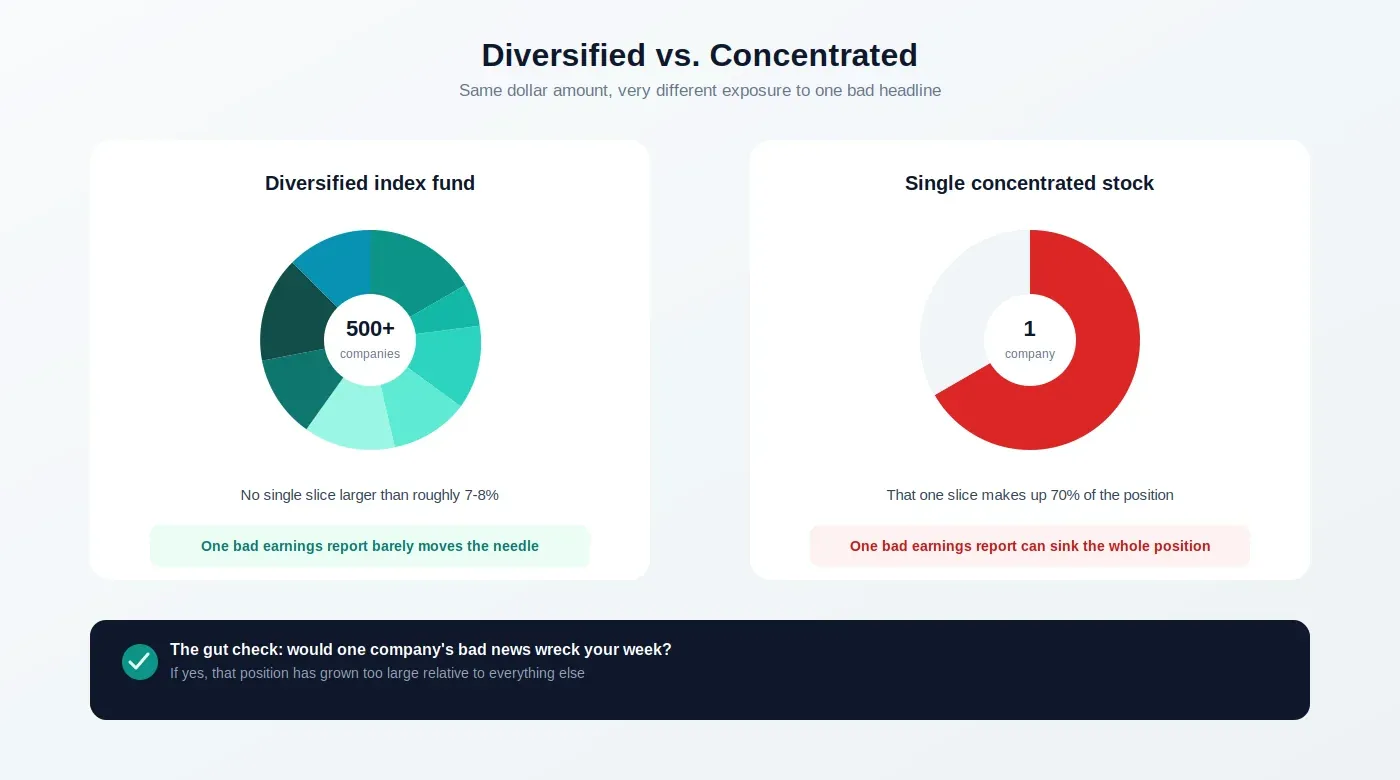
A single company you're excited about, especially
one on a hot streak, feels a lot more compelling than a faceless index fund.
That excitement, though, comes with a meaningfully higher risk price tag.
●
Why
it occurs: It is easier to be excited about one company than five hundred, and
it is hard to ignore success that has been seen recently.
●
How
to fix it: Stick with diversification through your main portfolio, which
includes an index fund or ETF of several hundred companies, but if individual
stocks are still attractive to you, keep them to a limited portion of your
portfolio.
Try
this gut check: if one company's bad news, a disappointing earnings call, a
scandal, a lost contract, would genuinely wreck your week financially, that
position has grown too big relative to everything else. A properly diversified
portfolio should be able to shrug off any single company having a terrible year
without the whole plan wobbling.
Mistake 3: Panic Selling During a Downturn
Selling when things drop feels like
you're protecting yourself. All it really does is cement the losses and return
the gains which have followed virtually every market decline in history.
●
Why
it happens: loss aversion is a true behavioral phenomenon, losing money is
psychologically more painful than the corresponding gain, and this drives investors
to sell just to end the pain.
●
How
to fix it: decide on your asset allocation according to your actual risk
tolerance prior to any market decline, not during one. Reviewing the strategy
when the going is good makes it much easier to stick to it down the road.
Here
the historical evidence is actually quite reassuring, though it certainly
doesn't feel that way during a downturn. Every major bear market in the last
hundred years has eventually recovered to new highs, sometimes in months,
sometimes taking a couple years. The investors who came out ahead weren't the
ones who nailed the exact bottom and timed their way back in. These are the
ones who simply hung around, making their paper loss remain as such rather than
converting it into an actual loss.
Mistake 4: Chasing Hype and Hot Tips
●
Getting
Blown Away by Hype and Tips
●
Listening
to whatever seems to be popular on the Internet or what a self-assured stranger
on the Internet has recommended to you rather than doing your own research, is
one of the fastest ways to get wiped out for rookies.
●
Why
it happens: confidence is cheap to fake and genuinely hard to distinguish from
real expertise, especially if you're new enough that you haven't developed a
feel for what solid research even looks like yet.
●
How
to fix it: treat any hot tip as a lead worth checking, never a reason to buy on
its own. When you cannot express your thoughts about an investment in your own
words, then you should definitely stop and not rush. You cannot find words for
explaining why an investment is a good deal? This is when you need to be
careful.
Social
media has poured gasoline on this particular mistake. One confident video can
hit millions of people within hours, and the resulting momentum can push a
price up on its own, regardless of whether the fundamentals support it, which
creates a loop where the price move seems to prove the hype right. That cycle
is broken sooner or later, usually harshly, when the hype-induced buying stops
and reality reasserts itself at that price.
Mistake 5: Ignoring Fees
It may seem like a small figure at 1%.
Over the span of years, however, that becomes a truly substantial sum, and
beginners underestimate its importance for this very reason it is never
presented as one sum taken out of an account.
●
Why
it happens: fees get quoted as a tiny annual percentage instead of an actual
dollar amount pulled from an account, so the compounding cost hides in plain
sight.
●
How
to fix it: check the expense ratio before picking a fund. Low-cost index funds
and ETFs typically run 0.03% to 0.10%, versus a 0.44% average for actively
managed funds, a gap that snowballs into tens of thousands of dollars over
enough years.
There's more to watch beyond a fund's
own expense ratio, too. Account maintenance fees, trading commissions on
certain platforms, advisory fees on managed accounts, they all stack quietly on
top of the base cost. They all don’t amount to much by themselves, a few bucks
here and there, but add it all up over years and years and it adds up to
something that’s totally unnecessary that will weigh down your end result.
Mistake 6: Investing Without an Emergency Fund First
Paying into investments with all extra
money, without leaving any buffer for emergencies, will leave you to sell
everything at the wrong time during an actual emergency.
●
Why
it happens: investments always seem much more thrilling and rewarding than
putting your money in a savings account that earns practically zero interest.
●
How
to fix it: get a starter emergency fund of $500 to $1,000 in place before
investing seriously, then build it toward 3 to 6 months of expenses over time,
alongside your investing, not as a replacement for it.
This one tends to show up paired with
another mistake: carrying high-interest debt while investing hard at the same
time. A credit card balance charging 20% or more is a guaranteed cost that
almost always beats whatever return a diversified portfolio is likely to
deliver. Paying that off usually deserves priority right alongside the starter
emergency fund, before investing takes the spotlight.
Mistake 7: Home Bias, Ignoring International Markets
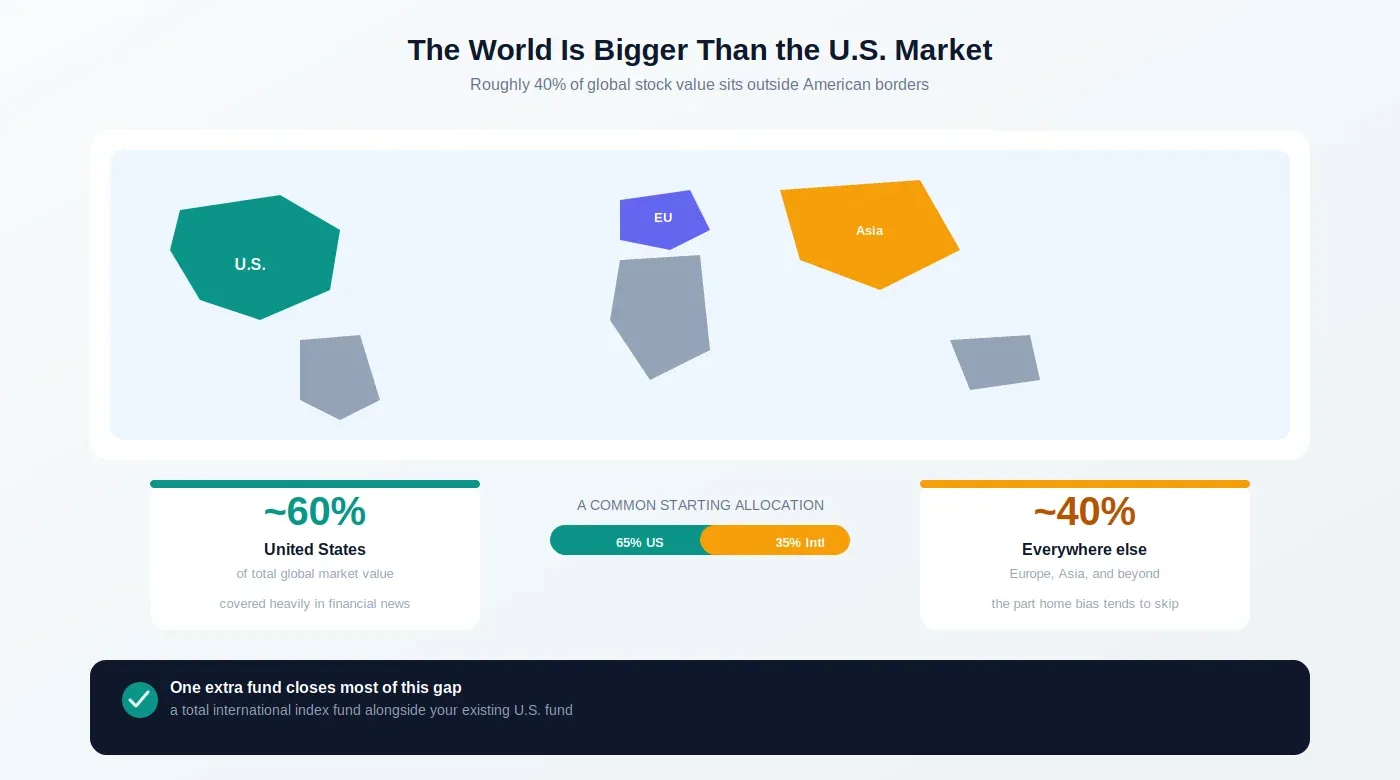
The U.S. accounts for roughly 60% of
total global stock market value. A portfolio built entirely from U.S. companies
is quietly skipping the other 40% of the investable world, a pattern common
enough that it's got its own name: home bias.
●
Why
it happens: domestic companies just feel closer and get covered constantly in
financial news, which pulls investor attention, and money, toward what's
familiar.
●
How
to fix it: pair a total international stock index fund with your domestic one.
A common starting mix runs 60% to 70% domestic and 30% to 40% international,
and one extra fund gets you there.
Morningstar's 2026 portfolio analysis
flagged "ignoring non-US stocks" as a mistake carried straight over
from 2025, a year when international stocks quietly beat their U.S.
counterparts. This isn't a bet that international will always win from here.
Think of it more as insurance, a diversified investor gets whichever region
performs better in any given year, rather than staking everything on U.S.
dominance lasting forever.
Mistake 8: Checking the Portfolio Too Frequently
Closely monitoring an investment account
makes people react more emotionally to changes in prices which, at the end of
the day, do not really matter, but it is precisely this that causes people to
make hasty decisions.
●
Why
it happens: checking a balance takes two seconds on a phone now, and short-term
swings can feel urgent even when they carry zero real weight over the years
that actually matter.
●
How
to fix it: pick a fixed schedule, monthly or quarterly covers a long-term
diversified portfolio just fine, and fight the urge to check more when things
get volatile, that's exactly when checking does the most damage.
There's a cruel irony here: the moments
checking feels most urgent, a sharp drop, a fast rally, are precisely when
checking does the most behavioral harm, feeding either panic selling or
impulsive buying right near a peak. Disabling push notifications on the stock
trading app can be considered a small step towards eliminating the temptation.
Mistake 9: Investing Without a Clear Plan
No objectives, no time frame, and before
you know it, it's tough to figure out what allocation would be right or even if
there's actually any need to make changes at all because of noise that will be
forgotten in a week's time.
●
Why
it happens: Getting started is the hardest part; everything else gets
overlooked.
●
How
to fix it: name a specific goal and timeline for each account, retirement, a
house, general wealth building, and let that timeline shape the allocation.
Closer goals lean conservative. Distant ones can afford to lean aggressive.
Mistake 10: Buying Assets You Don't Understand
Putting money into something without
knowing what it actually does or how it makes money isn't investing, it's
speculation wearing investing's clothes, and it gets brutally hard to hold onto
through a downturn when the original reasoning was never solid to begin with.
●
Why
it happens: momentum and the fear of missing out are so compelling that one
doesn’t really need to understand things anymore.
●
How
to fix it: Before buying anything other than an index fund, see if you can give
a quick summary about what it is and why you think it will perform well. Struggling
to answer that is your cue to dig deeper or walk away.
This isn't just about exotic or
complicated assets either. It applies just as much to a familiar company whose
products you use every single day. Liking a product tells you nothing about a
company's financial health, its competitive position, or whether the stock's
actually a good deal at current prices. Plenty of beloved brands have made
lousy investments, and plenty of boring, unglamorous businesses have quietly
done very well. The explanation test is not concerned about which one you
examine.
Key Takeaways
●
The
typical investor lags behind the markets by around 1.5% annually, largely
because of bad behavior rather than lack of information.
●
Diversification
and dollar cost averaging solve two of the most prevalent errors in one shot:
concentration and market timing.
●
Fees
compound hard over decades. Even a seemingly small percentage makes a large
financial difference over time.
●
An
emergency fund should come before risky investments because an actual emergency
should not necessitate an ill-timed sell-off of your assets.
●
A
specific plan and timeline make the right allocation obvious and make it easier
to sit still through normal ups and downs.
Conclusion
Every investor slips up somewhere,
especially early on. Getting it perfect wasn’t the objective. The real issue is
forming the habits to ensure that the costly mistakes that can be avoided do
not become compounded year by year. Diversifying, being consistent, paying
lower costs, and having a solid strategy, that takes care of most of the
difference between what investors earn and the market. None of it takes special
expertise. Just the discipline to keep doing it.
For the full picture on getting started
the right way, read our complete investing for beginners guide, and
see our best investment apps of 2026 guide if you
haven't opened an account yet.