Introduction
The average first-time investor starts with somewhere between $500 and $2,000, and mobile-first platforms now drive roughly 73% of new account creation, according to 2026 industry data. In other words, most people opening their first investment account today are doing it from a phone, not a desktop, and choosing between apps that all sound roughly the same on the surface, commission-free, no minimum, beginner-friendly.
The differences that actually matter are underneath that surface: how fractional shares work, whether there is a robo-advisor option, what the fee structure looks like once you dig past the headline “free” claim, and how each platform handles the specific things a beginner is likely to need. This guide breaks down the platforms that consistently rank at the top for beginners in 2026, with honest pros and cons for each.
None of the platforms below are objectively bad choices, all eight passed a meaningful bar for beginner-friendliness before making this list. The goal of this guide is not to crown one winner, it is to help match a specific platform's strengths to how you personally want to interact with investing, whether that means checking an app daily or setting it up once and genuinely forgetting about it for months at a time.
This guide is part of our larger investing for beginners guide, and it pairs well with our guides on how to start investing with $100 and index funds vs. ETFs once you have picked a platform.
Our Methodology
We focused specifically on platforms built for, or genuinely welcoming to, first-time investors, rather than every brokerage on the market. That meant weighing account minimums, whether fractional shares are supported and at what dollar amount, the real fee structure beyond just commission-free trading, and how much hand-holding versus direct control each platform offers. We excluded platforms primarily built for advanced or professional traders, since the tools that serve that audience well often overwhelm someone opening their very first account.
We also gave weight to how each platform handles the small, practical details that matter most in the first few months of investing, how quickly a deposit clears, how clear the fee disclosures are, and whether customer support is easy to reach if something goes wrong. A platform that looks identical to a competitor on paper can feel completely different in practice once these day-to-day details come into play, and they are often what determines whether a beginner sticks with investing or gets frustrated and gives up in the first few weeks.
Pricing research was conducted using each platform's publicly listed fee schedules as of August 2026. Fees, minimums, and features on any brokerage platform can change without much notice, so it is always worth double-checking current terms directly on a platform's website before opening an account, particularly for anything involving an ongoing management fee like Betterment's or Acorns' subscription tiers.
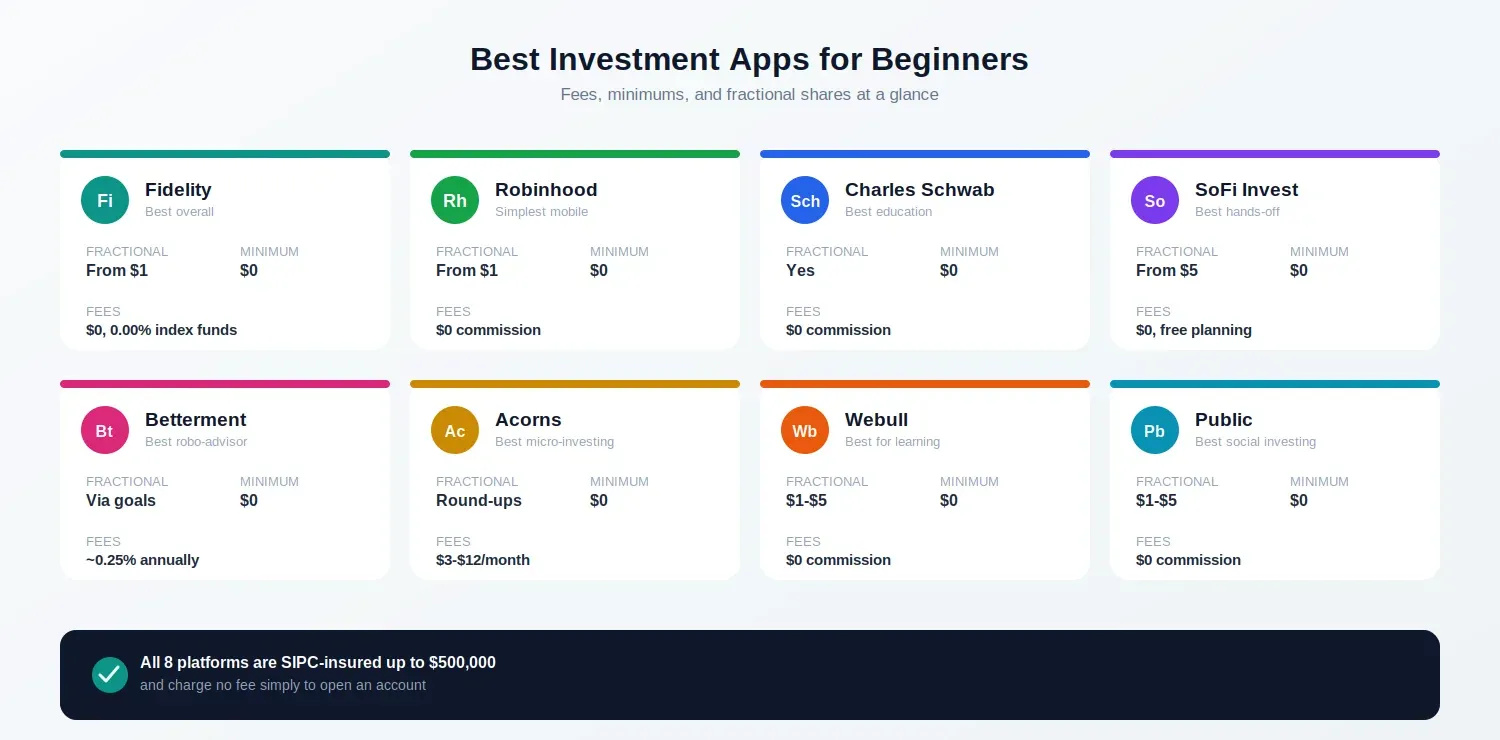
Quick Comparison Table
| Platform | Fractional Shares | Account Minimum | Fees |
|---|---|---|---|
| Fidelity | From $1 | $0 | $0 commission, 0.00% index funds available |
| Robinhood | From $1 | $0 | $0 commission |
| Charles Schwab | Yes | $0 | $0 commission |
| SoFi Invest | From $5 | $0 | $0 commission, free financial planning |
| Betterment | Via goals, from $10 | $0 | ~0.25% annual management fee |
| Acorns | Round-ups | $0 | $3–$12/month |
| Webull | From $1–$5 | $0 | $0 commission |
| Public | From $1–$5 | $0 | $0 commission, standard tier |
Individual Platform Reviews
1. Fidelity — Best Overall for Beginners
Fidelity consistently tops beginner rankings for a simple reason: it combines zero-fee index funds, over 7,000 fractional shares, no account minimum, and 24/7 customer support in one place. Its FZROX and FZILX funds carry a genuine 0.00% expense ratio, among the lowest available anywhere in the industry.
- Pros: zero-fee index funds, strong customer support, no account minimum, wide range of fractional shares available.
- Cons: the interface is less flashy than some newer, mobile-first competitors, which some beginners find less immediately engaging.
Fidelity also stands out for offering full-service features most beginners eventually grow into needing, retirement accounts, custodial accounts for kids, and even a cash management account with competitive interest, all under the same login rather than requiring a separate platform later.
2. Robinhood — Best User-Friendly Mobile Experience
Robinhood pioneered commission-free trading and remains one of the simplest apps to actually use, with fractional shares starting at $1 and support for stocks, ETFs, options, and crypto all in one place. Robinhood Gold, an optional $5-a-month tier, adds features like Level 2 market data and IRA contribution matching.
- Pros: extremely intuitive interface, fractional shares from $1, no account minimum, free stock for linking a bank account in some promotions.
- Cons: does not offer mutual funds or bonds directly, and the simplicity that makes it beginner-friendly can also encourage more frequent trading than is ideal for long-term investors.
Worth knowing: Robinhood's interface design, clean, game-like, and fast, has drawn some criticism for making trading feel almost too easy, which can be a double-edged sword for a beginner still building the discipline to buy and hold rather than react to every price movement.
3. Charles Schwab — Best for Educational Resources
Schwab pairs commission-free trading and fractional shares with genuinely strong educational content, a meaningful advantage for beginners who want to actually understand what they are doing rather than just clicking buttons. Its own index funds, like SWPPX and SWTSX, carry expense ratios as low as 0.02%.
- Pros: excellent educational resources, low-cost proprietary index funds, no account minimum, well-established and trusted brand.
- Cons: the mobile app interface feels less modern compared to some newer competitors, though functionality remains strong.
Schwab's educational library covers everything from basic terminology to more advanced portfolio strategy, organized in a way that lets a genuine beginner start with the fundamentals and progress at their own pace, rather than being dropped into content written for experienced investors.
4. SoFi Invest — Best for Hands-Off Beginners
SoFi Invest offers commission-free trading, fractional shares starting at $5, and free access to certified financial planners regardless of account size, a genuinely differentiated perk for a platform with no account minimum. Its automated investing option charges no advisory fee at all, unusually generous for a hands-off portfolio.
- Pros: free financial planning access, no advisory fee on automated portfolios, integrates with SoFi's broader banking products.
- Cons: fractional shares start at $5 rather than $1, a slightly higher floor than some competitors, and the fund selection is narrower than a full-service brokerage.
The free access to certified financial planners is a genuinely unusual perk at this price point, most platforms reserve that kind of personalized guidance for accounts holding much larger balances, making SoFi a strong pick for anyone who wants an occasional human check-in without paying a dedicated advisory fee for it.
5. Betterment — Best Robo-Advisor
Betterment builds and automatically manages a diversified ETF portfolio based on a specific goal, retirement, a house down payment, general growth, for a management fee around 0.25% annually. It requires essentially no ongoing decisions once set up, rebalancing and even tax-loss harvesting happen automatically in the background.
- Pros: fully automated, goal-based investing, no minimum to start, tax-loss harvesting included.
- Cons: the 0.25% annual fee, while reasonable for a robo-advisor, is higher than simply buying a low-cost index fund directly and managing it yourself.
Betterment works especially well for someone who knows they want to invest but does not want to spend time researching funds, choosing an allocation, or remembering to rebalance periodically. All of that happens automatically based on the goal and timeline entered at setup, closer to hiring a financial advisor than picking your own investments.
6. Acorns — Best for Micro-Investing
Acorns automatically rounds up everyday purchases to the nearest dollar and invests the spare change, turning routine spending into a passive, ongoing investment habit without requiring a single deliberate deposit. It charges a flat monthly fee rather than a percentage, ranging from $3 to $12 depending on the plan.
- Pros: genuinely passive, works in the background with no ongoing effort, good for building the habit before larger, deliberate investing begins.
- Cons: the flat monthly fee is a much larger percentage hit on a small balance, worth calculating your typical round-up total before committing to a paid tier long-term.
Acorns works best as a starting habit rather than a long-term primary account. Many users graduate from Acorns to a more deliberate platform like Fidelity or Robinhood once they are comfortable with the basics and ready to make larger, intentional contributions rather than relying purely on spare change.
7. Webull — Best for Learning Active Trading
Webull offers commission-free trading with fractional shares from $1 to $5, alongside advanced charting tools and extended trading hours. Its standout feature for beginners is a genuine paper trading simulator, letting new investors practice with virtual money before risking anything real.
- Pros: paper trading practice reduces beginner mistakes, advanced tools available for those who want to grow into more active investing, no account minimum.
- Cons: the advanced features can feel like unnecessary complexity for a beginner who just wants to buy a simple index fund and leave it alone.
The paper trading feature is worth calling out specifically. Rather than reading about how order types or market volatility work, a beginner can place practice trades with virtual money and watch the results play out in real time, a genuinely effective way to build intuition before any real money is on the line.
8. Public — Best for Social Investing
Public combines fractional share investing with a social feed showing what other users are buying and discussing, an engaging format for beginners who learn well by observing others. It also offers a Treasury account feature paying competitive yields on uninvested cash, useful for money not yet ready to be invested in stocks.
- Pros: engaging, community-driven interface, competitive yield on uninvested cash, no account minimum, fractional shares from $1 to $5.
- Cons: the social feed, while educational for some, can also encourage following trends rather than sticking to an independent, long-term plan.
Public deliberately does not pay for order flow the way some competitors do, a technical detail about how brokerages earn revenue on trades that Public has made part of its brand positioning around transparency, worth knowing for anyone who cares specifically about how their trades get routed and executed.
How to Choose the Right Platform for You
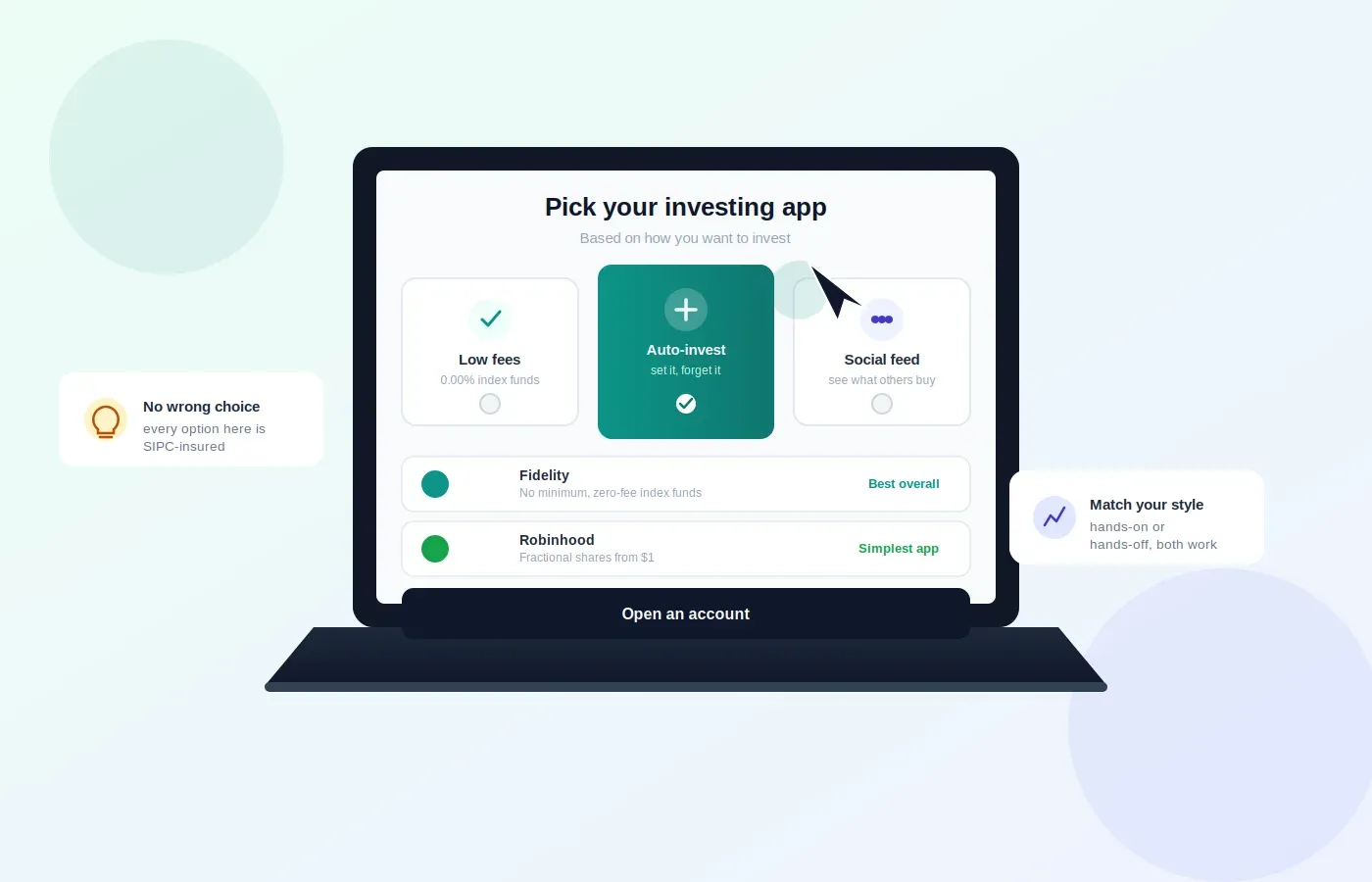
- If you want the lowest possible fees: Fidelity's zero-expense-ratio index funds are hard to beat, combined with no account minimum and strong support.
- If you want the simplest possible mobile experience: Robinhood remains the most straightforward app for buying and selling with minimal friction.
- If you want to learn while you invest: Charles Schwab's educational resources or Webull's paper trading both cater specifically to that goal.
- If you want to set it up once and forget it: Betterment or SoFi's automated investing both handle ongoing decisions for you.
- If you want to start without thinking about it at all: Acorns' round-up feature builds an investment habit passively, directly from spending you were already doing.
- If you specifically care about educational support: Charles Schwab's resources are built for exactly this, structured content that grows with you rather than assuming prior knowledge.
It is worth remembering that every platform on this list is SIPC-insured up to $500,000 in securities, and the differences between them are more about experience and features than fundamental safety. Picking any one of them and actually starting matters more than finding the theoretically perfect match.
It also helps to think about how your needs might change over the next few years, not just right now. Someone starting with Acorns today might outgrow it within a year once the habit is established and a more deliberate approach makes sense. That is a completely normal progression, not a sign the initial choice was wrong, most investors end up using more than one platform over time as their balance, confidence, and specific goals evolve.
Key Takeaways
- No single app is best for everyone, the right choice depends on whether you want direct control, full automation, or something in between.
- Fidelity and Robinhood lead for beginners wanting low fees and simplicity respectively.
- Betterment and Acorns suit beginners who want investing to happen automatically, with little to no ongoing input.
- Every platform reviewed charges $0 commission on stock and ETF trades, and carries no account minimum.
- All are SIPC-insured up to $500,000, the safety differences between them are minimal, the experience differences are what actually matter.
- It is common, and completely fine, to switch or add platforms over time, as your balance, confidence, and specific financial goals evolve beyond what your first choice was built for.
Conclusion
The right investment app is less about finding a hidden gem than it is about matching a platform's style, hands-on or hands-off, simple or feature-rich, to how you actually want to interact with your money. Any of the eight platforms above will get a first investment off the ground, and switching later, if a different platform ends up fitting better, is generally straightforward. The bigger risk is spending too long comparing options rather than opening an account and starting.
Whichever platform you land on, the account itself is really just the vehicle, what matters most for long-term results is what happens after you open it: choosing a diversified, low-cost fund, contributing consistently, and leaving the investment alone long enough for compounding to do the actual work.
For the full picture on getting started, see our complete investing for beginners guide.