
Introduction
$94,820. This is where
the price of Bitcoin was at the high for 2026 at mid-January. By February
onwards it had fallen to the mid-$60,000s and started to rise again to $77,000
by early September, marking a 30% change in either direction within a single
year. That's not some unusual blip. It's genuinely just how this asset has
behaved since it was created, and it's probably the single most important thing
to understand before deciding whether it belongs anywhere near a beginner's
financial plan.
This guide isn't trying
to sell you on crypto, and it isn't trying to talk you out of it either. Real,
legitimate use cases exist here, and early participants have made genuine
money. Plenty of others have lost significant amounts, sometimes everything,
often fast. Both of those are true simultaneously, and a guide worth reading
has to hold space for both instead of leaning hard toward hype or hard toward
dismissal.
It also helps to know
upfront that even seasoned financial professionals don't agree on this one.
Some advisors have gotten more comfortable recommending small allocations as
infrastructure, regulated exchanges, spot ETFs, has matured. Others stay openly
skeptical, pointing at the same volatility and lack of underlying cash flow
this guide walks through below. There's no settled professional consensus to
lean on here, which puts more weight on your own research and honest risk
assessment than it would for something more established, like stocks or bonds.
This article is part of
our larger investing for beginners
guide,
and it builds on the basics covered in what investing actually
means.
What is Cryptocurrency?
Basically,
cryptocurrency is a type of virtual currency that exists in an online network
called Blockchain and does not have any governmental or banking authority to
back it up, unlike conventional currencies. The first cryptocurrency was
Bitcoin, which was introduced in 2009 and holds the most extensive market
capitalization till today. On the other hand, Ethereum was the second
cryptocurrency and is based on the smart contracts, which offer an array of
applications beyond simple money transfer.
Here's the part that
trips people up coming from stocks: most cryptocurrencies don't represent
ownership in a company, a claim on earnings, or a legal right to anything
beyond the asset itself. Value comes almost entirely from what other buyers are
willing to pay for it, a fundamentally different foundation than a stock, whose
long-term value is at least theoretically anchored to a company's actual
profits and growth.
Thousands of
cryptocurrencies exist beyond Bitcoin and Ethereum, often lumped together as
"altcoins", ranging from established projects with years of real
development behind them to speculative tokens that amount to little more than a
website and a social media following. As of 2026, regulators have started
sorting some of this out more formally. A joint SEC and CFTC interpretation has
named 16 specific digital assets, including several major, widely traded
tokens, as digital commodities rather than securities. The broader framework
covering the thousands of smaller tokens out there, though, remains
considerably less settled.
How Cryptocurrency Actually Works
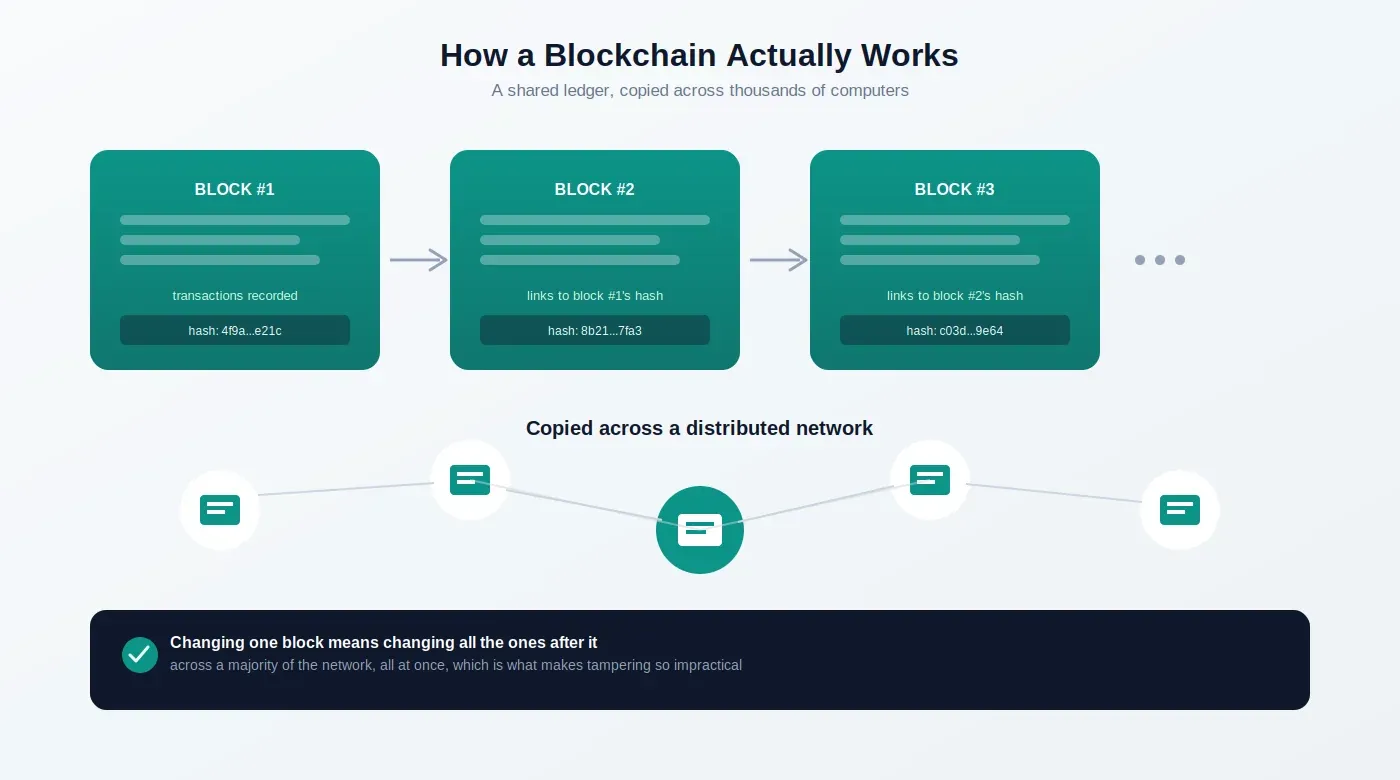
A blockchain is
essentially a shared, constantly updating digital ledger, maintained across a
distributed network of computers instead of sitting on one central server
somewhere. Every transaction is added to the "block" which is
connected cryptographically to the previous block, creating a chain that can
hardly be tampered with once it is done; tampering with the chain would require
changing all following blocks simultaneously within the majority of the
network.
●
Mining and verification: some cryptocurrencies such as Bitcoin rely
on mining process in which computers compete for the right to verify the
transactions and add new blocks in return for the reward - newly minted coins.
The others such as Ethereum since 2022 use proof-of-stake mechanism, which
consumes significantly less energy.
●
Wallets: a crypto wallet keeps your cryptographic keys necessary for
accessing your cryptocurrency balance; there are hosted wallets on exchanges
and self-hosted wallets where you keep the keys by yourself.
●
Decentralization: The Bitcoin or Ethereum networks are not controlled by any
corporation or government. Transactions get verified collectively by the
network's own participants, which is both the core appeal here and part of why
regulation and consumer protection get so much more complicated than with
traditional financial assets.
Ethereum's 2022 switch
from mining to proof-of-stake is worth understanding a bit further, it's a good
illustration of how differently various cryptocurrencies actually function
under the hood, despite so often getting lumped together as one uniform
category. Under proof-of-stake, validators lock up, or "stake", a
quantity of the cryptocurrency itself as collateral, and get chosen to validate
transactions partly based on how much they've staked. That uses dramatically
less energy than Bitcoin's mining setup, but it also means the network's
security rests on a different set of economic incentives entirely, worth
knowing since "how crypto works" genuinely depends on which specific
cryptocurrency you're actually talking about.
The Real Risks of Cryptocurrency
This section matters
more than any other one here. Worth reading slowly instead of skimming past.
●
Extreme volatility: Bitcoin swinging 20% to 30% within a few months isn't some
rare event, it's a recurring feature of the asset class, well beyond what a
diversified stock index fund typically experiences.
●
No underlying earnings or cash flow: unlike a stock, there's
no company profit or dividend backing the price here. Value comes almost
entirely from supply, demand, and market sentiment, which makes it genuinely
hard to pin down what a "fair" price even means.
●
Regulatory uncertainty: the landscape has been actively shifting
throughout 2026, with the SEC proposing new frameworks and the CLARITY Act
still stuck in Congress, meant to formally split oversight between the SEC and
CFTC. Rules in place today could change meaningfully with little warning.
●
Security and custody risk: exchange failures, hacks, and lost private
keys have led to permanent, unrecoverable losses throughout crypto's history, a
risk with no real equivalent in a traditional, insured brokerage account.
●
Emotional and behavioral risk: extreme swings tend to
trigger stronger emotional reactions than steadier assets do. Buying during a
rally out of excitement, selling during a crash out of panic, it's a
well-documented pattern, and it erodes returns for a lot of crypto investors
specifically.
●
Lack of SIPC protection: crypto sitting on an exchange generally
isn't covered by SIPC insurance the way stocks and cash in a traditional
brokerage account are. An exchange failure could mean a total, permanent loss.
None of this makes
cryptocurrency inherently a scam or worthless. It means the risk profile here
is genuinely different from, and generally higher than, a diversified stock or
bond portfolio, and it deserves evaluation on those terms rather than a direct
comparison to a traditional investment.
Tax treatment is
another detail that catches beginners off guard. The IRS treats
cryptocurrencies as property, not as currency; thus, the sale of any
cryptocurrency making a profit or the exchange of a cryptocurrency into another
cryptocurrency is taxed. The transaction of swapping Bitcoin into Ethereum is
not “just a trade” but rather a sale of an asset and then buying another asset.
How long you held it before selling matters too, longer holding periods
generally get taxed more favorably than quick trades, worth knowing before
trading frequently.
Should Beginners Invest in Cryptocurrency?
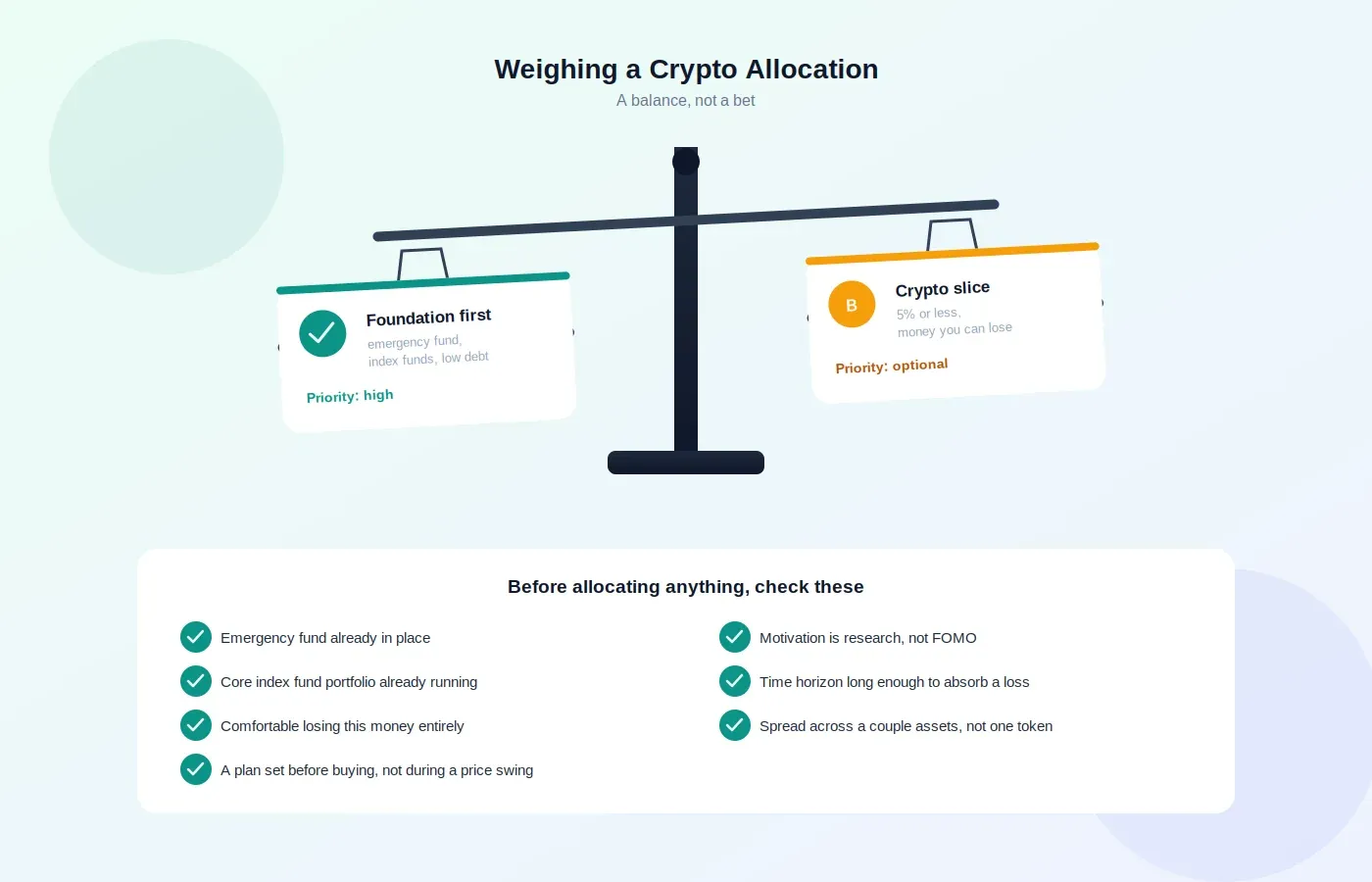
There is no universal
solution, but several honest factors may point us towards making the right
decision.
●
Start with the fundamentals: the emergency fund, manageable debt load, and basic portfolio of
diversified index funds are likely to come before any crypto investments, which
need to be seen as speculative investments, not the core of your portfolio.
●
Even if you choose to invest, do it cautiously: those who advise on cryptocurrency investing suggest keeping your
investment below 5% of the entire portfolio as a general rule.
●
Invest only the money you can afford to lose entirely: given the level of risk involved, the rule will apply to cryptocurrency
even more strictly than to any stock investment.
●
Diversify within a crypto allocation too, if you make one: spreading a small
allocation across a couple of established, larger-cap assets instead of concentrating
it in a single small token reduces, though doesn't eliminate, some of that
concentrated risk.
●
Realize why you are really doing it: investing when you have done your research on the technology and you can
handle the risks is entirely different from investing out of the fear of
missing the boat. This usually goes hand-in-hand with buying when at a peak and
selling during the trough.
● Set up a plan prior to
investing, and not while already involved in the process: planning in advance as to how much money to invest and for how long makes
it easier than making decisions during the middle of the action.
It is worth noting that the increasing participation by institutions,
with Bitcoin and Ethereum spot ETFs being traded on the major stock exchanges
and with custodians keeping crypt-related reserves, has made cryptocurrencies
more available and possibly more mainstream than they were previously. Accessible isn't the
same thing as less risky, though, and the price swings throughout 2026 make
that distinction pretty clear.
It's also worth
thinking about your actual time horizon, honestly. Someone with decades before
retirement and a diversified core portfolio already in place has a lot more
room to absorb a total loss on a small crypto position than someone investing
money they need for a near-term goal. This is really the same principle running
through every other decision in this guide, match the risk to the real timeline
and the real ability to absorb a loss, cryptocurrency just applies that
principle with a stricter bar given how severe the swings have proven to be.
Platforms for Buying Cryptocurrency
For newbies that choose
that small investment is reasonable, there are several types of platforms that
they should be aware of.
●
Crypto-only exchanges: such platforms
as Coinbase are dedicated to cryptocurrencies only and provide a variety of
coins to trade.
●
Mainstream brokerages: platforms like Fidelity and Robinhood,
already covered in our investment apps guide, now offer crypto trading right
alongside traditional stocks and funds, convenient if you want everything under
one login.
●
Self-custody wallets: for investors who'd rather control their
holdings directly than trust an exchange to hold them, a self-custody wallet
keeps private keys entirely in your own hands, along with the added
responsibility that comes with it, lose access to those keys and you generally
lose access to the funds permanently.
●
Spot ETFs: for investors who want price exposure without directly
holding or managing a wallet, spot Bitcoin and Ethereum ETFs now trade on
national exchanges just like a stock, held through a regular brokerage account.
Spot ETFs deserve a bit
more explanation, they solve a genuinely practical problem for a lot of
beginners. Instead of setting up a separate crypto wallet, managing private
keys, and learning an unfamiliar interface, a spot ETF lets you gain price
exposure to Bitcoin or Ethereum through the exact same brokerage account you're
already using for stocks and index funds. That does mean giving up direct
ownership of the underlying asset and any use cases that require actually
holding crypto, but for beginners whose only real goal is price exposure rather
than direct use of the technology, it strips out a meaningful chunk of the
operational complexity.
Whichever route you
pick, look specifically at security track record, insurance on cash balances
(not the crypto itself), and fee structure, which varies considerably more
between crypto platforms than it does between traditional stock brokerages.
Worth knowing too, even
for beginners not planning to buy crypto directly: Many mortgage companies are
now taking cryptocurrencies as collateral in traditional loans, while some
credit cards pay back rewards in the form of cryptocurrencies for normal purchases
made using them. These two are quite different from each other, with lower
risks attached to them than simply buying and holding cryptocurrencies, and
hence should be considered as something else rather than a risky asset like all
the other cryptocurrencies.
Key Takeaways
●
Cryptocurrency is actually highly volatile. In 2026 itself,
Bitcoin made about a 30% swing in each direction.
●
In contrast to stocks, there is no underlying income or cash
flow backing cryptocurrencies the value comes from the supply/demand.
●
Regulations themselves are constantly changing, with key
regulatory bodies having big regulations stalled in Congress/the SEC as of
2026.
●
If you're considering an allocation, many advisors suggest 5%
or less of a total portfolio, treated as speculative, not foundational.
●
Only invest money you could genuinely afford to lose
entirely, given the combination of volatility, regulatory uncertainty, and
limited traditional protections.
Conclusion
Cryptocurrency sits in
a genuinely different risk category than the diversified index funds forming
the core of most beginner portfolios covered elsewhere in this guide. It's
neither the guaranteed path to wealth some promotional content makes it sound
like, nor an inherently worthless technology. It's a highly volatile,
still-evolving asset class that deserves honest evaluation rather than hype or
dismissal. For most beginners, building a
solid foundation of emergency savings and diversified investments first, then
considering a small, deliberate allocation only with money you can afford to
lose, is the more balanced path. For the
full picture on building a diversified portfolio before considering higher-risk
assets, read our complete investing for beginner’s guide.