
Introduction
A big down payment. A mortgage. Years
spent learning how to actually be a landlord before any of it pays off. That's
the reputation real estate investing carries, and it's not wrong, exactly, just
badly incomplete. REITs, real estate investment trusts, delivered a 14.4%
year-to-date total return through much of 2026 according to Nareit data. Bought
through an ordinary brokerage account. For the price of one share. No property,
no tenants, no mortgage anywhere in sight.
This guide walks through the actual ways
beginners get exposure to real estate in 2026, starting with the lowest-effort
option, REITs, working through direct rental ownership, and landing on house
hacking, a middle-ground approach that's grown considerably in popularity
lately.
Real estate pulls in a lot of investors
for reasons that go beyond raw returns, too. It's tangible, something you can
actually point to, unlike a stock certificate representing an abstract claim on
some company. There's a genuine diversification angle as well, real estate
values don't always move in lockstep with the broader stock market, and during
stretches of high inflation specifically, physical property and the income it
throws off have historically held up reasonably well next to some other asset
classes.
This article is part of our larger investing for beginners
guide, and it builds on
the portfolio concepts covered in how to build an investment
portfolio.
The Main Ways to Invest in Real Estate
Real estate investing isn't a single
approach, it's a genuine spectrum running from completely passive to fully
hands-on, each point on that spectrum trading off effort, capital, and control
differently.
●
REITs:
these are public
companies that deal with income-generating real estates, just like ordinary
stocks. They provide the easiest and most effortless way of getting into real
estate on the list.
●
Rental
property: this involves
owning physical property and leasing it to tenants. It involves the most
responsibility and offers the greatest potential for leverage. It requires
capital as well as management.
●
House
hacking: This is buying
property, living in one part of the property and renting out the other part.
●
Real
estate crowdfunding: platforms
pooling money from many investors into specific projects or properties. More
direct ownership than a REIT, with less money needed than a full purchase, but
generally lower liquidity.
●
Vacation
home or vacation rental: a
property used both for personal use and rental income. A hybrid with its own
tax rules and management quirks, distinct from a standard long-term rental.
Where someone actually lands on this
spectrum usually comes down to three practical questions: how much capital is
there to start with, how much time can realistically go toward ongoing
management, and how much does control matter relative to just wanting
convenience. Someone with limited savings, a demanding job, and zero interest in
fielding a 10pm maintenance call is generally better matched to REITs. Someone
with more capital, more available time, and a genuine interest in hands-on
property management might reasonably lean toward direct ownership instead.
Neither answer beats the other, they just serve different situations.
REITs: The Easiest Entry Point
The REIT collects money from a wide
number of investors to purchase and manage rental properties, apartment blocks,
office complexes, storage facilities, data centers, malls, and pays most of it
back to the stockholders. By law, REITs have to distribute at least 90% of
taxable income as dividends, which is exactly why they're known for paying
meaningfully higher dividend yields than the average stock, commonly averaging
around 4% as of 2026.
●
No
property management required: professional
teams run the show, an investor just owns shares and collects dividends, none
of the landlord responsibilities that come with direct ownership.
●
Very
liquid: listed REITs
are tradable on any trading day, compared to actual physical properties which
may take months before they are sold.
●
Diversification
by type of real estate: one
can own hundreds of properties in several industries and locations
simultaneously through an individual REIT or a REIT index.
●
True
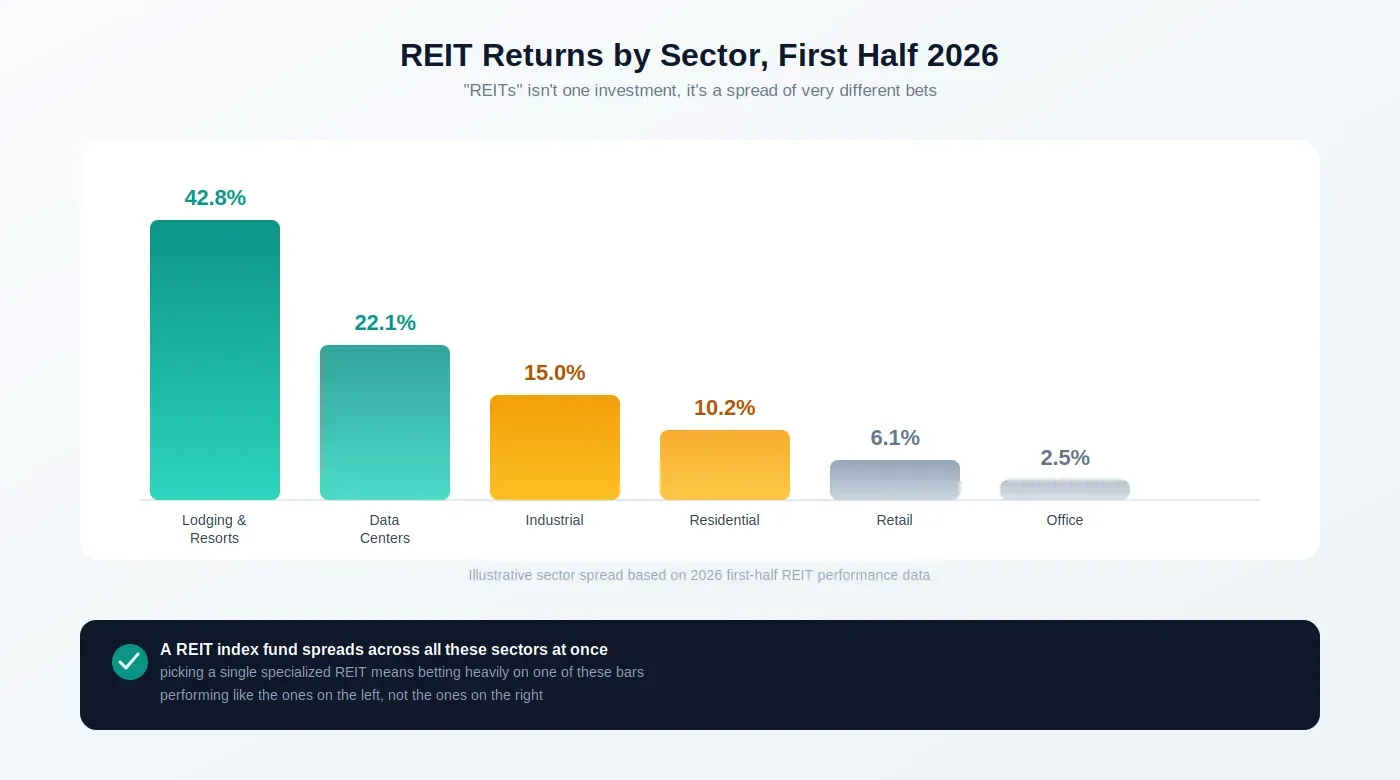
good performance recently: The
FTSE Nareit All Equity Index generated a return of 14.4% year to date through
most of 2026, following only a 2.3% return for REITs in 2025. Worth knowing how
much REIT performance swings by sector and by year. Lodging and resort REITs
led with a 42.8% return in the first half of 2026 alone, while some other
sectors returned less than 3% over that same stretch. That gap is a good
reminder that "REITs" is a broad category, not one uniform
investment, a REIT index fund spreading exposure across many sectors smooths
out a lot of that variation compared to picking a single specialized REIT and
hoping.
Financial research commonly points
toward a 5% to 15% portfolio allocation for investors after the diversification
benefit specifically, since real estate has historically shown a relatively low
correlation with stocks and bonds, meaning it doesn't always move in the same
direction at the same time. That's a genuine diversification advantage, not
just a nice-sounding phrase.
It also helps to know what kind of REIT
you're actually buying, since the category covers meaningfully different
business models under one label. Equity REITs, the most common type, directly
own and operate physical properties, earning income primarily through rent.
Mortgage REITs work completely differently, they don't own physical property at
all, instead financing real estate by holding mortgages and mortgage-backed
securities, earning income off the interest rate spread. As of mid-2026 this
distinction has mattered quite a bit, equity REITs posted strong gains while
mortgage REITs landed a narrow overall loss for the year, a good example of how
two categories sharing the same "REIT" label can behave completely
differently depending on where interest rates sit.
Rental Property: More Control, More Responsibility
Owning a physical rental property is
still the most hands-on way into real estate, and it comes with a meaningfully
different risk and effort profile than a REIT does.
●
Demands
a substantial outlay of money: in the beginning in the form of a down payment,
which can be around 15% to 25% for an investment property, along with other
closing costs and a reserve fund for future repairs. This is definitely a
higher initial expense than investing in a REIT.
●
Provides
an element of leverage: An
investor is able to control a high-value investment with the help of a low down
payment through a mortgage.
●
Involves
the need for continuous: management activities such as tenant selection,
maintenance, collecting the rent, vacancies, etc.
●
Less
liquid: selling a
physical property typically takes weeks to months. Selling a REIT share takes
seconds, during market hours.
Rental property can deliver strong
returns for investors willing to put in the research and the ongoing effort,
but it's a fundamentally different commitment than buying a REIT or an index
fund, closer to running a small business than to passive investing.
Worth running the numbers honestly
before committing to this path. The typical rookie error here is basing the
computation of the expected return on only the difference between the rent
earned and the mortgage payments without taking into consideration things like
taxes, insurance, maintenance expenses, the likelihood of there being some
period of vacancy, and the eventual expense of repairing something significant
like a roof or an HVAC unit. A better way to come up with your estimate would
be to set aside a portion of the rental income, which is commonly about 1% of
the value of the property per year, for these expenses independent of the
mortgage payment.
House Hacking: A Middle-Ground Approach
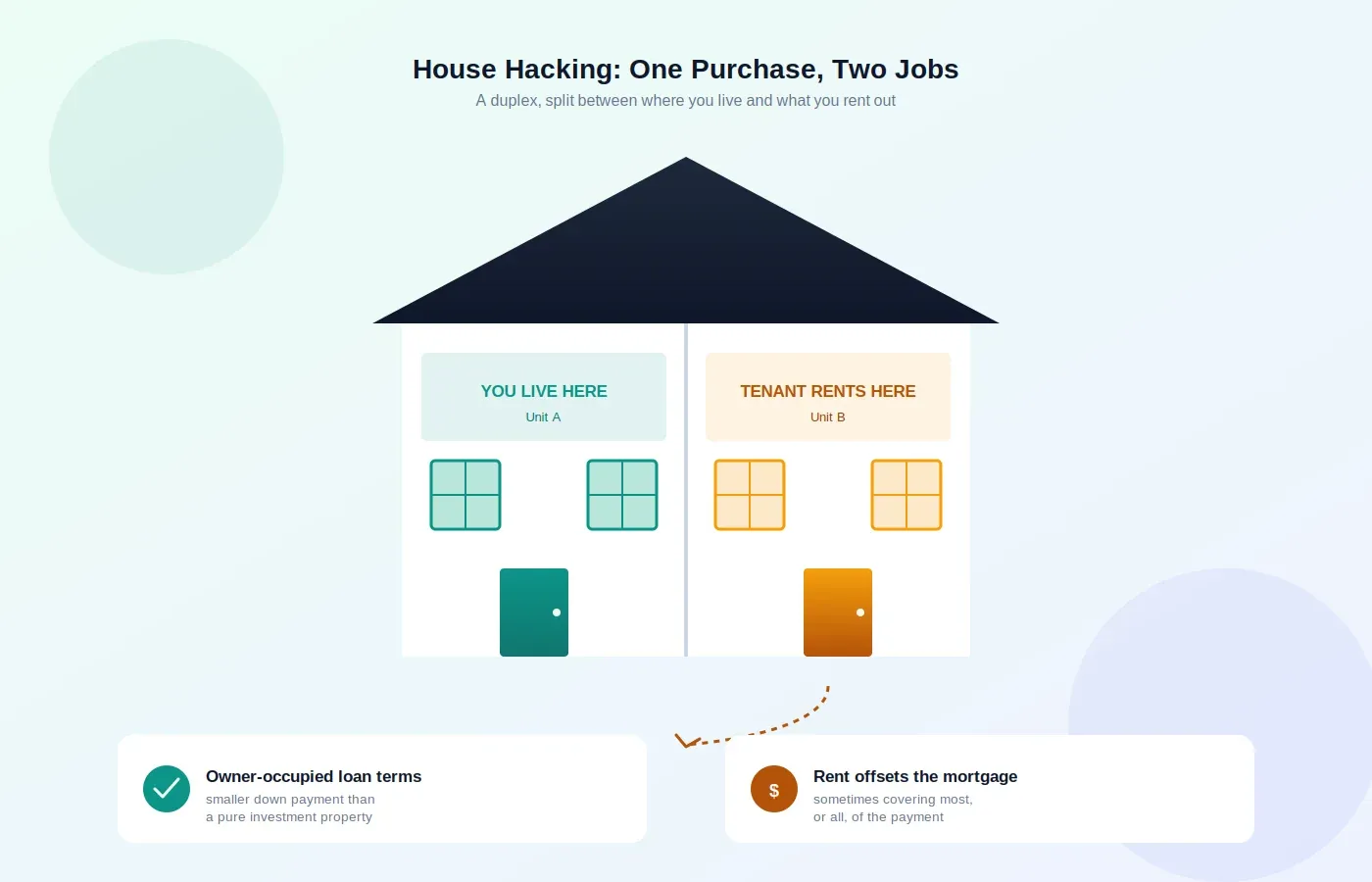
House hacking is a method by which a
person buys a property that usually consists of either a duplex, a triplex, or
a fourplex; lives in one of the units, and rents out the other units. This
concept has become very popular since it accomplishes both the objectives
simultaneously through a single transaction.
●
Owner-occupied
financing: because the
buyer lives in one unit, the purchase often qualifies for owner-occupied
mortgage terms, which typically need a smaller down payment than a pure
investment property loan.
●
Rental
income offsets the mortgage: rent
collected from the other units can cover a big chunk, sometimes all, of the
monthly mortgage payment, meaningfully cutting the buyer's own housing cost.
●
Hands-on
landlord experience with lower stakes: living on-site makes managing tenants and handling
maintenance a lot more direct, a practical way to actually learn property
management before scaling up to a bigger portfolio.
●
Still
requires real capital and effort: a
down payment, ongoing maintenance, and dealing directly with tenants living in
the same building are all real tradeoffs against the fully passive nature of a
REIT.
The trend of house hacking has grown
very popular in young, first time home buyers because of the fact that it has
managed to solve a problem of affordability which has become more pressing
recently. It takes into consideration not only the aspect of living but the aspect
of earning from buying a house as well. That doesn't erase the real estate
risks covered throughout this guide, vacancy, maintenance costs, and tenant
management still apply, it just means the property is doing double duty instead
of being purely a housing expense.
Financing a house hack typically runs
through the same mortgage process as any home purchase, worth understanding in
full before moving forward, our complete loan guide covers mortgage basics in
more depth.
Comparing the Options
●
Want
the most passive option? REITs,
bought through a regular brokerage account, no property management, same-day
liquidity.
●
Want
to reduce your own housing costs while investing? The concept of house hacking works out
well, particularly for someone purchasing his/her very first property.
●
Want
maximum control and ready for active management? Direct rental property ownership offers
the most potential leverage and control, at the cost of real time and real
capital.
●
Want
real estate exposure without a large upfront commitment? REIT index funds or real estate
crowdfunding platforms sit in the middle, between full passivity and direct
ownership.
None of these are mutually exclusive.
Plenty of investors start with REITs inside a diversified portfolio, and only
look at direct property ownership or house hacking later, once they've got more
capital, more stability, and a clearer sense of whether hands-on property
management is actually something they want to take on.
Worth revisiting this decision
periodically, too, rather than treating it as permanent. Someone starting with
REITs in their twenties might find house hacking makes sense at the point of
their first home purchase, and might consider direct rental property ownership
only years later, once income, savings, and risk tolerance have grown alongside
the rest of their financial picture. The process of investment in real estate,
just like other aspects of personal finance management, appears to be more
successful when considered an evolving approach rather than one-time choice.
Common Real Estate Investing Mistakes
●
Underestimation
of costs associated with upkeep. There are many hidden costs associated with
maintenance, vacancy, taxes, and insurance that eat into profits far more than
people realize.
●
Over-leveraging
on a single property. A large mortgage on one property concentrates risk
heavily, unlike a diversified REIT fund spread across hundreds of properties
and sectors.
●
Writing
off REITs as "not real" real estate investing. REITs own real,
physical properties just like a direct owner does, they just structure
ownership differently, dismissing them outright means overlooking a genuinely
strong, liquid option.
●
Not
comparing equity and mortgage REITs before buying. The two categories behave
quite differently depending on interest rate conditions, treating them as
interchangeable can lead to results you weren't expecting.
●
Underestimating
the time commitment of direct ownership. Tenant issues and maintenance calls
don't follow a convenient schedule, worth thinking through honestly if you're
already juggling a full-time job.
●
Buying
on emotion instead of the numbers. Falling for a property's aesthetics rather
than its actual rental income potential and expense ratio is a common way
beginner rental investments end up underperforming.
For more common pitfalls across
investing generally, see our guide on investing mistakes beginners make.
Key Takeaways
●
REITs
provide the least barrier entry into real estate investments, providing an
annual return of 14.4% until the end of 2026 without the need to manage any
property.
●
REITs
need to pay out at least 90% of their taxable incomes as dividends, which is
why they usually have higher dividend yields than the average stock.
●
The
rental property provides more control, but requires substantial capital and
effort from the investor.
●
House
hacking offers a practical middle ground, using rental income from other units
to offset a buyer's own mortgage payment.
●
A
5% to 15% portfolio allocation to REITs is the range that comes up most often for
investors after real estate diversification specifically.
Conclusion
Real estate investing doesn't force a
choice between taking on a huge mortgage and staying out of the space entirely.
REITs offer genuine, liquid exposure to real, income-producing property through
an ordinary brokerage account, while house hacking and direct rental ownership
offer more control for investors ready to take on the extra capital and effort
those paths require. Most beginners are well served starting with REITs as part
of a diversified portfolio, and only considering the more hands-on approaches
once the fundamentals, and a genuine appetite for active management, are
actually in place.
For the full picture on building a
diversified portfolio, read our complete investing for
beginners guide.