Introduction
Opening a bank account
sounds like it should be a hassle it's your money, after all but in practice
it's one of the easier errands on your list. Most online applications take less
than ten minutes, and the requirements barely change from one bank to the next,
because they come from federal law, not bank policy.
Below, you'll find
exactly which documents to bring, the step-by-step process from application to
first deposit, what ChexSystems actually checks, and what your options look
like if you've run into banking trouble before. None of it requires special
prep just a few documents most people already have on hand.
And it doesn't matter
whether this is your first account or you’re fifth the process is the same
either way. What changes isn't the paperwork you need, it's whether a
particular bank decides to look into your banking history as part of approving
you. More on that later.
This piece is part of
our full guide to banking in 2026, and if you haven't settled
on a bank yet, our best online banks of 2026 roundup is a good
companion read.
Why the Requirements Are So Consistent
It can feel like every
bank made up its own rules, but that's not really what's happening. The core
requirements come from federal identity verification law, not individual bank
preference. Under the Customer Identification Program rules tied to the Bank
Secrecy Act, every U.S. financial institution has to verify who you are before
opening an account which is exactly why you'll see the same handful of
documents requested everywhere you go.
That consistency
actually helps you. Learn what the law requires once, and you'll know what to
expect from any bank big national chain, small local credit union, or
online-only. The documents stay the same; what varies is how fast each bank
processes them. Some verify your identity instantly; others take a day or two.
A few situations, like joint accounts or accounts for a minor, call for extra
paperwork on top of the basics.
What You Need to Open a Bank Account
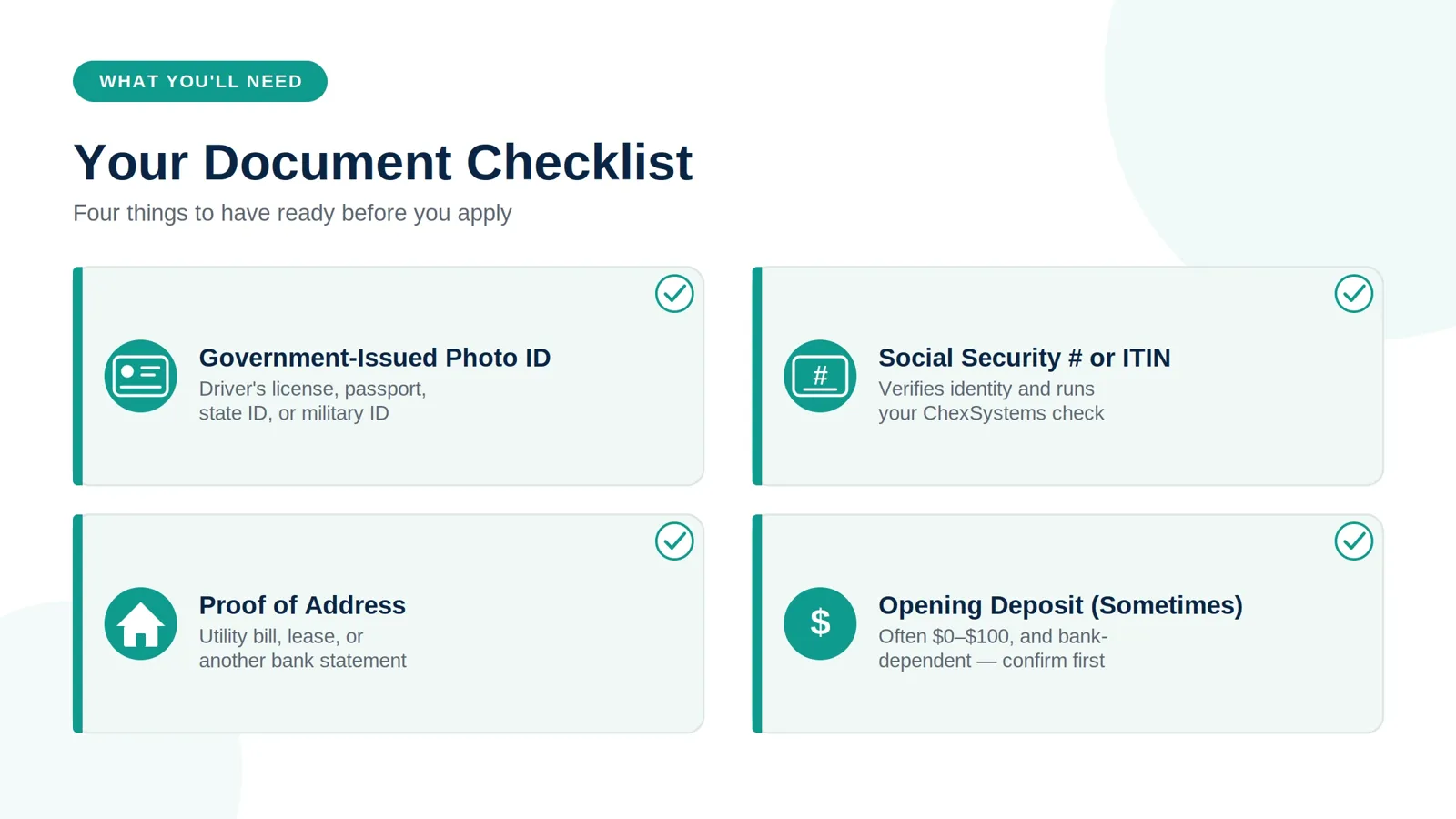
•
A government photo ID: A driving license, state ID card, US
passport, or military ID will suffice. Non-US citizens may submit their foreign
passport or consular ID.
•
Your Social Security number or ITIN: This confirms your
identity, enables the bank to report any interest earned to the IRS, and is
also used to conduct a ChexSystems background check. In case you lack a Social
Security number, you can submit your Individual Taxpayer ID.
•
Proof of address: a recent utility bill, lease agreement, or another bank
statement in your name is usually fine. This one trips people up if they're new
to an area and don't have bills in their name yet.
•
An opening deposit, sometimes: plenty of accounts
don't require one at all, but check your bank's specific policy and have a
funding method ready regardless: cash, a check, or a transfer from an existing
account.
When a minimum opening
deposit is required, it's usually modest somewhere in the $25 to $100 range and
it's a different thing from any ongoing minimum balance the account might
require later. People mix these two up fairly often. An account with no opening
deposit requirement can still hit you with a fee down the line if your balance
dips below a separate threshold, so it's worth actually reading the account
terms instead of assuming no requirement at signup means no requirement ever.
If you're opening a
joint account or one for a minor, have your co-applicant's documents ready to
sort this out beforehand rather than finding out you're missing something at
the branch.
Proof of address
probably deserves its own callout, since it's the document people forget most
often. A recent utility bill, a lease, mail from a government agency, or a
statement from another bank in your name will typically work. The real snag
comes up for anyone new to an area who hasn't had time to get bills in their
own name yet recent movers, students, and new arrivals run into this
constantly. In those cases, some banks will accept a landlord letter, an employer
letter confirming your address, or, if you're relocating from abroad, proof of
address from your home country while your domestic account gets set up.
Step-by-Step: Opening Your Account
Step 1: Choose the Right Bank and Account Type
Choose what is important
to you a traditional bank, a credit union, or an internet-only bank; as well as
whether you require a checking account, a savings account, or both. The
Checking vs Savings Accounts guide, along with the Banks vs Credit Unions vs
Online Banks guide, will assist you in your decision.
Step 2: Gather Your Documents
Organize your documents
like photo ID, Social Security number or ITIN, and proof of address prior to
applying. Being organized means that you will not be left midway with a need
for a repeat visit to a branch office.
Step 3: Apply Online or in Person
Most banks let you
apply entirely online in ten to fifteen minutes now. Some larger banks, Chase
and Wells Fargo among them, offer eligibility-based online opening, while
smaller or newer banks might still want you in a branch for certain account
types.
Step 4: Verify Your Identity
The bank verifies your
identity using whatever documents you provided sometimes instantly if you
applied online, sometimes after a short review of a day or two. This is the
step that satisfies the federal Know Your Customer requirement mentioned
earlier.
In case you have
applied online, there is an automatic process where the bank will scan the
image of the identification document that you have provided in the online
application and may even ask you to take a picture to check if the details
match. Very few applicants are selected for manual verification, where a human
verifies the documents instead of an algorithm. This just delays the process by
one or two days.
Step 5: Fund the Account
Transfer money in from
an existing account, deposit cash or a check in person, or mail a check if
you're opening remotely. If the account has no minimum deposit requirement, you
can even skip this step for now and fund it once a paycheck or transfer comes
through.
Step 6: Set Up Direct Deposit and Online Access
Link your paycheck to
the new account and get mobile and online banking set up. Most banks hand your
account and routing numbers right after approval, so you can often set up
direct deposit the same day.
Check with your
employer's payroll team on how long the switch actually takes on their end it
varies by company and sometimes takes a full pay cycle. Keep your old account
open and funded until that first deposit actually lands in the new one, just so
a paycheck doesn't end up heading toward a closed or empty account
mid-transition.
Understanding ChexSystems
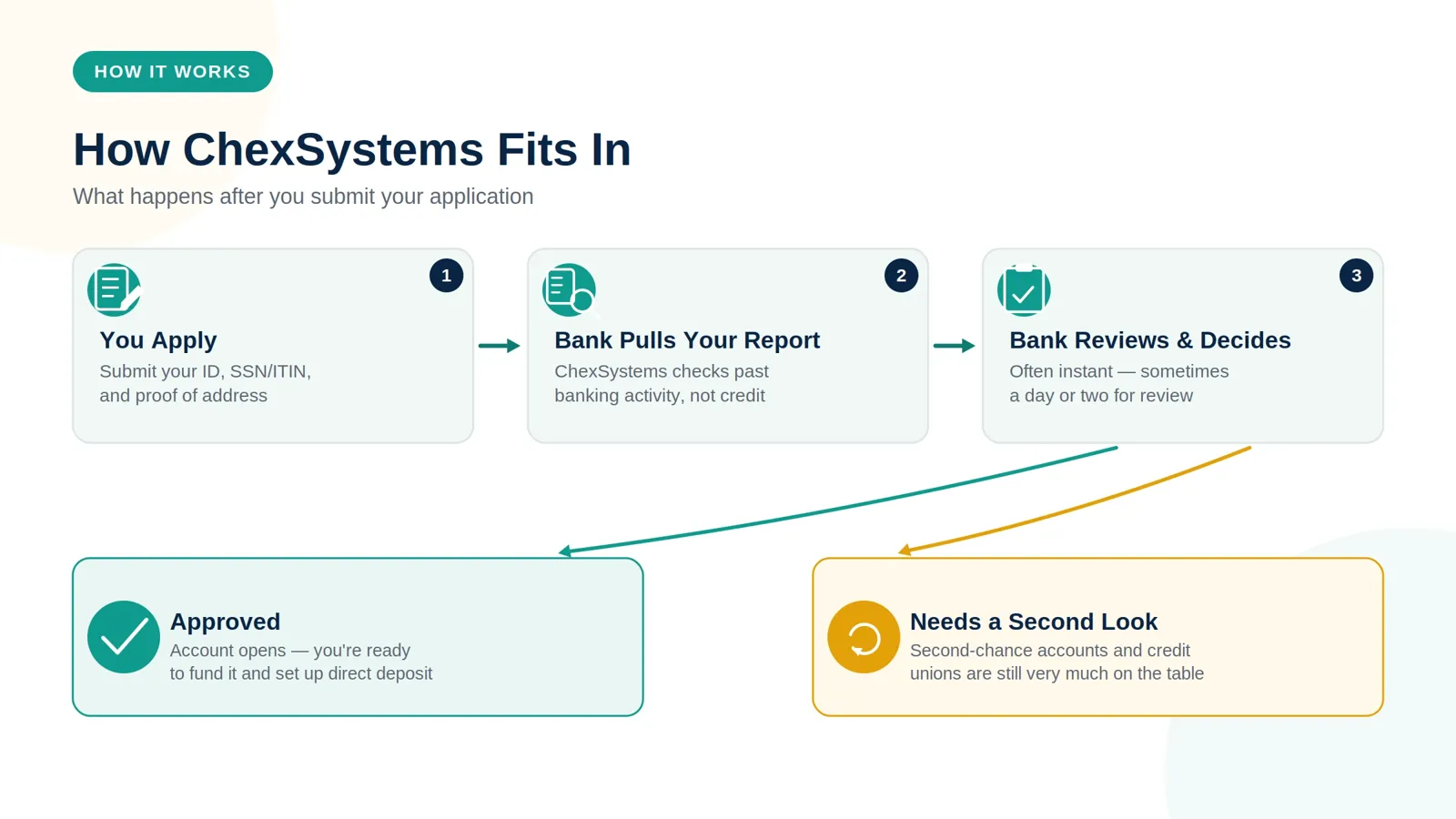
Most checking and
savings accounts skip the credit check, but many banks still pull a ChexSystems
report a consumer reporting agency that tracks your banking activity rather
than your credit. A negative ChexSystems record usually comes down to unpaid
overdraft fees, an account closed with a negative balance, or suspected fraud
on a past account.
•
Your report is free to check: you get one free
ChexSystems report a year at chexsystems.com. The request will take
approximately ten minutes to complete on-line and the report will come through
the mail within five to seven business days.
•
The right to dispute: if there is an error on the report, you
have the right to challenge it directly with ChexSystems and they have up to 30
days to investigate and correct/remove it if it is indeed an error.
•
Negative marks don't stick around forever: most entries fall off
after five years, though settling an unpaid balance directly with the original
bank can sometimes clear things up faster.
•
Banks have to explain a denial: if a ChexSystems
report is the reason you got turned down, the bank is legally required to tell
you why, so you're not left guessing what to fix.
It helps to know
exactly what gets someone flagged, since the list is narrower than most people
assume. A low balance, a single bounced check that got sorted out, or normal
account activity generally won't land you on the report. What it does track is
unresolved trouble an account the bank closed over an unpaid negative balance,
suspected fraud, or a pattern of overdrafts that never got covered. A single
overdraft you pay back, followed by closing the account voluntarily in good
standing, usually doesn't get flagged at all. The fear around ChexSystems tends
to outpace what it actually reports.
Options If You Have Banking Issues in Your Past
A negative ChexSystems
history doesn't lock you out of banking for good you've got real options.
•
Second-chance accounts: built for people rebuilding their banking
history. You still get a debit card, direct deposit, and online bill pay,
though fees can run higher and features can be more limited than a standard
account. Use one responsibly for a while and you can often upgrade to a
standard account.
•
Credit unions: plenty of them skip ChexSystems entirely when deciding on
new accounts. Check what's available locally before assuming you'll be turned
down.
The National Credit
Union Administration's website is a solid place to start looking for credit
unions near your membership rules have loosened up at a lot of them lately, and
sometimes joining is as simple as a small one-time deposit into a share
account.
•
Banks built around financial inclusion: Chime and Varo among
them explicitly skip ChexSystems, focusing more on your current income and
identity than your banking past.
•
Prepaid cards as a bridge some prepaid card programs lead toward a
traditional account, letting you show a few months of responsible use without
needing ChexSystems approval first.
None of this should
feel like settling. Second-chance accounts and inclusion-focused banks still
give you a debit card, direct deposit, mobile banking, and online bill pay the
stuff you actually use day to day. The tradeoffs are usually a monthly fee
where a standard account might be free, or a few missing premium features, and
that's a small price next to just having a working account again. A few months
of avoiding overdrafts and keeping things in good standing is often all it
takes to qualify for an upgrade, or for approval somewhere else entirely.
Common Mistakes When Opening an Account
Showing up without proof of address: this is the document
people forget most, especially if you pay bills electronically and don't have a
paper statement lying around.
Assuming one denial
rules out every bank: credit unions and inclusion-focused banks approve plenty of
applicants that a big traditional bank would turn away automatically.
Not checking the
minimum deposit requirement beforehand: showing up without a funding method ready
can stall what should've been a quick application.
Skipping your free
annual ChexSystems check: knowing what's on your report before you apply means no
surprises, and gives you time to dispute real errors first.
Giving up after one
denial:
getting turned down at one bank doesn't mean you'll get turned down everywhere.
Different banks weigh ChexSystems differently, and some don't check it at all.
Key Takeaways
The core requirements come from federal law: a government-issued
photo ID, an SSN or ITIN, and proof of address and they're consistent across
nearly every bank and credit union.
Most online
applications take ten to fifteen minutes: and identity verification is sometimes
instant.
ChexSystems, not a
credit checks:
is what most banks actually look at it tracks banking activity like unpaid
overdrafts, not credit history.
You can pull a free
ChexSystems report once a year: and disputed errors get a 30-day investigation window.
Second-chance accounts, credit unions, and
inclusion-focused banks: all offer a real way forward if your banking history isn't
clean.
Conclusion
Opening a bank account
really is one of the simpler financial tasks out there, as long as you've got
the right documents ready. For most people, it comes down to a photo ID, a
Social Security number, proof of address, and about ten minutes online. And if
your banking history is complicating things, second-chance accounts, credit
unions, and inclusion-focused banks all offer a real way back in none of it
permanent, none of it requiring much more than a bit of research to find what fits.
For the bigger picture
on banking fundamentals, check out our complete guide to banking in 2026.