Introduction
59% less. That's how much cheaper the
average online checking account runs compared to its branch based counterpart,
according to a WalletHub analysis. The difference in savings accounts interest
rate is even more pronounced; the country's average APY being 0.38% while some
of the best online banks' interest rates are above 4%. Online banking has
stealthily become the default mode of banking for most people especially those
who rarely make physical deposits and don't need to see a banker. This guide
reviews the online banks that consistently rank at the top in 2026, looking at
what each one actually does well rather than just listing rates and calling it
a day. SoFi won NerdWallet's annual award for best overall bank in 2026, while
Chime took best overall checking account, which gives a decent sense of where
the competition currently stands. Still, the right pick genuinely depends on
how you actually bank, not just who won an award.
Worth knowing upfront: there's no
requirement to move everything to a single institution. Plenty of people keep a
checking account at one bank and savings at another, capturing the best
features of each without fully switching either one. The reviews below are
written with that flexibility in mind rather than assuming you need one bank to
do everything.
This guide is part of our larger complete guide to banking in 2026, and it
builds on the account basics covered in checking vs. savings accounts.
Our Methodology
We focused on the features that actually
affect what a bank costs and how usable it is day to day, rather than ranking
purely by advertised APY. That meant weighing monthly fees and minimum balance
requirements, the size and accessibility of the ATM network, whether the
account earns meaningful interest, overdraft policy, and the overall quality of
the mobile app, which for an online bank is genuinely the entire branch
experience rolled into one.
We also gave weight to whether an
institution is an actual bank or a fintech company partnering with a bank
behind the scenes, since that distinction affects how FDIC insurance works and
what products are available. Both models can be perfectly safe, but it's worth
knowing which one you're dealing with rather than just assuming.
Rates and bonus offers on any banking
platform can shift with little notice, particularly as the Federal Reserve
adjusts its benchmark rate. The figures throughout this guide reflect rates and
offers available as of September 2026, and it's always worth confirming current
terms directly on a bank's own site before opening an account, especially for
anything involving a sign up bonus with specific qualifying requirements
attached.
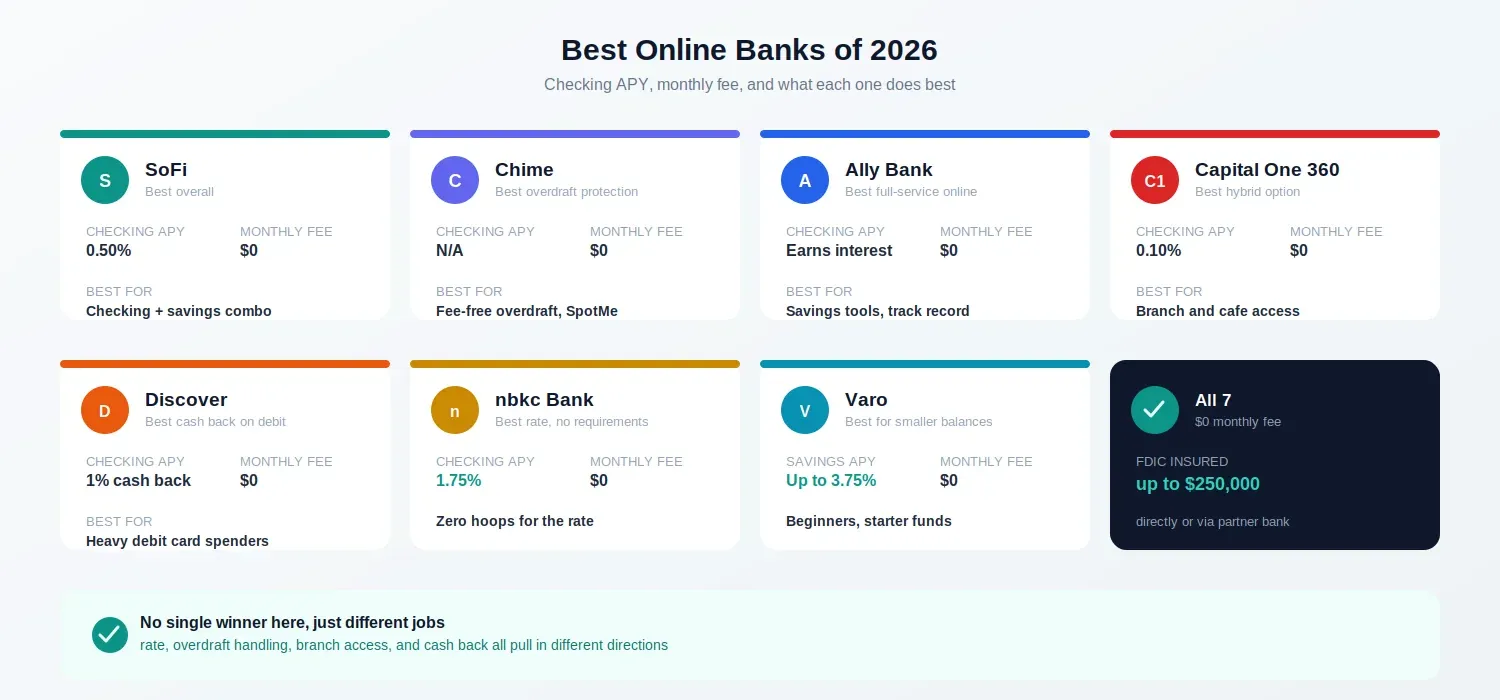
Quick Comparison Table
|
Bank |
Checking APY |
Monthly Fee |
Best For |
|
SoFi |
0.50% |
$0 |
Best
overall, checking and savings combo |
|
Chime |
N/A
(checking) |
$0 |
Overdraft
protection and early pay |
|
Ally
Bank |
Earns
interest |
$0 |
Full-service
online banking, savings tools |
|
Capital
One 360 |
0.10% |
$0 |
Branch
and cafe access |
|
Discover |
N/A
(1% cash back) |
$0 |
Cash
back on debit purchases |
|
nbkc
Bank |
1.75% |
$0 |
High
APY with no requirements |
|
Varo |
Up
to 3.75% (savings) |
$0 |
Beginners,
smaller balances |
Individual Bank Reviews
1. SoFi, Best Overall
SoFi won NerdWallet's annual award for
best overall bank in 2026, and the reasoning holds up once you actually look at
what it offers. The checking account pays 0.50% APY with no minimum balance, no
monthly fee, and no minimum deposit, while the savings side pays a meaningfully
higher rate on top of that. It also supports joint accounts, offers subaccounts
for organizing savings goals, and folds investing and lending products into the
same login.
●
Pros:
interest bearing
checking, strong savings rate, joint accounts supported, integrated investing
and lending, sign up bonus of $50 to $400 depending on direct deposit size.
●
Cons:
the best savings rate
typically requires a qualifying direct deposit, and there are no physical
branches for anyone who occasionally wants in person service.
SoFi's subaccount feature, sometimes
called vaults, deserves a specific callout for anyone juggling multiple savings
goals at once. Rather than opening several separate accounts at different
institutions, a single SoFi savings account can get split into labeled buckets,
an emergency fund, a vacation fund, a car repair fund, each tracked separately
while all earning the same rate. For anyone who's found that one
undifferentiated savings balance makes it harder to stay on top of specific
goals, this is a genuinely useful organizational tool.
2. Chime, Best for Overdraft Protection and Early Pay
Chime won NerdWallet's 2026 award for
best overall checking account, largely on the strength of its overdraft program
and everyday usability. Its SpotMe feature covers overdrafts up to a certain
limit without charging a fee, a genuinely meaningful benefit given that
overdraft fees elsewhere run $26.77 to $35 per incident.
●
Pros:
no monthly fee, strong
fee free overdraft program, early direct deposit access, broad free ATM
network, no minimum opening deposit, sign up bonus up to $350.
●
Cons:
Chime is a financial
technology company partnering with FDIC insured banks rather than a bank
itself, it doesn't support joint accounts, and the checking account doesn't pay
interest.
Chime's early direct deposit feature is
worth understanding alongside SpotMe, since the two work together well in
practice. Getting paid up to two days early shrinks the window where a balance
runs thin before payday, which is exactly when overdrafts tend to happen. For
someone whose overdrafts have historically clustered in the day or two before a
paycheck lands, that timing shift alone can eliminate most of the problem
before the overdraft program is ever even needed.
3. Ally Bank, Best Full-Service Online Bank
Ally has been functioning as an internet
banking system for more than ten years, which is much longer compared to the
tenure of any other competitor. It does not charge any monthly service charges
on checking or saving accounts, does not have a minimum balance requirement for
account opening, and provides overdraft protection by connecting the accounts.
●
Pros:
No Fees or Minimums,
Good reputation, useful savings features such as Buckets and Round-Ups, and
access to more than 75,000 ATMs which are charge-free with a limit of $10 per
statement cycle reimbursement.
●
Cons:
checking APY is modest
compared to the top interest bearing checking accounts available, and there are
no branches.
4. Capital One 360, Best Hybrid Option
However, Capital One 360 is quite
different from other financial institutions. This bank combines the convenience
of online banking services with access to brick-and-mortar branches and cafes.
360 Checking Account is a free-of-charge product that does not require a
minimum balance and provides customers with 0.10% interest rate on all
available balance levels.
●
Pros:
free access to over
70,000 Capital One, Allpoint, and MoneyPass ATMs, early direct deposit up to
two days ahead, physical locations available, sign up bonus up to $250.
●
Cons:
the 0.10% checking rate
runs low relative to competitors, and cash deposits work at Capital One ATMs
and some Allpoint ATMs but not all partner ATMs.
5. Discover, Best for Cash Back on Debit
The checking account from Discover is
unique in that it gives you 1% cash back on up to $3,000 in debit card
transactions per month, translating into up to $360 in annual cash back. There
are no monthly maintenance charges, no minimum opening deposit, no minimum
balance requirements, and even no overdraft charges whatsoever.
●
Pros:
1% debit cash back,
zero fees, including overdraft charges, and access to over 50,000 ATMs from
Allpoint and MoneyPass networks.
●
Cons:
no reimbursement for
out of network ATM fees, and the checking account itself doesn't pay interest,
the cash back is the return instead.
6. nbkc Bank, Best High APY with No Requirements
The nbkc Everything Account pays 1.75%
APY with genuinely no requirements attached to earn that rate, no direct
deposit minimums, no debit transaction quotas, no balance thresholds. There are
no monthly fees, unlimited ATM accessibility along with fee reimbursements, and
a savings goal calculator that will calculate how much should be saved every
month to achieve that goal.
●
Pros:
high APY along with no
hurdles, no monthly fee, ATM fee reimbursement, and savings goals calculator.
●
Cons:
nbkc declines
transactions that would overdraw rather than covering them, meaning there's no
overdraft protection program at all, and it has only four branches, all in
Kansas City.
7. Varo, Best for Smaller Balances
Varo gives 3.75% APY on their savings
but this is valid for only a maximum amount of $5,000 and only those people are
eligible who get at least $1,000 through their direct deposits. For anything
above $5,000, they give an interest rate of 1.00%, so Varo will be more
appropriate for starting emergency funds.
●
Pros:
high rate on smaller
balances, no fees, beginner friendly mobile first app, no overdrafts permitted
so no overdraft fees are possible.
● Cons: the top rate caps at $5,000, accounts can only be owned by one person so joint accounts aren't an option, and wire transfers aren't supported.
How to Choose the Right Online Bank?
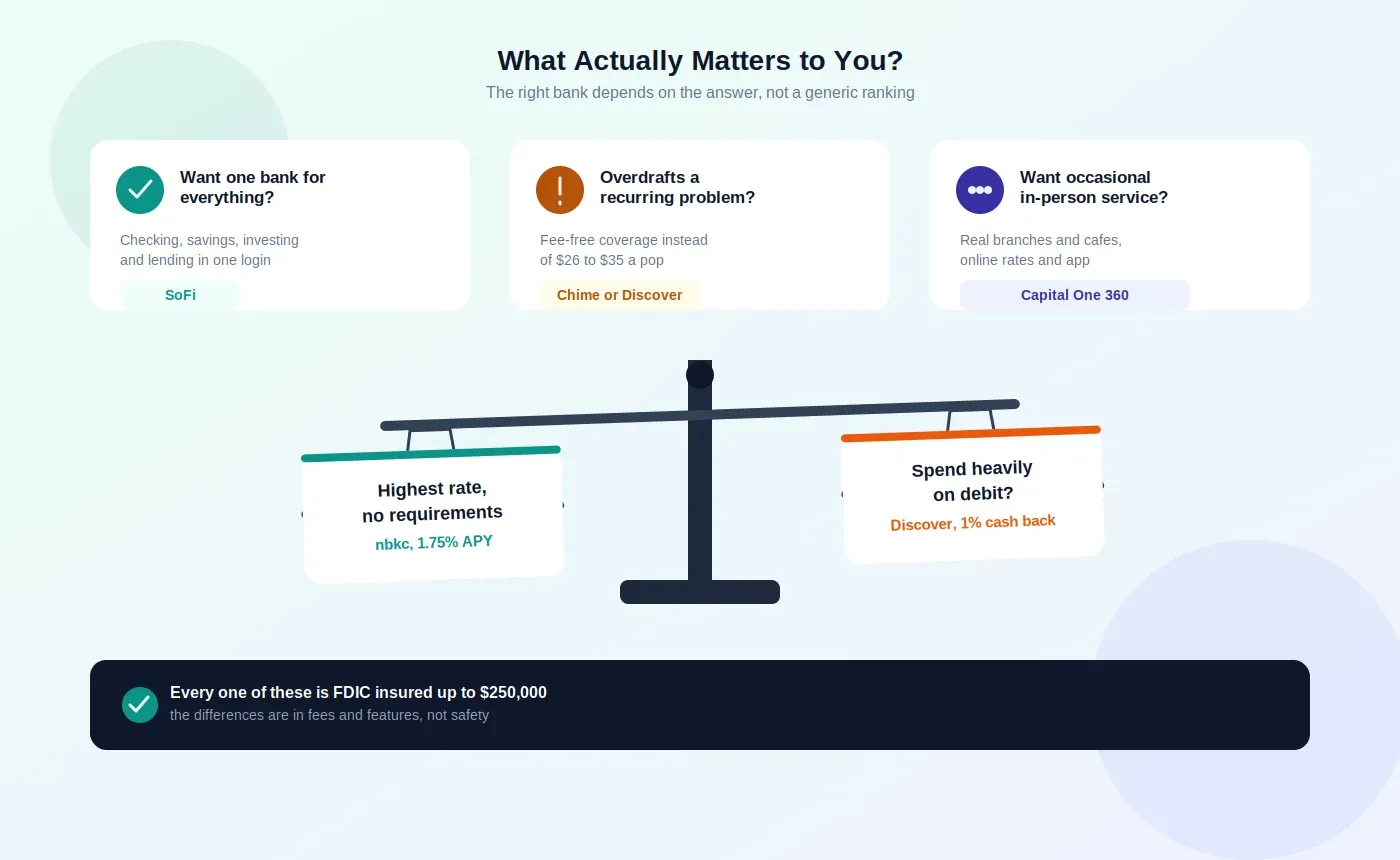
●
If
you want one bank for everything: SoFi
combines interest bearing checking, competitive savings, investing, and lending
in a single platform, which is part of why it took the 2026 best overall award.
●
If
overdrafts are a recurring concern: Chime's
fee free SpotMe program, or an account like Discover or nbkc that simply
doesn't charge overdraft fees at all, eliminates a cost that averages $26.77 to
$35 elsewhere.
●
If
you occasionally want in person service: Capital One 360 is the clearest hybrid option, pairing
online convenience with actual branches and cafes.
●
If
you want the highest checking rate without requirements: nbkc's 1.75% APY with no qualifying
hoops is difficult to beat among no strings accounts.
In case you spend a lot using a debit card: The 1% cash back rewards from Discover, capped at $3,000 per month, may beat a low interest rate with the proper spending behavior.
Good to note that every financial institution discussed in this essay provides FDIC insurance coverage of up to $250,000 per customer. There isn't much difference in terms of safety. Differences come in terms of costs, benefits, and how well each one serves your banking needs.
Bank vs. Fintech: A Distinction Worth Understanding
Several popular options in this space,
Chime most notably, are financial technology companies rather than banks
themselves. They partner with FDIC insured banks that actually hold customer
deposits, meaning the money is still federally insured, but the relationship is
structured differently than banking directly with a chartered bank.
Practically, this rarely affects day to
day experience, and the insurance protection functions the same way either way.
Where it can matter is in product range, fintechs often don't offer joint
accounts, wire transfers, or lending products that a full service bank
provides. It's worth confirming which partner bank actually holds the deposits
and verifying that institution's FDIC status directly, which takes about a
minute on the FDIC's official verification tool.
Common Mistakes When Choosing an Online Bank
●
Choosing
purely on advertised APY. A headline rate that requires a large direct deposit
or caps at a low balance may deliver far less than a slightly lower rate with
no conditions attached.
●
Overlooking
the ATM network. For anyone who uses cash even occasionally, the difference
between 70,000 fee free ATMs and a smaller network, or reimbursement versus
none, adds up meaningfully over a year.
●
Ignoring
the overdraft policy. Some accounts decline transactions, some cover them fee
free up to a limit, and some still charge, this single feature can be worth
hundreds of dollars a year for some households.
●
Not
checking whether joint accounts are supported. Several popular fintech options
don't offer them, a genuine dealbreaker for couples managing shared expenses.
●
Assuming
cash deposits work the same everywhere. Fully online banks vary widely here,
some support cash deposits at partner ATMs while others have no cash deposit
option at all, worth confirming upfront if you handle cash even occasionally.
Key Takeaways
●
Online
checking accounts cost 59% less on average than branch based accounts,
according to WalletHub's analysis, largely thanks to lower overhead.
●
SoFi
won NerdWallet's 2026 best overall bank award, while Chime took best overall
checking account for its overdraft program and everyday features.
●
Every
option reviewed charges $0 monthly fees and requires no minimum balance, making
fees a non-issue across the board.
●
The
meaningful differences are in APY conditions, ATM access, overdraft policy, and
joint account support, not in fundamental safety, all are FDIC insured up to
$250,000.
●
Fintechs
like Chime partner with FDIC insured banks rather than being banks themselves,
which affects product range more than it affects deposit safety.
Conclusion
The best online bank genuinely depends
on how you actually use a bank account, not which one tops a generic ranking.
Someone who overdrafts occasionally is better served by Chime or Discover than
by an account with a marginally higher rate and a standard overdraft fee
waiting to catch them. Someone consolidating their whole financial life in one
place will likely prefer SoFi. Any of the options reviewed here will cost less
and pay more than a typical branch based account, which is really the main
decision worth making. The specific pick among them matters a lot less than
simply moving away from an account charging fees and paying nothing at all.
For the full picture on banking basics,
fees, and insurance, read our complete guide to banking in 2026, and if
you're focused specifically on maximizing savings rates, see our best high yield savings accounts of 2026 guide.