Introduction
0.38%. That's the national average
savings account rate as of September 2026, unchanged since April. Meanwhile the
average overdraft fee ran somewhere between $26.77 and $35 depending on the
bank, according to Bankrate's most recent Checking Account and ATM Fee Study.
Put those two numbers side by side and the picture gets pretty clear fast: the
bank you pick, and how well you actually understand the account you already
have, genuinely affects how much of your own money stays yours.
Banking is one of those topics everyone assumes
they've already figured out. Most people open their first account as a teenager
and never really revisit that decision again. But the banking landscape in 2026
looks meaningfully different from even five years ago. Online only banks now
routinely beat branch based banks on both rates and fees, overdraft policies
have shifted considerably following new federal rules, and switching banks has
gotten a lot easier than it used to be. This guide focuses on what's truly
relevant: the distinction between types of accounts, how to select a bank
suitable for your circumstances, what to watch out for as far as fees go, and
the protection of your funds.
All the information herein is based on
2026 data provided by Bankrate, NerdWallet, WalletHub, the FDIC, and the
Consumer Financial Protection Bureau. This guide was written taking into
consideration our explanation of the banking process to a person who has never
stopped to think if his bank is right for him, no prior knowledge assumed in
regard to things like the distinction between APY and interest rate, or the
reason behind fees on certain checking accounts. This guide pairs well with our
complete guide to saving money and our complete budgeting guide for beginners, since
the account you bank with is really the foundation both of those systems run on
top of.
Checking vs. Savings Accounts: The Basics
Nearly every bank relationship starts
with these two account types, and getting the difference between them straight
is the foundation for everything else in this guide.
●
Checking
accounts: built for
frequent, everyday transactions, paying bills, making purchases, receiving a
paycheck through direct deposit. Easy access through a debit card, unlimited
transactions, but historically little to no interest.
●
Savings
accounts: built for
money you're setting aside rather than spending regularly. Usually pays more
interest than checking, though federal rules historically limited certain types
of withdrawals to encourage exactly this kind of behavior.
The right approach for most people isn't
picking one over the other. It's using both together: a checking account for
the money flowing in and out each month, and one or more savings accounts for
money set aside for emergencies, goals, or just a general safety net.
It helps to think of these two accounts
as having different jobs rather than competing for the same one. A checking
account is built for movement. Money comes in, money goes out, dozens of times
a month, and it needs to be instantly accessible with zero friction. A savings
account is built for staying put. The whole point is that the money's a little
harder to touch, and in exchange for that friction, it earns a meaningfully
better rate. Try using one account for both jobs, either keeping everything in
checking or paying bills straight out of savings, and you'll usually end up
working against both goals at once.
If you haven't built a dedicated
emergency fund yet, our emergency fund guide walks through exactly how
much to save and where to keep it. A savings account, specifically a high yield
one, is where that money belongs.
Why Your Bank Choice Actually Matters
It's easy to assume all banks are
basically interchangeable, since the core function, holding your money safely
and letting you access it, is the same everywhere. In practice, the gap in
rates and fees is large enough to genuinely matter.
●
The
rate gap is real: the
national average savings rate sits at 0.38% as of September 2026, while top
high yield savings accounts pay around 4.20% to 4.21%, roughly 10 times the
national average, on the exact same type of account.
●
Fees
add up quietly: the
average overdraft fee runs $26.77 to $35 per incident, and roughly 11% to 12%
of Americans pay at least one overdraft fee in a given year, a cost that's
almost entirely avoidable with the right account and a little awareness.
●
Online
banks have closed the convenience gap: a WalletHub analysis found the average online checking
account costs 59% less than its branch based counterpart, while modern mobile
check deposit, instant transfers, and 24/7 digital support have made skipping
the physical branch a lot less of a tradeoff than it used to be.
None of this means a traditional, branch
based bank is a bad choice. For people who genuinely value in person service or
need to deposit cash regularly, it can be exactly the right fit. It just means
the choice is worth making on purpose rather than defaulting to whichever bank
happened to open a branch nearby years ago.
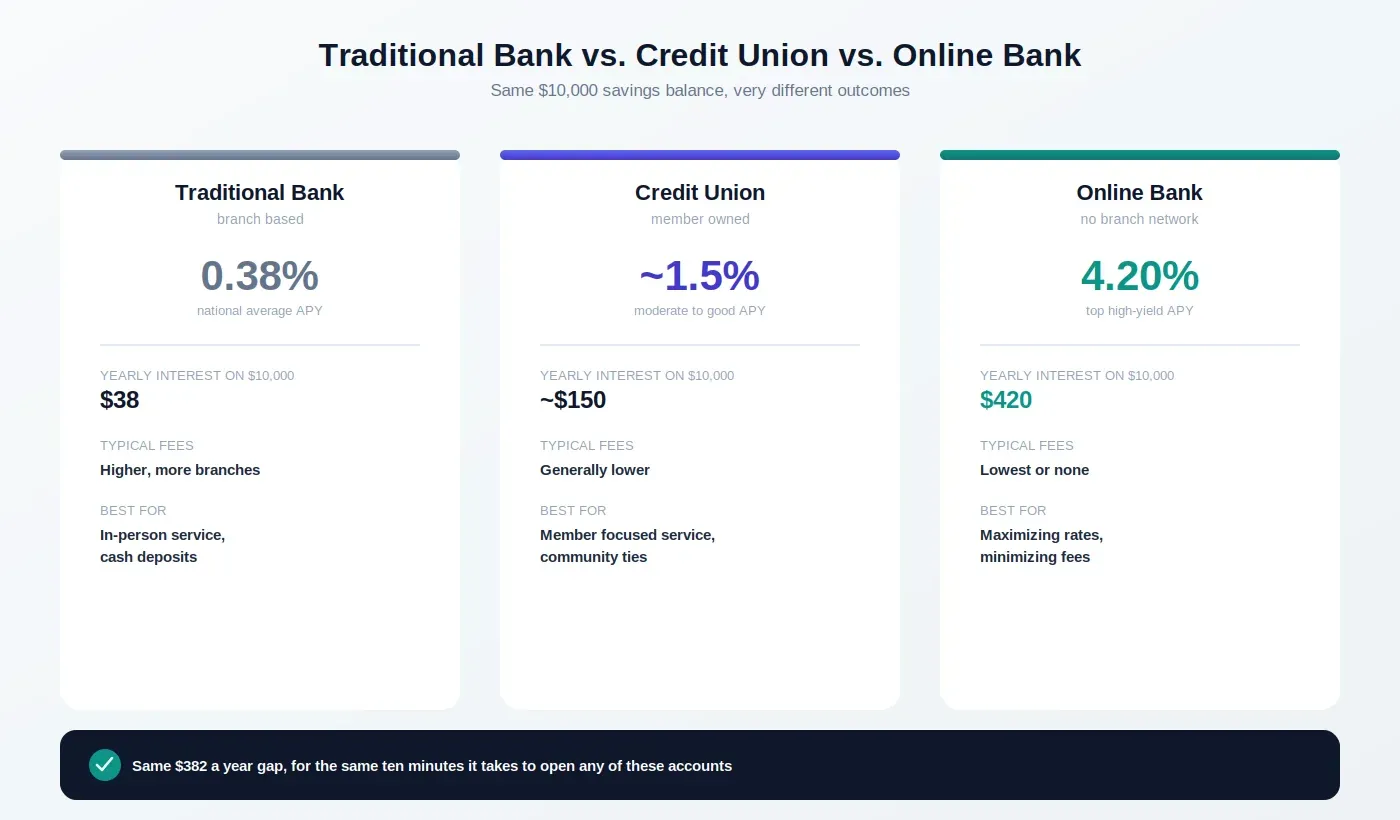
Worth putting the rate gap into an
actual dollar figure, since percentages alone are easy to gloss over. On a
$10,000 savings balance, the difference between the national average rate of
0.38% and a top high yield rate of 4.20% works out to roughly $382 a year,
money that either sits in your account or quietly gets left on the table, for
the exact same amount of effort either way. Opening an account online takes
about the same ten minutes no matter which one you pick.
Types of Bank Accounts Explained
There are a few other types of accounts
that are common enough to mention beyond the simple split of checking and
savings accounts.
●
Money
market accounts: a kind
of blend of savings and checking accounts that pays a higher rate of interest
compared to regular savings but may provide check writing or debit card
facility sometimes.
●
Certificates
of deposit, or CDs: a
time deposit that holds your funds for a fixed period of time and provides you
a higher interest rate in return; however, a penalty is imposed if you withdraw
money from this account prematurely.
●
Cash
management accounts: typically
offered by investment platforms rather than traditional banks, functioning like
a checking account while sometimes earning a more competitive rate on
uninvested cash.
●
Joint
accounts: usually provided
by an investment service provider and not by banks and are similar to a
checking account with better rates on idle money.
Choosing between these is less about
picking one overall winner and more about matching each type to a specific job
in your financial plan. Someone with a solid emergency fund and no large
purchase coming up might not need a money market account or a CD at all.
Someone saving toward a specific goal with a known date, a wedding eighteen
months out, say, might find a CD's fixed rate genuinely appealing precisely
because the timeline lines up with the CD's term. There's no rule saying you
need every account type available, only the ones that actually serve a purpose
for your situation.
Traditional Banks vs. Credit Unions vs. Online Banks
These three categories cover almost
every banking option out there, and each comes with its own set of tradeoffs.
|
Type |
Typical Rates |
Typical Fees |
Best For |
|
Traditional
bank |
Low,
often near 0% |
Higher,
more branches |
In
person service, cash deposits |
|
Credit
union |
Moderate
to good |
Generally
lower |
Member
focused service, community ties |
|
Online
bank |
Highest,
often 4%+ |
Lowest
or none |
Maximizing
rates, minimizing fees |
Credit unions run as not for profit,
member owned institutions, which is part of why they often offer better rates
and lower fees than traditional banks. The profit that would otherwise go to
shareholders gets returned to members instead. Membership sometimes requires
meeting specific criteria, living in a certain area, working for a certain employer,
joining an affiliated organization, though a lot of credit unions have made
membership easier to qualify for than it used to be. Online banks manage higher rates and lower fees
largely thanks to a simple structural advantage: no physical branch network to
build, staff, and maintain.
That overhead savings gets passed along to
customers as better APYs and fewer fees, rather than funding real estate and in
person staffing across hundreds of locations. This is also why online banks
tend to be newer to the market than century old traditional banks. The online
only model only became fully workable once digital banking infrastructure,
mobile check deposit, instant transfers, remote identity verification, matured
enough to replace what a branch used to handle in person.
Worth noting that plenty of traditional
banks now offer online only sub brands or high yield savings products
specifically to compete with dedicated online banks, blurring the line between
these categories somewhat. A large traditional bank might offer a competitive
online savings account alongside its branch network, giving customers a hybrid
option, branch access when you need it, competitive rates for the money that
doesn't need a branch at all.
How to Choose a Checking Account?
A few features consistently separate a
genuinely good checking account from a mediocre one in 2026.
●
No
monthly maintenance fee, or an easy way to waive it: many free checking accounts require no
minimum balance at all, others waive the fee with a qualifying direct deposit.
●
A
large fee free ATM network: look
for tens of thousands of in network ATMs, plus reimbursement for out of network
fees, particularly important if you use cash regularly.
●
Early
direct deposit: many
online banks now make paycheck funds available up to two days before the
official pay date, a genuinely useful feature with zero downside.
●
Overdraft
policy: some accounts
decline transactions rather than charging a fee, some offer fee free overdraft
coverage up to a small buffer, and some still charge the traditional fee. Worth
checking carefully before choosing.
●
A
savings features or interest rate: some
checking accounts now pay a modest rate. SoFi's checking and savings
combination pays 0.50% APY on all balances, well above the traditional 0% most
checking accounts still pay.
●
Mobile
deposit and digital tools: depositing
a check by photo, setting up spending alerts, and accessing budgeting tools
directly in the app has become close to a baseline expectation rather than a
bonus feature in 2026.
Once your checking account is set up,
our guide on how to make a monthly budget walks through actually managing the
money flowing through it.
Signing Bonuses and Promotions Worth Knowing About
Many banks, particularly online banks
and newer entrants competing for customers, offer a cash bonus for opening a
new checking account and meeting a qualifying direct deposit requirement within
the first 60 to 90 days. These bonuses have ranged widely. Some offers on the
market in 2026 have paid anywhere from $50 to $400 depending on the size of the
direct deposits received, essentially free money for doing something you were
going to do anyway, moving your paycheck to a new account.
A few things worth checking before
chasing a bonus specifically. Read the fine print on what counts as a
qualifying direct deposit, some banks require a specific minimum dollar amount
or a certain number of deposits within the window. Also confirm there's no
minimum balance requirement or monthly fee that would offset the bonus over
time, and check whether the bonus itself is taxable, banks generally report
account opening bonuses as interest income, meaning a 1099 INT may show up at
tax time. None of this makes the bonuses not worth pursuing. This simply means
that what is in the small print becomes more important than what the headline says.
Understanding Bank Fees (And How to Avoid Them)
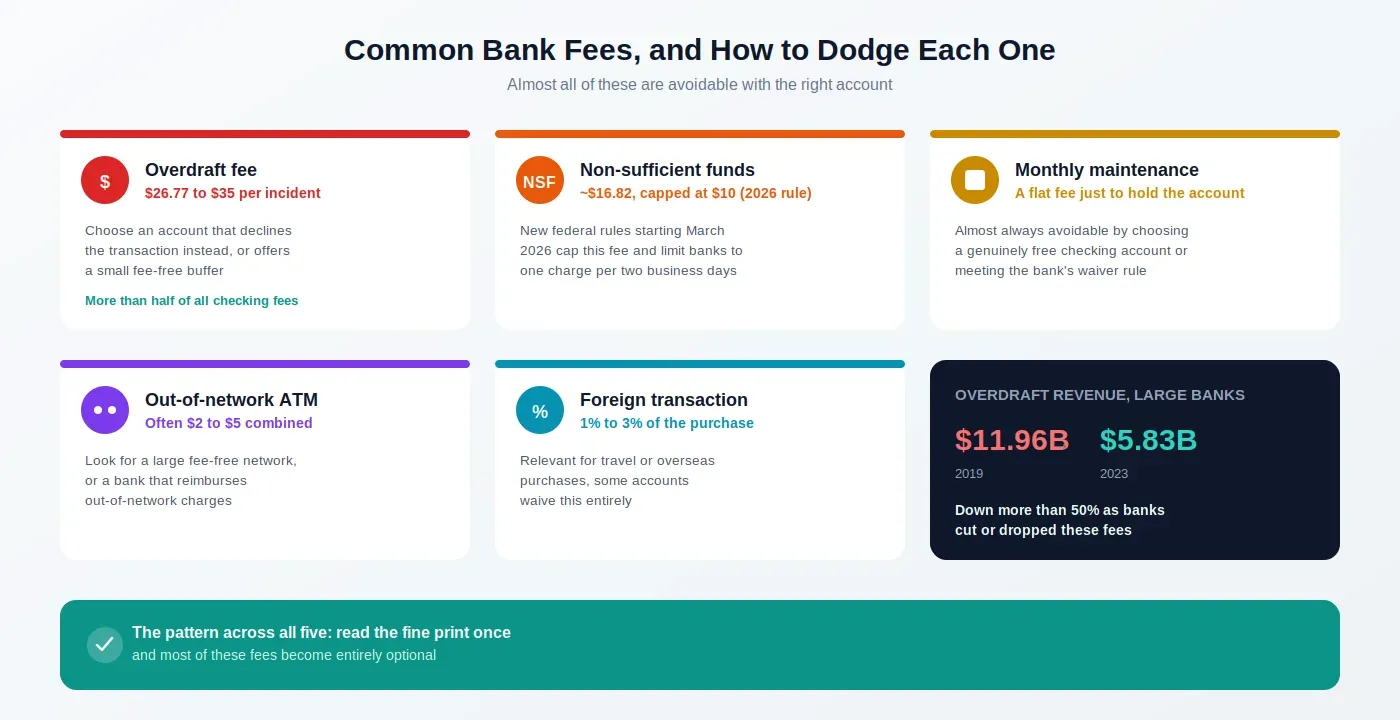
Fees are where a seemingly free checking
account can quietly turn into an expensive one. Some categories account for a
great deal of what people actually pay out in fees.
●
Overdraft
fees: Fee that you
incur when the bank pays your transactions beyond the money in your account; it
averages from $26.77 to $35. Choosing an account that declines transactions
instead, or offers a small fee free buffer, avoids this entirely.
●
Non-sufficient
funds, or NSF, fees: charged
when a transaction gets declined due to insufficient funds, averaging $16.82 as
of the most recent data, though new federal rules beginning March 2026 cap NSF
fees at $10 for personal accounts at many institutions.
●
Monthly
maintenance fees: a
flat fee simply for holding the account, almost always avoidable by choosing a
genuinely free checking account or meeting a bank's waiver requirement.
●
Out-of-network
ATM fees: charged both
by your own bank and sometimes by the ATM's operator for using a machine
outside your bank's network, often $2 to $5 combined per withdrawal.
●
Foreign
transaction fees: typically,
1% to 3% of the purchase amount, relevant for international travel or purchases
from overseas merchants, some accounts waive this entirely.
The Consumer Financial Protection Bureau
has found that overdraft charges alone make up more than half of all fees charged
on checking accounts, meaning a single category of fee, one that's almost
entirely avoidable with the right account, accounts for the majority of what
people lose to banking costs each year.
The overdraft landscape has genuinely
shifted in recent years, worth understanding since it affects which account
features actually matter now. Overdraft and NSF fee income from large banks has
decreased from an estimated $11.96 billion in 2019 to approximately $5.83
billion in 2023, representing a drop of more than 50% owing to the fact that
many big banks have ceased or cut back on these fees in response to the outcry
and pressure from regulatory bodies. However, beginning from March 2026, new
legislation stipulates that NSF fees be set at a maximum of $10 per transaction
in personal deposit accounts, and that no more than one NSF fee be charged over
two business days. None of this means overdraft fees have disappeared entirely.
Roughly two thirds of large banks still charge fees in the $35 to $38 range for
actual overdrafts specifically, as opposed to declined transactions, but the
overall trend has moved meaningfully in consumers' favor.
Worth knowing that overdraft and NSF
fees don't affect everyone equally. Research has found meaningful disparities
by income and demographic group, with lower income households and certain
minority groups overdrafting at notably higher rates than the population
overall, often because a thinner cash buffer makes an unexpected charge more
likely to trigger an overdraft in the first place. This is part of why choosing
an account with a favorable overdraft policy, one that declines transactions
rather than charging a fee, or offers a small fee free buffer, matters more for
some households than others, though the underlying advice, check this setting
before it costs you unexpectedly, applies to everyone.
FDIC and NCUA Insurance: How Your Money Is Protected
Every account discussed in this guide
should be held at an institution insured by the FDIC, for banks, or the NCUA,
for credit unions, both of which protect deposits up to $250,000 per depositor,
per institution, in the event the bank or credit union fails.
●
Coverage
applies per institution, not per account: having a checking and a savings account at the same bank
doesn't double your coverage, the $250,000 limit applies to your combined
deposits at that one institution.
●
Joint
accounts get separate coverage: a
joint account is generally insured up to $250,000 per co-owner, effectively
$500,000 for a two-person joint account, on top of each person's individual
account coverage.
●
Online
only banks are just as protected: as
long as the institution is FDIC or NCUA insured, which nearly every legitimate
bank and credit union is, coverage works identically to a traditional branch
based bank.
This insurance has never failed to
protect a depositor's covered balance in the history of either program. It's
about as close to a guarantee as personal finance gets, and it's worth
confirming before opening any new account, a quick search for the institution
on the FDIC's or NCUA's official verification tool takes less than a minute.
For anyone with balances approaching or
exceeding the $250,000 limit at a single institution, a few strategies extend
coverage further without requiring a completely different type of account.
Spreading deposits across multiple FDIC insured banks is the most
straightforward approach, each institution offers its own separate $250,000 of
coverage. Some banks also offer accounts structured specifically to maximize
coverage across ownership categories, single accounts, joint accounts, and
certain retirement accounts are all insured separately from each other, even at
the same institution, which can meaningfully raise the effective coverage for
one household without opening accounts anywhere else.
How to Open a Bank Account: Step by Step?
●
Step
1, choose the right account type: based
on the comparisons above, decide between a traditional bank, credit union, or
online bank, and whether you need checking, savings, or both.
●
Step
2, gather required documents: typically,
a government issued ID, Social Security number, and a way to fund the initial
deposit. Some accounts require no minimum opening deposit at all.
●
Step
3, apply online or in person: most
banks now offer a fully online application taking 10 to 15 minutes, though
branch based banks still support in person applications for anyone who prefers
that route.
●
Step
4, fund the account: transfer
money from an existing account, or deposit cash or a check if opening in
person. Some banks offer a sign up bonus for an initial deposit or qualifying
direct deposit.
●
Step
5, set up direct deposit and online access: linking a paycheck and setting up the mobile app and online
banking access finishes the setup.
How to Switch Banks Without the Hassle?
Switching banks used to be a genuine
hassle, tracking down every recurring payment linked to the old account,
waiting on a new debit card, risking a missed bill during the transition. It's
gotten considerably easier in 2026.
●
Open
the new account before closing the old one: keeping both accounts active during the transition avoids
any gap in access to your money.
●
Update
direct deposit first: redirecting
your paycheck to the new account is usually the highest priority step, since it
affects your most important, recurring inflow.
●
List
and update recurring payments: review
the last two to three months of statements on the old account to catch every
subscription, bill, and automatic payment that needs to move.
●
Leave
a buffer before closing the old account: waiting 30 to 60 days after the switch, keeping a small
balance in the old account, catches any payment you might have missed the first
time around.
●
Watch
for new institution rules on Open Banking data sharing: the CFPB's Rule 1033 is rolling out
through 2026 and 2027, giving consumers stronger rights to securely transfer
their own financial data between institutions, which should make switching even
easier as it fully takes effect.
Digital Banking and Mobile Apps
Mobile banking has moved from a
convenience to the default way most people interact with their bank. A strong
mobile app now typically includes mobile check deposit, instant peer to peer
transfers through services like Zelle, spending alerts and budgeting tools
built directly into the app, and biometric login for security.
Some newer digital first banks have gone
further, offering automatic savings features, early paycheck access, and built
in credit building tools. The core banking functions, insurance, security, and
basic account features, are generally comparable between a well-established
traditional bank's app and a newer digital first bank. The differences show up
more in extra features and overall user experience than in fundamental safety.
The Consumer Financial Protection
Bureau's Rule 1033, sometimes called the Open Banking rule, is worth watching
specifically because of how much it could reshape digital banking over the next
couple of years. The rule gives consumers a stronger legal right to securely
access and share their own financial data across institutions, in theory making
it far easier for a budgeting app, a new bank, or a lending platform to
securely pull your transaction history with your permission, rather than
requiring the clunky screen scraping workarounds many financial apps have
historically relied on. Large institutions are required to comply by April
2026, with smaller institutions following in April 2027, meaning the practical
benefits will likely become more visible to everyday users gradually over the
next year or two rather than all at once.
Common Banking Mistakes to Avoid
●
Keeping
too much cash in a low interest checking account. Money not needed for near
term spending belongs in a savings account earning real interest, not sitting
in checking earning close to nothing.
●
Never
reviewing your account for fees you could avoid. A quick statement review once
or twice a year often reveals a fee that a different account, or a small
behavior change, would eliminate entirely.
●
Ignoring
overdraft settings. Many accounts let you choose whether transactions get
declined or covered for a fee when a balance runs short. Checking this setting
can prevent an unwanted overdraft charge.
●
Sticking
with a bank purely out of habit. Loyalty to a bank rarely earns a better rate.
Comparing options every couple of years costs little and can meaningfully
improve what your money earns.
●
Not
confirming FDIC or NCUA insurance before opening an account. Particularly
relevant with newer fintech apps that may hold funds through a partner bank
rather than being a bank themselves. A quick check on the official FDIC or NCUA
verification tool takes under a minute and confirms exactly how the money is
protected.
A lot of these mistakes overlap with
broader saving habits, our 10
saving mistakes guide covers more of them in depth.
Banking for Different Life Stages
What matters most in a bank account
shifts somewhat depending on where someone is financially, so it's worth
briefly looking at how the guidance above applies differently across a few
common situations.
●
Students
and early career: a fee
free checking account with no minimum balance requirement matters most here,
since balances tend to be lower and unpredictable. A monthly maintenance fee or
minimum balance requirement hits this stage disproportionately hard.
●
Established
career, building savings: this
is typically when the rate gap between a standard and high yield savings
account starts to matter most in real dollar terms, as balances grow large
enough for the percentage difference to translate into meaningful money.
●
Families
with shared expenses: joint
accounts, or a hybrid setup with both individual and joint accounts, tend to
make sense once household expenses are being managed together. Worth revisiting
the account structure specifically when a major life changes like marriage or a
first child happens.
●
Approaching
or in retirement: easy
access to funds and minimal fees remain important, though the balance between
checking and savings may shift, with a larger share potentially moving toward a
high yield account or CD ladder for predictable, accessible income.
Key Takeaways
●
Use
a checking account for spending and a savings account for setting money aside.
The combination, not either alone, is the right approach for most people.
●
The
rate and fee gap between banks is real. Top savings accounts pay roughly 10
times the national average, while avoidable fees cost the average affected
household real money each year.
●
FDIC
and NCUA insurance protects deposits up to $250,000 per institution, a
guarantee that applies equally to online only banks and traditional branches.
●
Switching
banks has gotten considerably easier, particularly with new Open Banking rules
rolling out through 2026 and 2027.
●
A
handful of avoidable fees, especially overdraft charges, make up the majority
of what people actually lose to banking costs each year.
Conclusion
Banking isn't the most exciting part of
a financial plan, but it's genuinely the foundation everything else sits on. A
checking account that avoids unnecessary fees and a savings account that
actually pays competitive interest costs nothing extra to set up. It just takes
a bit of comparison shopping that most people skip out of habit. Take a look at
the guides linked throughout this article for the next step, whether that's
building an emergency fund, setting up a budget, or eventually putting savings
to work through investing.
Once your banking foundation is solid,
our investing for beginners guide covers the
natural next step for money that won't be needed for several years.