Introduction
0.15 to 0.40 percentage points. That's
roughly how much the average credit union savings rate beats the average
traditional bank rate by, as of 2026. The best online banks can match that gap
or beat it outright. On the lending side, credit unions have historically saved
borrowers 0.5 to 1.5 percentage points on loans compared to traditional banks,
savings that can pile up into hundreds or even thousands of dollars over the
life of a car loan or mortgage.
None of this means one type of
institution simply beats the other two. They each have their own unique areas
of strength, and in 2026, there are increasingly many financially intelligent
individuals who utilize two or even three types simultaneously, taking
advantage of a credit union for loans, an online bank for saving, and at times,
a standard bank simply for the sake of having lots of branches available. This
guide will go through what each type does better based on data from 2026.
The old framing of which type is simply
best has gotten a bit stale by 2026. The more useful question has shifted to
what combination of institutions fits a specific financial life, since the real
differences between these three categories show up situation by situation,
savings rates here, loan rates there, in person needs somewhere else, rather
than collapsing into one universal ranking. This guide is built around that
more practical question.
This article is part of our larger complete guide to banking in 2026, and it
builds on the account basics covered in checking vs. savings accounts and our best online banks of 2026 guide.
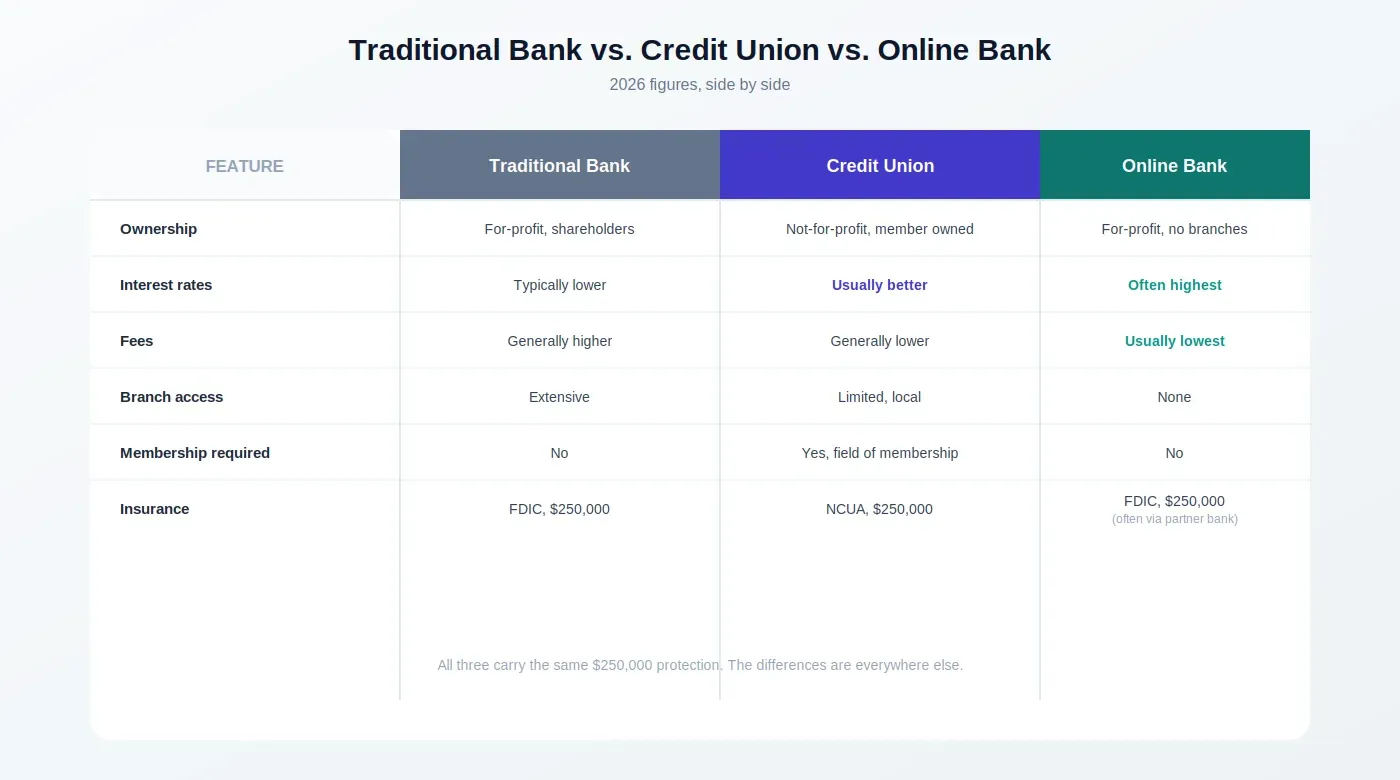
The Three Types, Side by Side
Traditional Banks: What They Still Do Best
For-profit institutions are the nature
of branch banking institutions, and therefore, they operate in such a way that
they charge interest on loans which is higher than the amount they pay to the
depositors. That's the mechanism behind why traditional bank savings rates
typically sit at the bottom of the three categories.
●
Extensive
branch and ATM network: national
banks have huge branch networks, which are actually helpful for handling cash
transactions, vaults, and face-to-face assistance when required.
●
Wide
product range: be it
basic checking account services or highly sophisticated products like business
banking, wealth management, and international services, traditional banks
provide the widest variety of all.
●
Relationship
lending: an established
history with a loan officer can genuinely help with mortgage or business loan
approval, particularly for self-employed borrowers or those with non-traditional
income, something an app only institution can't easily replicate.
●
The
tradeoff: higher fees
and lower rates fund all of this infrastructure. The average traditional bank
savings rate stays a fraction of what online banks or credit unions typically
offer.
None of this makes traditional banks
obsolete. It makes them specialized. For a household with straightforward,
digital first banking needs, a traditional bank's advantages might add up to
very little in practice. For a small business owner depositing cash weekly and
wanting an actual relationship with a lender, those same advantages can matter
enormously.
Credit Unions: The Not-for-Profit Alternative
Credit unions are member owned, not for
profit financial cooperatives. Each member gets an equal say when voting on the
board of directors, and there is no consideration of how much money they have
deposited, and profits go back to members and not shareholders.
●
Higher
average rates: the
average national credit union savings rate is higher than the average for
traditional banks by 0.15 to 0.40 percent as at 2026, with the spread being
even bigger on loan rates.
●
Significant
loan savings: traditionally,
credit unions offer auto loans and personal loans at rates that are lower by
0.5 to 1.5 percent compared to those charged by banks. This means that a loan
of 30,000$ from a credit union will be cheaper by several hundreds of dollars.
●
More
lenient underwriting, sometimes: credit
unions can be more willing to work with fair or limited credit histories than a
large traditional bank, worth checking even if you assume you wouldn't qualify
elsewhere.
●
Personalized
service: with a
smaller, more local membership base, credit unions frequently rate more
favorably on customer service satisfaction surveys than large traditional
banks, a genuine benefit if you value speaking with the same few staff members
over time.
●
Membership
requirements: joining
requires meeting a credit union's field of membership, typically based on where
you live, work, or an affiliated organization. Many modern credit unions have
broadened these criteria considerably, and some of the largest now have open or
easily met requirements, often just a small one-time deposit of $5 to $25 into
a share account.
The deposits held in federally chartered
credit unions are covered by the NCUA, which stands for the National Credit
Union Administration, to a limit of $250,000, which is just like the coverage
of FDIC at banks.
The mechanics of field of membership
deserve a closer look, since it's the single biggest hesitation people have
about credit unions and it's usually less restrictive than assumed. A credit
union's charter defines who's eligible to join, which historically meant
working for a specific employer or living in a specific county. Plenty of
credit unions have since expanded their charters to include broad categories,
membership in an alumni association, a small donation to an affiliated
nonprofit, or simply living in a large metropolitan area, meaning a large share
of the population now qualifies for at least one strong credit union without
needing to change jobs or move house.
Online Banks: Rate and Fee Leaders
Online banks operate without a branch
network, and that lower overhead is exactly why they can pay the rates they do.
As for September 2026, some of the best interest rates offered by online
savings accounts were between 3% and 4.2%, while the national average stood at
0.38%, and many have zero maintenance fees.
●
Highest
typical rates: for pure
savings yield, online banks frequently top both traditional banks and credit
unions, especially for anyone without access to a particularly competitive
local credit union.
●
Lowest
fees: with no branches
to maintain, online banks generally offer the leanest fee structures of the
three categories, often $0 monthly fees with no minimum balance.
●
Strong
technology: mobile
check deposit, instant transfers, and app based customer service tend to be more
polished at online banks, which have no physical fallback and so invest heavily
in the digital experience.
●
The
tradeoff: no in person
service, limited or no cash deposit options, and a narrower product range. Most
online banks focus on checking, savings, and sometimes basic lending, without
the full suite a large traditional bank or well established credit union might
offer.
For a detailed breakdown of specific
online banks, see our best online banks of 2026 guide.
Putting the Rate Gap into Real Numbers
It helps to see what these percentage
differences actually translate to in dollars, since a 0.38% versus 4.10%
comparison is easy to gloss over in the abstract. On a $15,000 savings balance
held for one year, the national average traditional bank rate of roughly 0.38%
generates about $57 in interest. The same balance in a competitive online bank
or credit union account paying 4.10% generates around $615, a difference of
well over $550 for doing nothing more than choosing a different account for
money that was already sitting idle.
The loan side tells a similarly concrete
story. On a $30,000, 60-month auto loan, a 1 percentage point difference in
interest rate, entirely plausible when comparing a credit union quote against a
dealership arranged bank loan, works out to roughly $800 in total interest
saved over the life of the loan. However, on a larger loan such as a mortgage,
where there is just a 0.5 percent differential between interest rates charged
on a $300,000 loan for 30 years, the savings can amount to thousands of
dollars, which is why it makes sense to take that extra half an hour to get a
credit union quote.
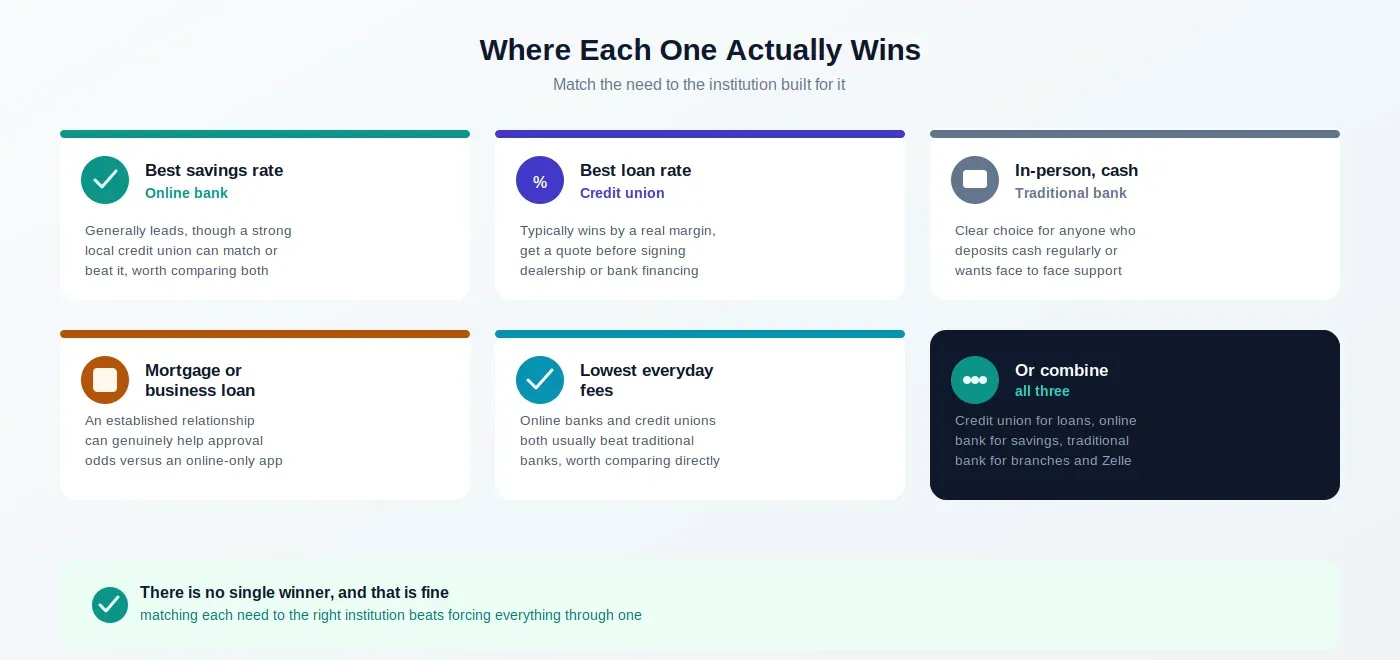
Where Each One Actually Wins
●
Best
for savings rates: online
banks generally lead, though it's worth comparing against your local credit
union specifically, since some credit unions match or beat online bank rates.
●
Best
for loan rates: credit
unions typically win here by a meaningful margin, worth getting a quote before
committing to financing through a dealership or a traditional bank.
●
Best
for in person service and cash handling: traditional banks, with their larger branch networks,
remain the clear choice for anyone who regularly deposits cash or wants face to
face support.
●
Best
for a mortgage or business loan: an
established relationship at a traditional bank, or a credit union with strong
local ties, can genuinely help with approval odds compared to an online only
application process.
●
Best
for lowest everyday fees: online
banks and credit unions both generally beat traditional banks here. Specific
accounts vary enough that comparing directly is worth the few minutes it takes.
Why Combining Institutions Often Makes the Most Sense
Worth naming directly: an increasing
number of financially engaged people in 2026 don't pick just one institution,
they deliberately split their banking across types to capture the strengths of
each. A common setup looks something like a local credit union for auto loans
and mortgages, an online bank for the bulk of savings, and sometimes a large
traditional bank kept open for its extensive Zelle and ATM network, or simply
because switching a decades old relationship doesn't feel worth the hassle for
a small rate difference.
There's no rule requiring all banking to
happen under one roof, and treating the decision this way often produces better
outcomes than picking a single institution and forcing every financial need
through it. The upfront cost of managing more than one login is genuinely small
compared to the ongoing benefit of getting the better rate or lower fee in each
specific category.
One version of this combined approach
worth naming specifically: local credit union for loans, high yield online
account for savings, and a large traditional bank kept active mainly for its
ubiquitous ATM and payment app presence. This isn't the only valid combination,
someone without an upcoming loan need might skip the credit union step
entirely, and someone who never uses Zelle or needs a nationwide ATM network
might not need the large traditional bank at all. The point isn't to copy a
specific template, it's to actively decide which institution serves each need
rather than defaulting to whichever bank happened to be convenient when the first
account was opened years ago.
Common Mistakes When Choosing Between Them
●
Assuming
a credit union is inaccessible. Membership eligibility has broadened
considerably at many credit unions, some of the largest now welcome members
from across the country with minimal requirements.
●
Not
comparing loan rates before financing at a dealership or through a bank. A
credit union quote obtained in advance is one of the easiest ways to negotiate,
or simply secure, a meaningfully better rate.
●
Assuming
online banks are less safe. As long as the institution is FDIC insured,
directly or through a partner bank, protection is identical to a traditional
branch based bank.
●
Staying
at a traditional bank purely out of habit. Loyalty rarely earns a better rate,
and moving savings specifically, while keeping a primary checking relationship
if desired, costs little effort for a real ongoing benefit.
●
Not
requesting a rate quote before assuming a bank's stated number is final. Some
credit unions and banks have room to negotiate certain loan terms, particularly
for existing members or customers with strong credit. The cost of not asking is
high.
Key Takeaways
●
Credit
unions usually offer higher interest rates for both savings and loans than
conventional banks by around 0.15 to 0.40 points for savings and 0.5 to 1.5
points for loans in 2026.
●
Online
banks normally offer better savings interest rates and fees, although there are
also top credit unions that can outdo them in certain aspects.
●
Traditional
banks still win on branch access, cash handling, and relationship lending,
genuinely useful for mortgages and business banking.
●
All
three are equally safe when properly insured, FDIC for banks, NCUA for credit
unions, both covering $250,000 per depositor.
●
Using
more than one type of institution at once is increasingly common and often
produces better overall outcomes than picking just one.
Conclusion
It seems impossible to say that there is
any clear victor between traditional banks, credit unions, and online banks as
each of them is definitely the best for some particular task. The choice for
savings and loans usually goes to credit unions while for fees and savings rate
- to online banks. However, traditional banks continue playing an important
role because of such aspects as personal presence of customers, physical money
and the creation of relations which may prove useful when applying for a
mortgage loan or business loan in the future.
For the full picture on banking
fundamentals, read our complete guide to banking in 2026.