
Introduction
Exact
amount: $250,000. What is important to know, however, is that there is actually
a much more positive side to this story than what the media have reported. That
limit applies per depositor, per bank, per ownership category. In practice, one
person can hold well over $250,000 at a single bank and still have every dollar
covered, just by setting up accounts the right way.
This
guide walks through how FDIC and NCUA insurance work in 2026: what counts as a
separate ownership category, how joint and retirement accounts get covered,
what actually happens if a bank fails, and a handful of myths worth putting to
rest.
If
your combined balance at one bank sits comfortably under $250,000, you don't
need to do anything. Your money's already fully protected. This guide is really
for anyone getting close to that limit, or anyone who's just curious what that
FDIC sign on a bank's website is actually promising.
This
piece is a part of our comprehensive guide to banking in 2026 and an extension
of what we discussed in banks vs credit unions vs online banks.
The
Basics: What FDIC and NCUA Insurance Actually Cover
Federal
Deposit Insurance Corporation is the full form of FDIC. On the other hand,
National Credit Union Administration is the full form of NCUA. They function in
an identical manner and are guaranteed by the full faith and credit of the U.S.
Government.
·
Standard limit: $250,000
per depositor, per insured depository institution, per account ownership
category.
·
What's covered: checking
accounts, savings accounts, money market deposit accounts, and certificates of
deposit.
·
Notice what these all have in common: each one
is a straightforward deposit, money you've handed the bank in exchange for a
promise to give it back, sometimes with interest. That's exactly what makes
insurance possible in the first place. The bank owes you a fixed, known amount,
which is a very different relationship than owning a share of something that
fluctuates in value.
·
What's not covered: investments
held at a bank, stocks, bonds, mutual funds, annuities, none of it is FDIC or
NCUA insured, even if you bought it through your bank. Money market mutual
funds trip people up especially often. While they are not FDIC-insured, they
are described like a money market deposit account.
· Since
2008: The $250,000 limit has been stable since October 2008, when
it was increased from $100,000 temporarily during the financial crisis and made
permanent.
It would be useful to know why there is
insurance for deposits and what its history has to do with how it functions now
Deposit insurance was created in 1933 after a wave of bank failures and bank
runs during the Great Depression, when panicked customers rushing to pull their
money out all at once could sink an otherwise healthy bank. Guaranteeing that
ordinary deposits are safe no matter what happens to the bank removed the
reason to panic in the first place, and that's a big part of why bank runs on
that scale haven't happened since.
Ownership
Categories: How to Get More Than $250,000 Covered
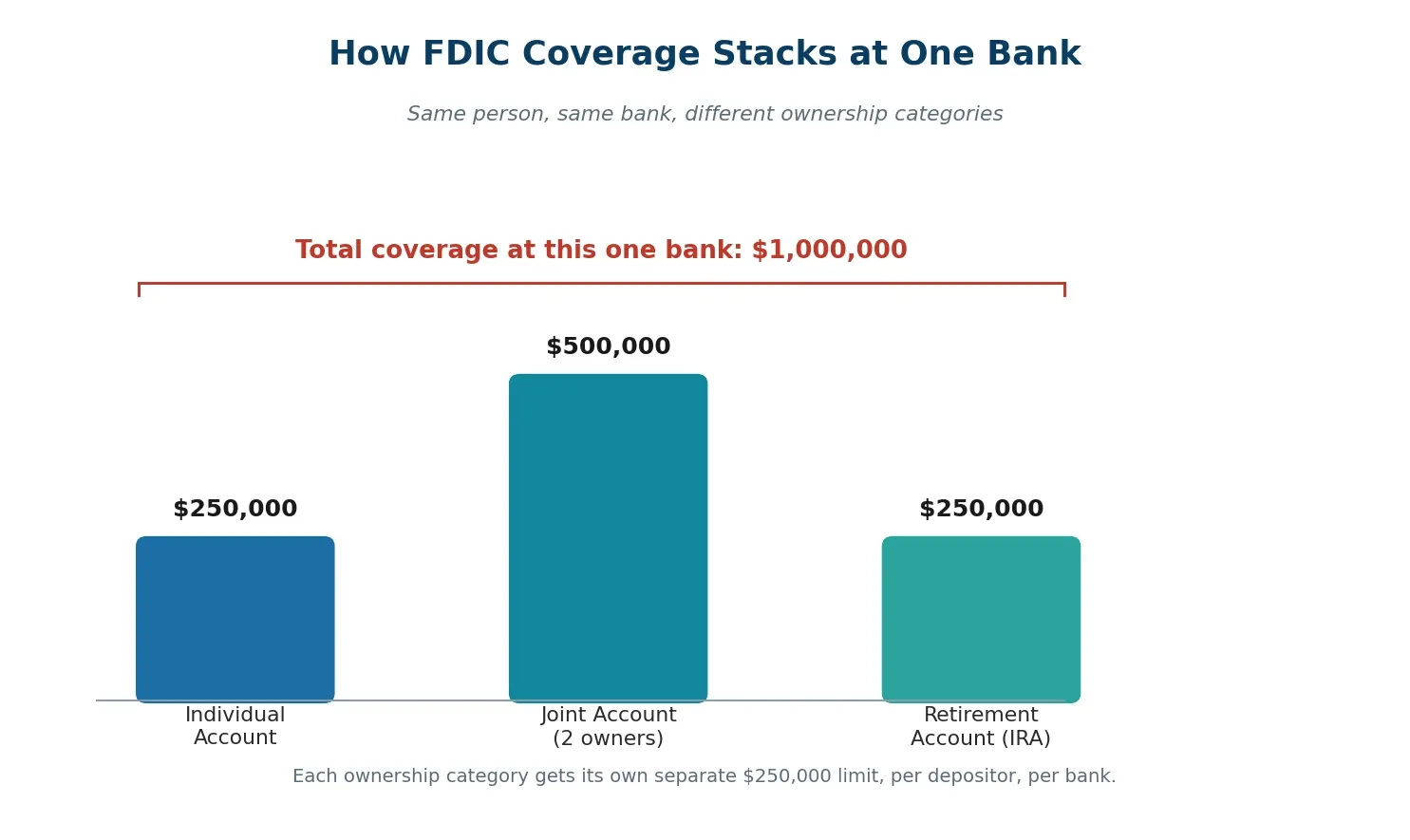
This
is the part most people never learn. The $250,000 limit resets for each
distinct ownership category, not just for each bank. That means a single person
can hold several times that amount at one institution and still be fully
covered.
|
Ownership
Category |
Coverage |
Example |
|
Single
accounts |
$250,000 |
An individual
checking or savings account |
|
Joint
accounts |
$250,000 per
co-owner |
A two-person
joint account covers $500,000 |
|
Retirement
accounts (IRAs) |
$250,000 per
owner |
Traditional
and Roth IRAs at the same bank |
|
Revocable
trust accounts |
Varies by
beneficiary |
Often
$250,000 per named beneficiary |
|
Business
accounts |
$250,000 |
Separate from
the owner's personal coverage |
A
concrete example makes this click. Let us consider the case that one individual
has a personal checking account, joint savings account along with a spouse and
an IRA account at one bank. The coverage therefore becomes $250,000 for the
personal checking account, $500,000 for the joint savings account (which will
be divided between the two individuals holding it), and $250,000 for the IRA
account. The grand total becomes $1,000,000. Revocable trust accounts deserve
their own mention, since they work a little differently and tend to confuse
people doing estate planning. Coverage generally depends on how many
beneficiaries are named, with each one potentially adding another layer of
coverage, up to a certain number before the math changes. This makes it so that
trust accounts are actually quite helpful for large estates, although the laws
are so specific that anybody who has any sort of balance in their trust account
should speak with their financial institution or a financial advisor.
Joint
Accounts: The Rules That Trip People Up
Joint
accounts are provided a separate section since there are specific guidelines
that should be followed accurately.
·
All co-owners must be living individuals: corporations,
trusts, and partnerships don't qualify for joint account coverage under this
category.
·
Equal withdrawal rights are required: every
co-owner needs equal rights to withdraw funds for the account to count as joint
for insurance purposes.
·
Coverage is per co-owner, not per account:
a
two-person joint account is covered up to $500,000 total, $250,000 attributed
to each owner's share, regardless of who actually contributed the money.
·
Multiple joint accounts combine: if the
same two people hold more than one joint account at the same bank, those
accounts are added together and share one combined $500,000 limit, rather than
each getting its own separate coverage.
What
Happens If a Bank Actually Fails?
Bank
failures are rare, and when they happen, the process moves fast. The FDIC
typically makes insured deposits available within one to two business days of a
bank's failure, either by transferring accounts automatically to another
insured bank or by mailing a check directly.
·
No depositor has ever lost insured funds: not
since FDIC insurance began in 1933, and NCUA share insurance has the same
record.
·
Bank mergers come with a grace period: when
two insured banks merge, deposits stay separately insured under each bank's
original coverage for six months, giving depositors time to restructure if
their combined balance would otherwise exceed the standard limit.
·
Uninsured amounts aren't automatically
gone: money above the insured limit isn't guaranteed, but
depositors often recover some or all of it anyway through the bank's remaining
assets during resolution. Insured coverage simply removes the uncertainty on
that portion entirely.
It
helps to understand what actually happens behind the scenes. As it is the case,
the FDIC arranges a sound bank to assume control of the failing bank within a
weekend so that the following day, the bank accounts can be accessible to its
depositors without any problems, using the same debit card and the same login
information, just like nothing has happened. This is how things usually go, and
not an exception; hence, why bank failures are shocking news but do not cause
much disturbance to those depositors who have insured deposits.
How to
Verify Your Bank Is Actually Insured?
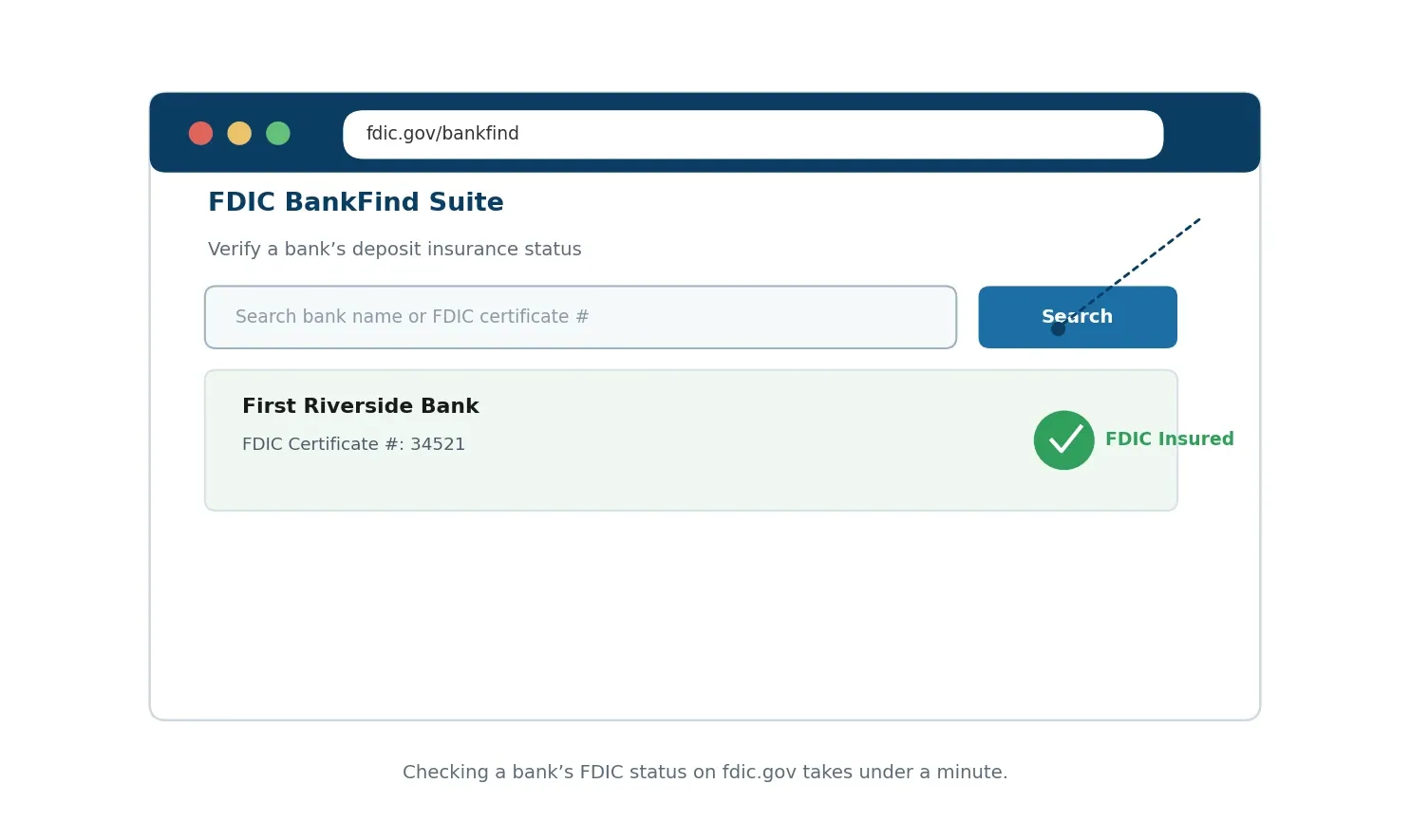
·
Use the FDIC's BankFind tool: it's
free, lives on fdic.gov, and confirms whether a bank is FDIC insured along with
its certificate number, in well under a minute.
·
Check the NCUA's equivalent for credit
unions: the NCUA runs its own tool for confirming a credit union's
federal insurance status.
·
Look for official signage, but verify
directly too: insured banks display FDIC signage at branches
and online, though checking the official tool is more reliable than signage
alone.
·
Confirm the actual bank behind fintech
apps: some banking apps aren't banks themselves, they partner
with an FDIC-insured bank behind the scenes. It's worth knowing which bank
actually holds the deposits and checking that bank's status directly.
·
Try the FDIC's EDIE calculator: The
Electronic Deposit Insurance Estimator lets you plug in your specific accounts
and ownership structure to see your exact coverage total, useful if your
balance is getting close to the standard limit.
Common
Myths About Deposit Insurance
·
Myth: coverage depends on the interest
rate offered. False. A high-yield account at an insured bank
gets the exact same $250,000 protection as a low-yield one. Rate has nothing to
do with insurance coverage.
·
Myth: online banks are less protected than
branch banks. False. As long as the institution is FDIC
insured, directly or through a partner bank, the protection is identical
whether or not it has physical branches.
·
Myth: credit unions are riskier than
banks. False. NCUA coverage mirrors FDIC coverage exactly,
$250,000 per owner per ownership category, backed by the same federal
government guarantee.
·
Myth: all money held at a bank is insured.
False.
Investment products like stocks, bonds, and mutual funds sold through a bank
aren't covered, even when bought at the same institution as an insured deposit
account.
Strategies for Balances Above $250,000
If
your savings are genuinely approaching or past the standard limit, a few
practical moves extend your coverage without adding much complexity.
·
Use multiple ownership categories at one
bank: as the earlier example shows, combining individual, joint,
and retirement accounts at a single institution can multiply effective coverage
considerably.
·
Spread deposits across separate banks: every
FDIC or NCUA insured institution gives you its own independent $250,000 per
category, so splitting a large balance across two or three banks is a simple
way to extend coverage.
·
Ask about cash management sweep accounts: some
brokerages and banks offer accounts that automatically spread large balances
across a network of partner banks behind the scenes, extending coverage into
the millions without requiring you to juggle multiple logins.
Sweep
programs are worth understanding a bit further, since they solve the
multiple-bank hassle automatically. Instead of personally opening and tracking
accounts at five or six banks, a sweep account splits a large deposit across a
network of partner banks behind the scenes, while you see and manage just one
account and one login. Each partner bank in that network provides its own
separate $250,000 of coverage, so a sweep program spread across ten partner
banks can insure $2.5 million or more, all while looking and working like a
single ordinary account on your end.
Common
Mistakes People Make with Deposit Insurance
·
Assuming coverage is per account rather
than per ownership category: two individual accounts at the
same bank still share one combined $250,000 limit, opening a second account in
your own name doesn't double your protection.
·
Not verifying a fintech app's actual bank
partner: confirming which institution actually holds the deposits,
and that institution's insurance status, takes only a minute and removes any
doubt.
·
Overlooking retirement account coverage as
a separate category: an IRA at the same bank as your checking
account gets its own distinct $250,000, worth factoring in when calculating
total coverage.
·
Assuming a merger instantly eliminates the
six-month grace period: some depositors rush to restructure
accounts immediately after a merger announcement, when in reality separate
coverage continues for six months, giving plenty of time to plan calmly.
·
Forgetting that business and personal
accounts are separate categories: a small business owner's
business account coverage is entirely independent of their personal account
coverage at the same bank, worth knowing when calculating total protection
across both.
Key
Takeaways
·
The
typical insurance limit is $250,000 for each depositor and for each bank
according to ownership categories and not just $250,000 for all depositors.
·
Single,
joint and retirement accounts within one bank may be used to increase
protection above the $250,000 limit without having other accounts.
·
Joint
accounts are insured up to the $250,000 limit for each owner which means that a
joint account with two people provides coverage up to $500,000.
·
FDIC
and NCUA insurance are essentially the same; both are guaranteed by the full
faith and credit of the US government and there has never been any loss of
insured money in either of these institutions.
·
Checking
on whether a bank is insured can be done in less than one minute with FDIC’s
BankFind program.
Conclusion
Deposit
insurance is one of the few genuine guarantees in personal finance, and
understanding how it actually works turns a vague sense of safety into
something you can calculate exactly. If your checking and savings sit
comfortably under $250,000, none of this changes anything for you, the coverage
is already automatic and complete. If you're getting close to that limit, a few
minutes with the FDIC's EDIE calculator, or a conversation about ownership
categories, can extend real protection a lot further without adding much
complexity to your banking life.
For
the full picture on banking fundamentals, read our complete guide to
banking in 2026.