
Introduction
Buying a stock for the first time can feel like a bigger deal than it actually is. There is a specific button to click, a specific number to type in, and a very real sense that getting it wrong somehow matters more than it does. In practice, buying a stock is one of the more mechanically simple things you can do in a brokerage account, the harder part is deciding what to buy and understanding what you actually own afterward.
This guide is written specifically for that first purchase, the moment where hesitation tends to be highest and where a little concrete guidance goes the furthest. By the end, the mechanics should feel routine, leaving the actual decision-making, what to buy and why, as the only part that still requires real thought.
This guide walks through what a stock actually is, how to open a brokerage account if you have not already, a simple framework for researching a company before buying, and the exact steps to place your first order.
This article is part of our larger investing for beginners guide, and it pairs well with our best investment apps of 2026 guide if you have not chosen a platform yet.
Why Buy Individual Stocks at All?
Given how strongly beginner advice tends to favor diversified index funds, it is a fair question to ask why anyone buys individual stocks in the first place. For most long-term wealth building, index funds genuinely are the more reliable approach, spreading risk across hundreds of companies rather than concentrating it in one. But individual stocks still serve a real purpose for a lot of investors, as a smaller, deliberate slice of a broader portfolio rather than its foundation.
Some investors enjoy the process of researching specific companies and want a small amount of money reflecting that interest and conviction. Others hold individual shares of a company they work for, or one whose products they use and believe in. Neither reason needs to be the primary engine of a portfolio's growth to be worth understanding properly, which is exactly what this guide is here to help with.
What is a Stock?
A stock represents a share of ownership in a company. When a company issues stock, it is dividing ownership into pieces, and buying even one share makes you a partial owner of that business, with a legal claim to a proportional slice of its profits and, in some cases, a vote on major company decisions.
Stock prices move based on supply and demand, shaped by how investors collectively view a company's current performance and future prospects. A company reporting stronger-than-expected profits tends to see its stock price rise, as more investors want to own a piece of that growth, while disappointing news tends to push the price down as investors sell.
- Common stock: the standard type most investors buy, offering voting rights and a claim on profits, though dividends are not guaranteed.
- Preferred stock: typically offers fixed dividend payments and priority over common stock if a company is liquidated, but usually without voting rights.
- Dividend stocks: companies that regularly distribute a portion of profits directly to shareholders, generally more established, stable businesses.
- Growth stocks: companies reinvesting profits into expansion rather than paying dividends, often younger or faster-growing businesses with higher volatility.
It also helps to understand what you are not getting when you buy stock in a public company. Owning shares does not give you a say in daily operations, a seat at the table, or any direct control beyond a proportional vote at shareholder meetings on major matters, like electing the board of directors. What you do get is a legal, transferable claim on a slice of the company's value, which is exactly why the stock can be bought and sold freely on an exchange, its value simply reflects what other investors believe that claim is currently worth.
How to Open a Brokerage Account
Before buying any stock, you need a brokerage account, the platform that actually executes the purchase on your behalf. Most major brokerages in 2026 make this process quick and largely painless.
Step 1 — Choose a Platform
Look for $0 commission on stock trades, no account minimum, and fractional share support, standard features across most beginner-friendly platforms today.
Step 2 — Provide Basic Information
Opening an account typically requires your name, address, Social Security number, and employment information, standard requirements under financial regulations designed to verify identity and prevent fraud. This information gets used to satisfy Know Your Customer rules that every regulated brokerage in the U.S. is required to follow, not a red flag specific to any one platform.
Step 3 — Fund the Account
Link a bank account and transfer money in, most transfers clear within one to three business days, though some platforms offer instant access to a portion of the deposit.
Step 4 — Confirm the Account Type
Decide between a taxable brokerage account, offering full flexibility with no contribution limits, or a tax-advantaged account like a Roth IRA, which has a $7,000 annual contribution limit in 2026 but offers tax-free growth for retirement-focused investing.
For a very first stock purchase, either account type works fine mechanically, the decision mostly comes down to purpose. Money meant for retirement, decades away, generally benefits from the tax advantages of an IRA. Money for a more flexible, sooner-term goal, or simply for learning how investing in individual stocks works, is usually better suited to a standard taxable account, which carries no restrictions on when funds can be withdrawn.
How to Research a Stock Before Buying
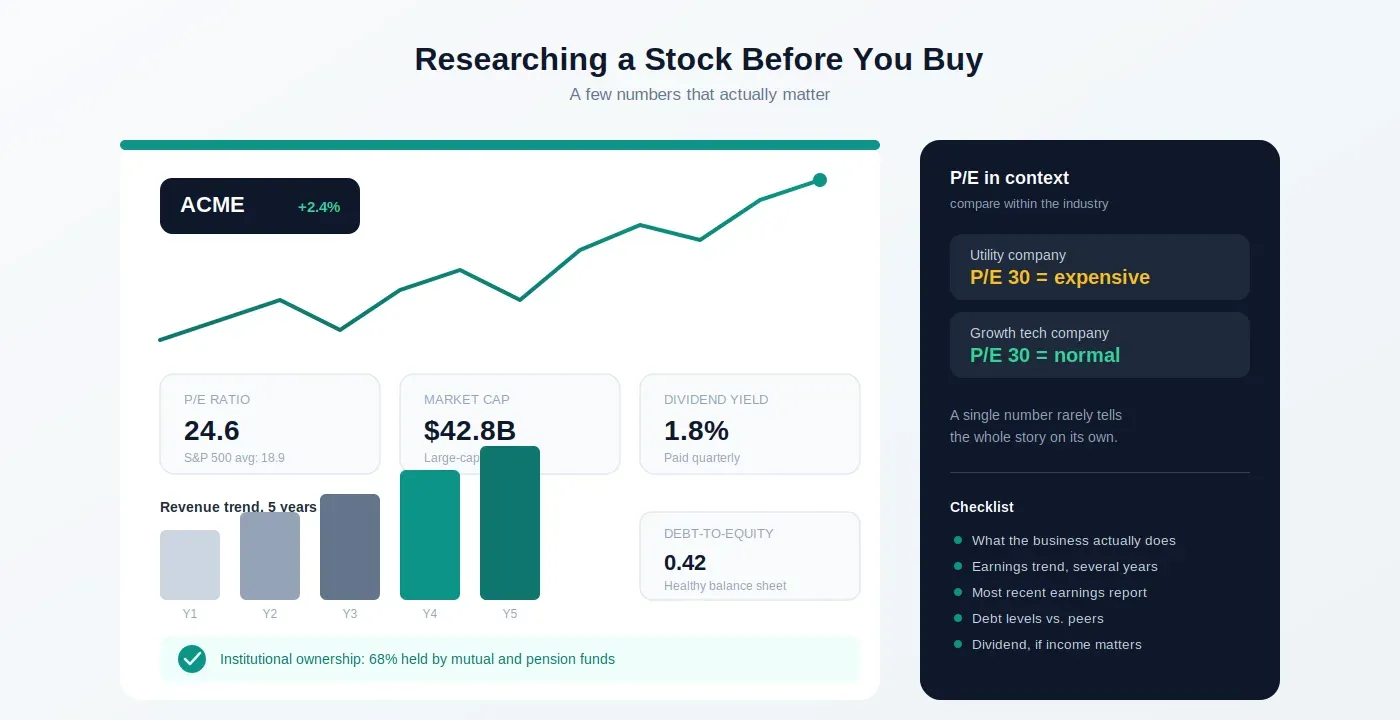
This is where most of the actual thinking happens. A few core concepts give a reasonable starting framework for evaluating any individual company.
- Start with what the company actually does: understanding the business itself, how it makes money, who its customers are, what its competitive position looks like, matters more than any single financial number.
- Check the P/E ratio for context: the price-to-earnings ratio divides a stock's price by its earnings per share, showing how much investors are paying for each dollar of profit. The S&P 500's average forward P/E has hovered around 18.9 over the past decade, giving a rough benchmark for comparison.
- Compare P/E within the same industry: a P/E of 30 might be expensive for a stable utility company but perfectly normal for a fast-growing technology company, comparing across unrelated industries can be misleading.
- Look at earnings trends over several years: a single strong or weak quarter tells you much less than a consistent multi-year pattern of revenue and profit growth or decline.
- Read the most recent earnings report: publicly traded companies release quarterly earnings reports summarizing financial performance, available free through the company's investor relations page or most brokerage research tools.
- Note who else owns the stock: significant institutional ownership, large mutual funds and pension funds holding meaningful stakes, can be a signal of broader confidence, though it is a supporting data point rather than a reason on its own.
- Consider the dividend, if any: for income-focused investors, a company's dividend yield and history of maintaining or growing that dividend over time can be a meaningful factor.
None of these metrics work in isolation. A low P/E ratio can signal a genuine bargain, or it can signal a company in real trouble, the number alone does not tell you which. Treating any single metric as a complete answer is one of the most common beginner research mistakes.
A few other metrics are worth knowing, even if the P/E ratio remains the most commonly cited starting point. Revenue growth shows whether a company's sales are actually expanding year over year, a company can technically be profitable while its revenue shrinks, which is generally a warning sign rather than a strength. Debt levels matter too, a company carrying heavy debt is more vulnerable during an economic downturn than a similar company with a stronger balance sheet, since debt payments do not pause just because business slows down.
Market capitalization, the total value of all outstanding shares, also shapes how to think about a company. Large-cap companies, generally valued above $10 billion, tend to be more established and stable, while small-cap companies carry more growth potential alongside meaningfully more volatility and risk. Neither category is inherently better, they simply behave differently, and knowing which category a stock falls into helps set realistic expectations for how much its price might swing.
Steps to Buy Your First Stock
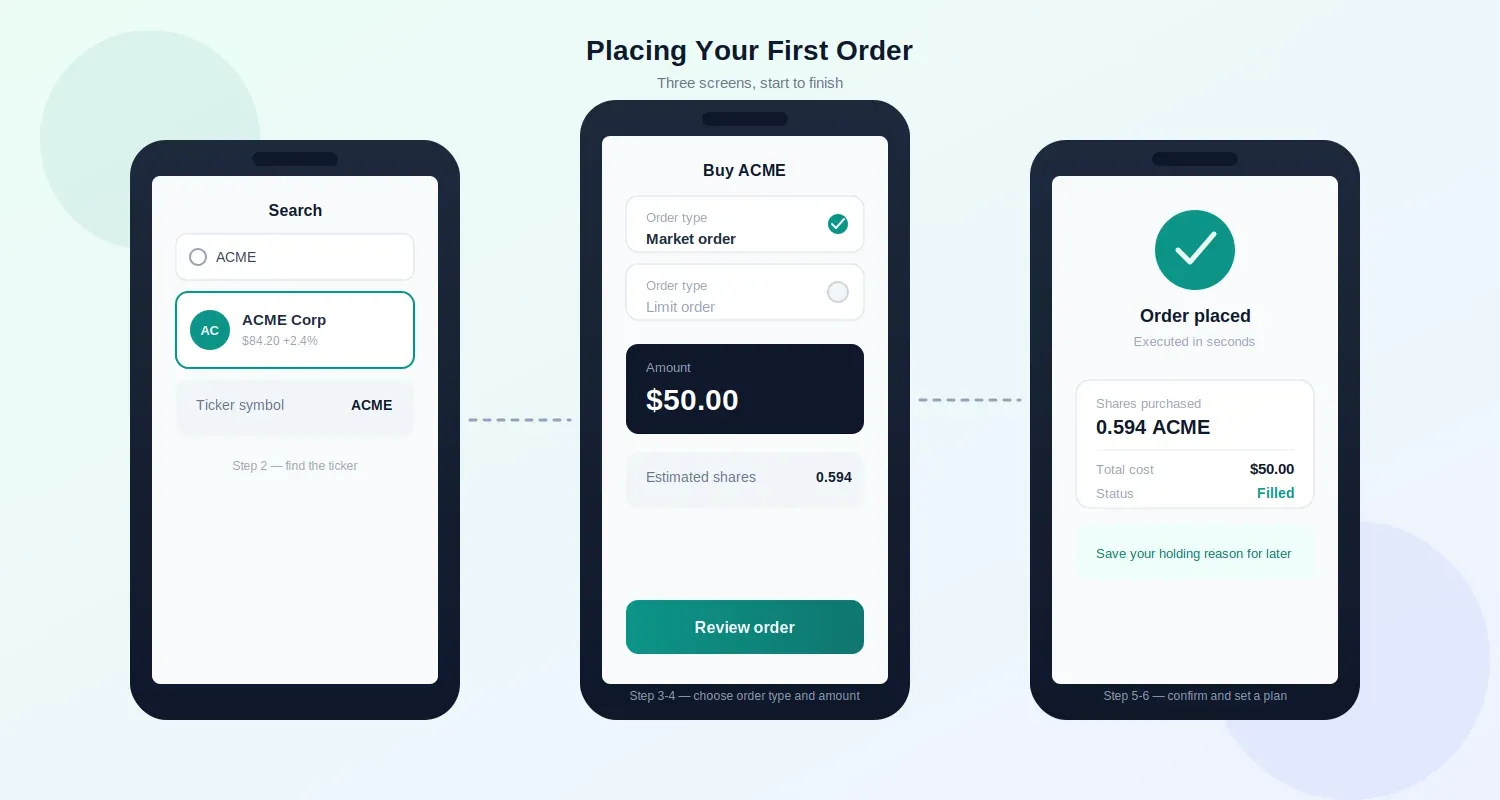
Step 1 — Decide How Much to Invest
Start with an amount you are genuinely comfortable holding through normal ups and downs, fractional shares mean even $20 or $50 is enough for a first purchase.
Step 2 — Search for the Company's Ticker Symbol
Every publicly traded company has a unique ticker symbol, a short abbreviation used to identify it on an exchange, like AAPL for Apple or MSFT for Microsoft.
Step 3 — Choose an Order Type
A market order buys immediately at the current price, the simplest option for a first purchase. A limit order lets you set a specific maximum price you are willing to pay, executing only if the stock reaches that price.
Step 4 — Enter the Amount and Review
Enter either a dollar amount or a number of shares, most platforms show the estimated cost before you confirm, review it carefully before finalizing the order.
Step 5 — Place the Order
Confirm the purchase. Market orders during trading hours typically execute within seconds, and the shares appear in your account almost immediately afterward.
Step 6 — Decide on a Holding Plan
Before buying, it helps to have at least a rough idea of why you are holding this specific stock and for how long, a specific reason makes it much easier to stay calm and avoid a panicked decision during normal short-term price swings.
Writing this reason down, even in a single sentence saved in a notes app, turns out to be surprisingly effective. Something like “I am holding this because the company has grown revenue consistently for five years and I expect that to continue” gives you a concrete standard to check against later. If the original reason no longer holds, that is a legitimate signal to reconsider the position. If the price simply dropped without anything about the underlying business actually changing, the original reasoning likely still applies, and reacting to the price alone would mean abandoning a plan based on nothing more than short-term noise.
Common Mistakes When Buying Individual Stocks
- Buying based on a hot tip alone: a recommendation from social media or a friend is a starting point for research, not a substitute for actually understanding the company.
- Putting too much into a single stock: concentrating a large share of a portfolio in one company carries meaningfully more risk than spreading the same money across a diversified fund.
- Ignoring the P/E ratio's context: comparing a growth stock's P/E to a value stock's P/E, without adjusting for industry and growth expectations, leads to flawed conclusions.
- Checking the price too frequently: daily price movements on an individual stock are often just noise, and checking constantly tends to encourage impulsive, emotionally driven decisions.
- Selling immediately after a dip: short-term price drops are normal even for fundamentally strong companies, panic-selling locks in a loss that might have recovered with patience.
- Confusing a falling price with a bad company: stock prices fall for many reasons, some tied to the company itself, others tied to broader market sentiment that has little to do with any single business, conflating the two leads to selling good companies at exactly the wrong moment.
For a deeper look at how prices move and what drives the broader market, see our guide on how the stock market actually works.
Key Takeaways
- A stock represents partial ownership in a company, with a claim on its profits and, for common stock, voting rights.
- Opening a brokerage account typically takes about ten minutes, requiring basic identification and a way to fund the account.
- The P/E ratio is a useful starting point for research, but should always be compared within the same industry and alongside other factors.
- A market order is the simplest way to buy, executing immediately at the current price, while a limit order sets a maximum you are willing to pay.
- Avoid concentrating too much of a portfolio in a single stock, diversified funds carry meaningfully less risk for a similar long-term return potential.
Conclusion
Buying your first individual stock is a mechanically simple process once you understand the basics, open an account, research the company, choose an order type, and confirm the purchase. The more important skill is the research and discipline that surrounds that click, understanding what you actually own, why you are holding it, and resisting the urge to react to every short-term price swing. Start small, research honestly, and let the position prove itself over time rather than judging it after the first week.
For the full picture on investing, including how individual stocks fit into a broader strategy, read our complete investing for beginners guide.