
Introduction
Say you're 35 and
healthy. You get a term life quote and it's for half a million dollars of
coverage, and the monthly bill is less than a single streaming subscription.
Yeah, really. Most people are shocked the first time they see it. Life
insurance has this reputation: confusing, pricey, something for later. Term
life isn't any of those.
In this guide I'll
cover how term life works, what it costs by age in 2026, how the conversion
option and the usual riders work, and the handful of mistakes first-time buyers
keep making. After that, getting a quote shouldn't feel scary. It's just a
decision.
How Term Life Insurance Actually Works
Term life covers you
for a fixed number of years. Usually 10, 15, 20 or 30. You pay the same
premium, monthly or yearly, the whole time. If you die while the policy's
active, the insurer pays a tax-free death benefit to the person you named as
beneficiary. If you're still around when the term ends, the coverage stops and
nobody gets paid. That's what happens for the large majority of people, and
it's fine. That's the deal.
It's also why term is
so much cheaper than permanent insurance. There's no lifelong coverage and no
cash value account being built inside the policy. You're paying for exactly one
thing, which is the insurer carrying the risk of your death during a set
window. And most insurers guarantee a level premium for the full term. So if you
lock in a rate at 35 for a 20-year term, you're paying that same rate at 55,
even if your health goes downhill in between.
What Term Life Insurance Costs in 2026
The price is
determined by the individual’s age, gender, health, level of coverage desired
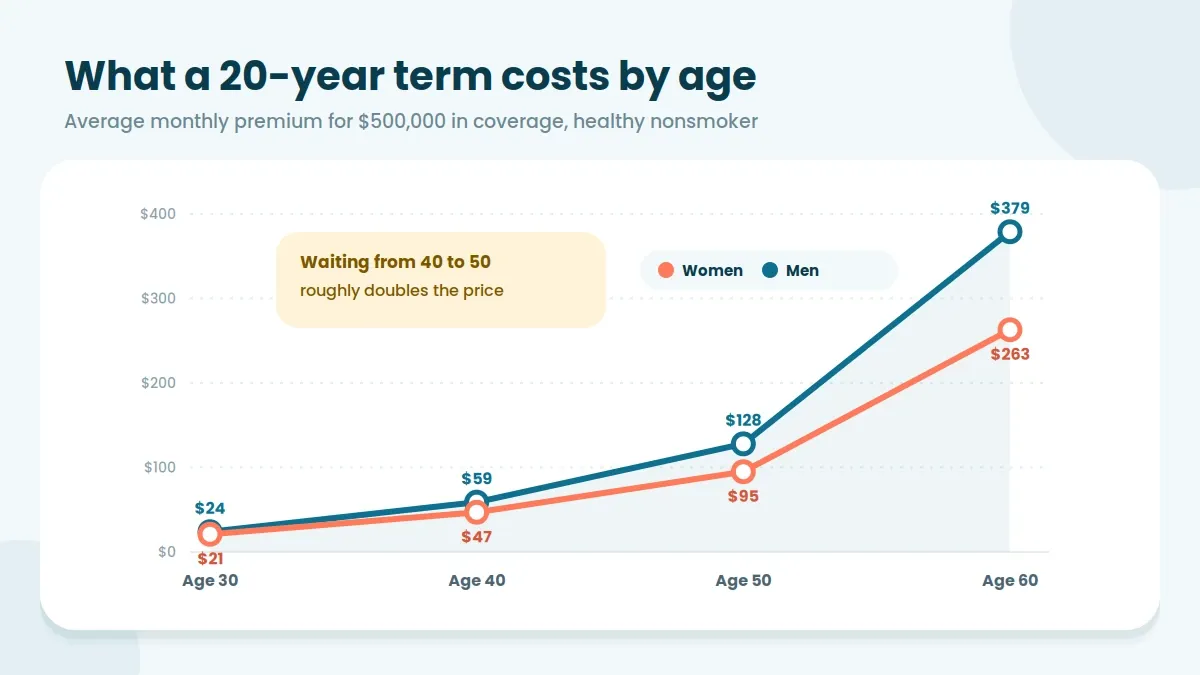
and years bought. Considering a fit 40-year old non-smoker, a 20-year $500,000
policy would cost on an average $47 per month for women and $59 per month for
men. Go younger and it's noticeably cheaper. After 50 it climbs fast, because
the odds of the insurer paying out keep rising with your age.
|
Age |
20-Year
Term, Women |
20-Year
Term, Men |
|
30 |
~$21/mo |
~$24/mo |
|
40 |
~$47/mo |
~$59/mo |
|
50 |
~$95/mo |
~$128/mo |
|
60 |
~$263/mo |
~$379/mo |
Those numbers assume
$500,000 of coverage and a healthy nonsmoker, and they'll move around by insurer
and health class. Being a smoker, it is expected that you will be required to
pay twice or thrice the amount charged to non-smokers. Moreover, 10 years is
much cheaper than 30 years of term insurance at all ages because the risk being
assumed is relatively low during that period.
Choosing the Right Term Length
How long should your
term be? As long as your family would actually need the money. That's the whole
answer. A round number that just feels right isn't a plan. Most people tie it
to their biggest obligations. A 20 or 30-year term covers the mortgage plus the
years until the kids can look after themselves. If it's one specific,
time-limited debt you're covering, a shorter 10-year term does the job.
● A
10-year term is the cheapest, and it's good for a specific short-term
obligation like a business loan or the last years before retirement
● A
20-year term is what most people buy, and it's built for the years from having
young kids until they're launched into adulthood
● A
30-year term costs more, but if you're younger with a long mortgage or very
young kids, it locks in a low rate for the longest stretch
Here's a trick:
laddering. Instead of one big policy, you stack two or three smaller ones with
different lengths. Imagine a parent purchases a 10-year, $200,000 coverage to
cover his liability until his mortgage period ends and also purchases a
20-year, $300,000 coverage to cover until his children grow up. Liability will
be high while obligations are high and will automatically reduce as each period
of the policies expires. Often the total premium comes out lower than one big
policy sized for the whole 20 years.
Most term policies
also let you renew once the level term is over. You keep the policy year to
year with no new medical exam. Sounds nice, but the catch is price. Renewal
premiums jump a lot, often to several times the original rate, since they're
priced on the age you are now and not the age you started at. So treat renewal
as a short bridge while you arrange new coverage. It's not a long-term plan. A fresh
term policy at a competitive rate is almost always cheaper than riding out an
expired term on renewal pricing.
The Conversion Option: Your Safety Net
Most term policies
sold today come with a conversion option. That means you can switch some or all
of the term coverage into a permanent policy (usually whole or universal life)
before a set deadline, without a new medical exam or new health questions. The
insurer has to accept the conversion at the health class you first qualified
for, even if your health has changed a lot since.
That matters more
than it sounds. Imagine you get a serious diagnosis halfway through your term.
Buying a brand new policy at that point could mean a much higher premium, or a
flat no. The conversion option sidesteps all of that. So before you buy, check
that the policy has one and find the deadline. Not every term policy does,
especially the cheaper employer-sponsored group term coverage. Read the actual
contract. Don't assume.
Common Riders Worth Knowing
● The
waiver of premium rider is when you stop paying your premiums in case you have
become disabled and unable to work while the policy remains active
● Accelerated
death benefit riders allow you to take some portion of the death benefit if you
have been diagnosed with a fatal illness; it is usually available free of
charge
● The
children’s term rider provides you with a little insurance for your children
and is also convertible without any health examination in the future
● The
guaranteed insurability rider allows you to increase your policy coverage in
the future or even after certain life-changing events
In general, all the
riders provide you with additional options but do increase your cost of
insurance. A solid base policy with zero riders is still way better than no
coverage. Riders are a bonus. Skip any you won't use.
How Underwriting Actually Works
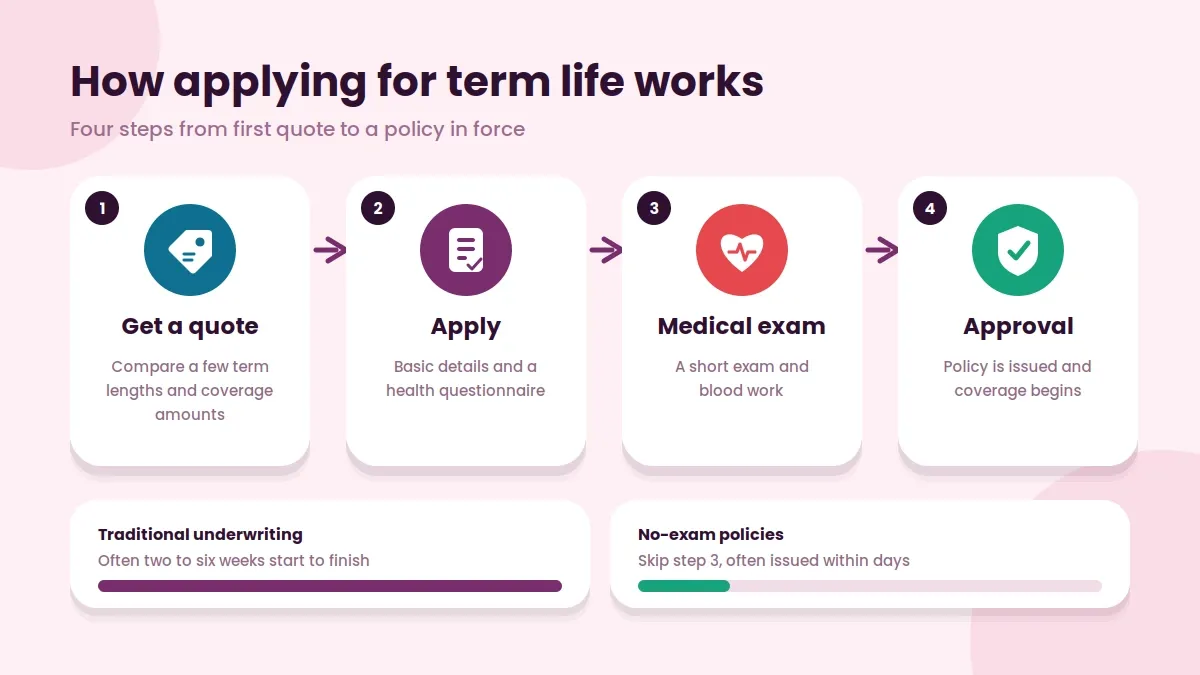
No-exam policies have
become increasingly popular and conduct underwriting through algorithms using
information such as prescription history and driver record without the physical
examination, and they can usually provide a policy in a few days' time.
The no-exam policy is
somewhat more expensive than the underwritten one and the maximum coverage is
limited up to somewhere between $1M-$2M based on the insurance company. It is
more advantageous for those who are younger than 50 in good health condition to
opt for the underwritten policy as it is cheaper per dollar of coverage.
No-exam is more appropriate for quick coverage or people who want to avoid the
exam.
Term Life vs. Whole Life: A Quick Recap
Whole life premiums
are considerably higher, often five to ten times as high, due to its lifetime
duration and cash value component that allows borrowing against the policy.
Whole life insurance for a 40-year-old healthy person in the amount of $500,000
would cost about $540-$575 per month instead of $47-$59 monthly as a term
insurance.
The advantages of whole
life include guaranteed lifetime coverage and cash value component. However, it
comes with a very high price, with most of the premium paid out in commissions
in the early years of the policy. Usually the need for life insurance comes
from covering certain period in the future: bringing up children, repaying a
mortgage, covering income loss while working. Whole life makes more sense for
narrower situations like estate planning or business succession. It's not a
good default for replacing income.
Who Should Be Named as Your Beneficiary
Most term life
insurance contracts enable you to appoint not only a primary beneficiary but
also one or more secondary beneficiaries, and the selection of the
beneficiaries becomes more crucial than most individuals believe. In most
cases, the first beneficiary selected is the spouse or partner. If you're a
single parent, naming a trust, or a named guardian as trustee for a minor
child, is usually a better setup than naming the child directly. Insurance
companies do not usually release benefits directly to a minor.
Check on your
beneficiary in case of any significant changes in your life such as marriage,
divorce, birth of a child, and death of a beneficiary. The insurance company
pays exactly what the form on file says. Your will doesn't override it, and
neither do your current relationships. So an outdated form from a decade ago
can send the payout to an ex-spouse instead of your current partner if nobody
ever updated it.
How Much Coverage Actually Makes Sense
It is always common
to start with ten times your yearly income, then inflate it to account for
debts, and deflate it to account for savings and existing coverage. If one
earns an income of $75,000 per year, has a mortgage, two children under the age
of five, and no other insurance, he would require between $750,000 and $1 million
of term insurance coverage. The honest test is simple. If nobody relies on your
income to keep up their standard of living, term life is optional, not essential.
This is also where
life insurance and an overall savings plan team up instead of
working alone. Insurance replaces your income if you're gone. Savings and
investments build the assets that eventually mean you don't need as big a death
benefit. They aren't competing for your attention. These two forms constitute
the short and long term parts of one protection strategy that is essential for
most families in various stages of their lives.
Common Mistakes to Avoid
● Delaying
in purchasing since premiums increase with age and any major illness during the
period of delay may result in exorbitant coverage or rejection of the
application
● Underinsuring
for saving a few cents per month considering that the cost of term life
insurance is low enough to allow for much higher coverage
● Relying
solely on your employer's insurance, considering that employer provided group
life insurance is often one to two times your salary and not portable to a new
job
● Not
having a contingent beneficiary, where failure to do so will have the policy
proceeds tied up in probate in case the primary beneficiary predeceases you
● Missing
the conversion deadline. An expired conversion option is the same as never
having one, so know the date, not only that the feature exists
Conclusion
Term life does one
job and does it well. It replaces your income for the people who depend on it
if you're not there, and it costs a fraction of what permanent coverage does.
The hardest part is usually getting started: pull a quote, compare a couple of
term lengths, apply before life gets busy again. And if the emergency fund that should sit next to life
insurance isn't built yet, work on that at the same time. They cover different
kinds of risk, and they do better together than as stand-ins for each other.