Introduction
Open
enrollment shows up once a year with a stack of acronyms: HMO, PPO, HDHP. And
what do most of us do? Scan for the lowest premium, click it, done. Fast
forward six months. You see a specialist, a bill arrives that makes no sense,
and you start wondering what exactly you signed up for.
Quick
reality check. These three plans aren't one product with three prices. They
work differently. They decide who you can see, and they decide how the bill
gets split between you and the insurer. Land on the wrong one and it can run your
hundreds of dollars a year, maybe thousands. The plan itself might be perfectly
fine. It just wasn't made for your situation. Thus, below is how each works,
the cost in 2026, and a decision rule that doesn’t require any guesswork.
One
way to keep them apart: each answers the same three questions in a different
manner. Who do you get to see? How much do you pay before insurance chips in?
How much control do you have over where you go? Get that and the acronyms stop
being scary. You're really just trading cost against freedom.
HMO: Health Maintenance Organization
Start
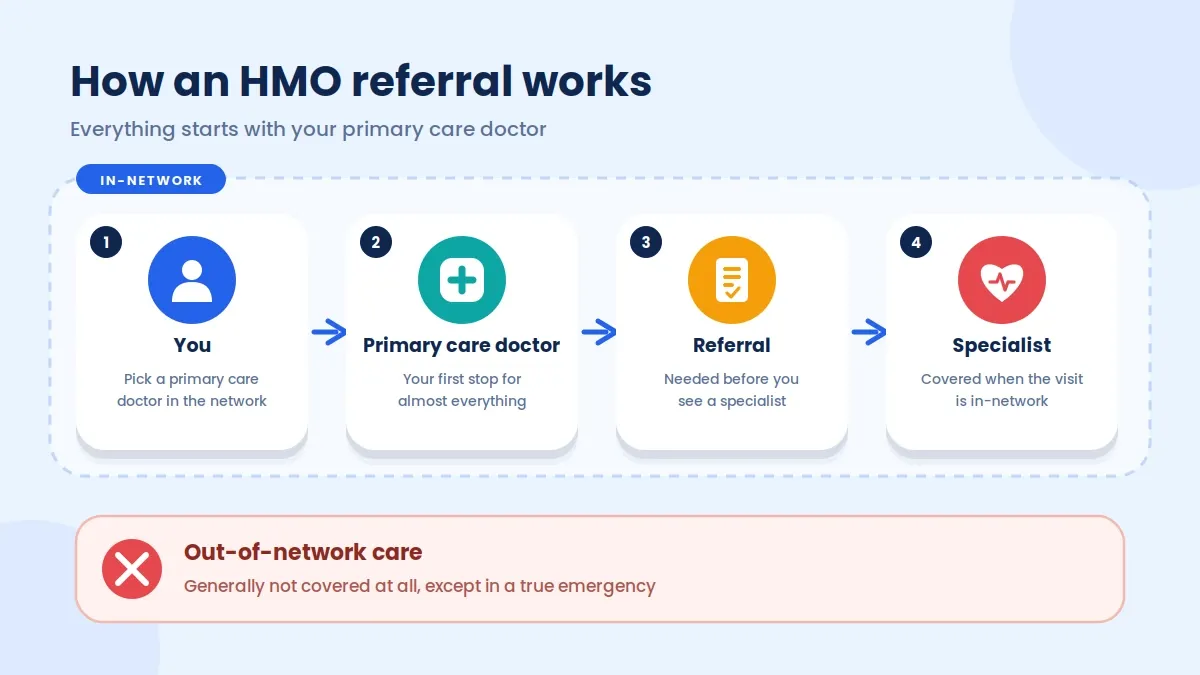
with the HMO. It's built around a gatekeeper. You choose a primary care doctor
inside the plan's network, and that person handles pretty much everything
first. Want a specialist? Usually you need a referral. Go outside the network
for something that isn't an emergency, and an HMO generally won't pay anything.
Not a smaller share. Nothing.
The
upside is cost. HMOs have the lowest monthly premiums out of all three. The
deductibles for HMOs that are in the network are generally low and can be zero
at times. If you go to see your primary physician regularly, you would have to
pay anywhere between $20 to $40. What you give up is choice. The network is
smaller, and there's one more hoop to jump through whenever you need a
specialist.
●
Best
for: Individuals who are loyal to their physician and do not visit specialists
frequently, who want low and consistent monthly payments
●
Watch
out for: A small local network in case you travel often or reside in two
different states
PPO: Preferred Provider Organization
A
PPO is basically the opposite. No gatekeeper, no referrals. See whoever you
want, even a doctor outside the network. You'll pay noticeably more out of
pocket for that out-of-network visit, but you can do it. That freedom is why
people buy PPOs, and it's priced in.
How
much is it priced in? PPO premiums run about 20% higher than HMO premiums on
average right now, and the gap isn't shrinking. In large employer surveys, PPO
premiums climbed roughly 12% in the most recent plan year, while HMOs rose
about 6.5%. Deductibles and coinsurance sit in the middle, higher than an HMO
and usually lower than an HDHP. Once you've met the deductible, coinsurance
often runs 20 to 30% for in-network care. Out of network it's a lot more.
●
Best
for: anyone with an ongoing condition, people who see several specialists
regularly, and anyone who just wants to pick any doctor without asking
permission
●
Watch
out for: When you’re healthy and don’t utilize the flexibility much, that
additional premium will really add up quickly.
HDHP: High-Deductible Health Plan
HDHPs
are different. You don't define them by how you see doctors. You define them by
numbers. For a policy to be qualified in 2026, it should have at least a
deductible amount of $1,700 for individual coverage and $3,400 for family
coverage, while out-of-pocket maximum amounts are limited to $8,500 for
individuals and $17,000 for families. You cover more of the early costs
yourself. In return the monthly premium is the lowest of the three, often by a
lot.
For
plenty of people the cheap premium isn't even the main attraction. The HSA is.
Only an HDHP lets you open and contribute to a Health Savings Account, and it's
a good one: money goes in before tax, grows tax-free, and comes out tax-free
when you spend it on qualified medical expenses. Triple tax advantage and one
thing that an HSA beats a Flexible Spending Account on is that HSA funds roll
over each year and continue with you regardless of job change or health
insurance plan change.
●
Best
for: healthy individuals who do not require frequent visits to the doctor and
people who want to save and invest in an HSA
●
Watch
out for: serious illness or injury early in the year means that you could pay
thousands out of pocket before coverage kicks in
Thinking
about an HDHP mostly for the HSA? Get a separate emergency fund set up first. An HSA works best
as a long-term account you invest and rarely touch, and you can only relax
about that when you've already got cash put away for the near-term medical
bills an HDHP leaves on your plate.
Side-by-Side Cost Comparison
|
Feature |
HMO |
PPO |
HDHP |
|
Monthly
premium |
Lowest of the
three |
Highest,
about 20% more than HMO |
Low, often
lowest overall |
|
Deductible |
Low or $0
in-network |
Low to
moderate |
$1,700+
individual / $3,400+ family (2026 minimum) |
|
Referrals
needed |
Yes, from
primary care doctor |
No |
Depends on
underlying plan design |
|
Out-of-network
coverage |
Emergency
only |
Yes, at
higher cost |
Depends on
underlying plan design |
|
HSA eligible |
No |
Rarely |
Yes, if
IRS-qualifying |
What "Network" Actually Means
All
three plans lean on a network. That's just the list of doctors, hospitals and
specialists who've agreed to accept the insurer's negotiated rates. Before you
pick, find out what happens when you step outside it. This one detail changes
your bill more than almost anything else, and it changes it differently for
each plan type.
With
an HMO, going out of network usually means no coverage unless it's a true
emergency. Period. A PPO does cover it, but you'll pay more: a higher
deductible and a bigger slice of coinsurance, often 40 to 50% of the bill
instead of the 20% or so you'd pay in-network. An HDHP could go either way. It
depends on whether the plan underneath is built like an HMO or like a PPO.
That's why two HDHPs from two different employers can act nothing alike once
you actually use them.
EPO and POS: The Plans You Might Also See
You
may also run into two more acronyms on the enrollment forms: EPO and POS. An
EPO (Exclusive Provider Organization) is a hybrid. No referrals needed, like a
PPO, but no out-of-network coverage outside of emergencies, like an HMO. A POS
(Point of Service) plan goes the other direction. You need a primary care
referral like with an HMO, but you can still go out of network for a higher
price, like with a PPO.
They
don't show up as often as the big three. Still, if your employer offers one,
know what you're looking at, because they borrow rules from both sides. The
same approach works here. Consider what is important to you between referrals
and restrictions within the network or out-of-network options, and choose a
hybrid plan.
How Employers Usually Subsidize These Plans
If
you get your plan through work, you're probably not seeing the full premium.
What you see is your share, after your employer pays theirs. The cost of
employer-only coverage is typically shared by employers at 70 to 85%. That
means the gap between plans on your paycheck can look smaller than the real gap
in what they cost.
And
employers don't always treat each plan the same. Some pay a bigger share of the
HDHP premium to nudge people toward it. Some even drop money straight into your
HSA. So ask HR if there's an employer HSA contribution with the HDHP. Just $200
or $300 in savings can make all the difference in terms of which option comes
out on top when all costs are added together.
How to Actually Decide Between Them
What
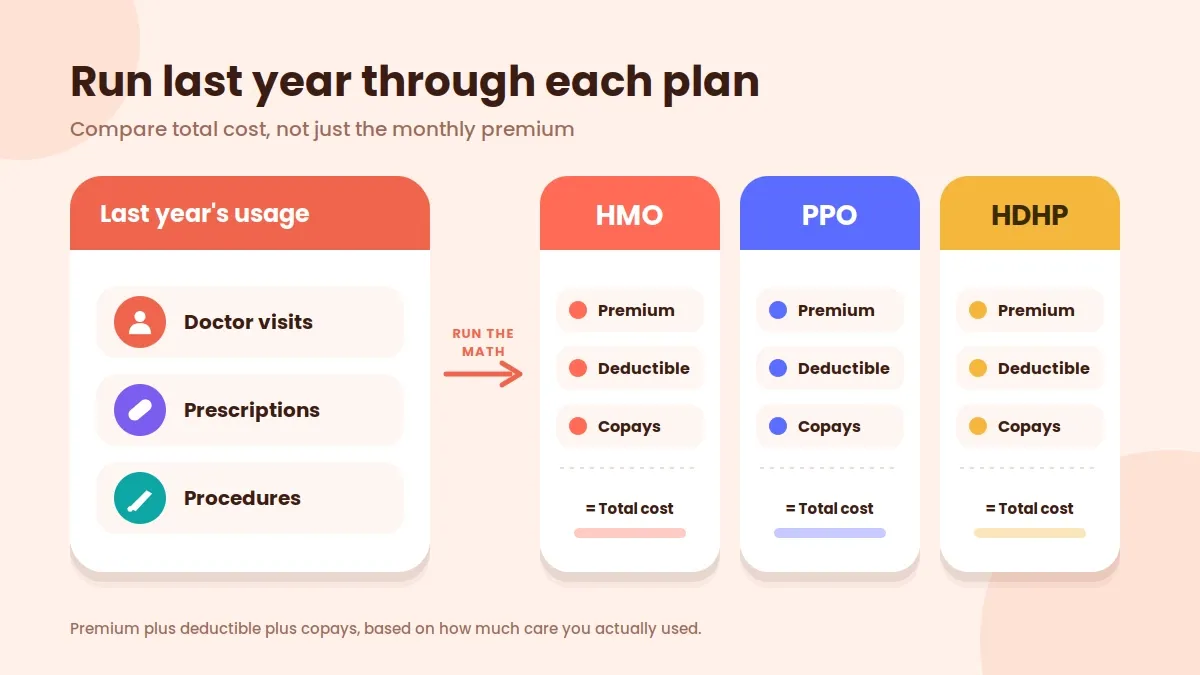
decides this? Pretty much just how many visits you had last year, rather than
how good your health is right now. Try to get last year's numbers on your
medical expenses that means visits to the doctor, prescription costs,
procedures. Premium plus deductible plus copays, all together. Just considering
the premium doesn’t say much:
●
If
you don’t visit the doctor’s office often and are not using any prescriptions,
an HDHP with an HSA is generally going to be the least expensive, and your HSA
will function as your savings account too
●
If
you visit the doctor a few times a year for preventive care and don’t need any
specialized treatment, an HMO will generally be the least expensive option,
provided that your physicians are in-network
●
If
you suffer from some chronic disease, require a lot of specialist care, or just
want more flexibility, then a higher premium of PPO is generally justified when
you consider all additional costs associated with the specialist copays and
prescriptions on a higher deductible plan
One
thing people forget all the time: make sure your current doctors are in-network
before you enroll. HMOs especially. A lower premium doesn't help if you have to
start over with a primary care doctor you've never met, and it's worse if
you're partway through treatment for something ongoing.
Look
at the bad year too, not only the average one. If you take the cost of each
plan in the event that you reach the out-of-pocket maximum (the entire year’s
premium cost plus the maximum amount you would pay) then there might be times
when the plan with the lowest premium in the HDHP category is still the one
with the lowest total cost in the worst-case scenario. You'd never see that if
you only compared premiums.
Common Mistakes People Make Choosing a Plan
●
Choosing
on premium alone, even though the cheapest monthly payment can turn into the
most expensive plan overall after one unplanned medical event
●
Skipping
the network check and finding out your longtime doctor is out-of-network after
you've committed to a full plan year, which is annoying and totally avoidable
●
Taking
an HDHP without any cash cushion, because the lower premium only pays off if
you can handle the higher deductible, and if you can't, one bad year can mean
real financial stress
●
Never
using the HSA, which wastes an HDHP's biggest financial advantage if you don't
open it and put money in
●
Assuming
last year's plan still fits, when a new diagnosis, a new prescription or a move
can change which plan makes the most financial sense
This
choice isn't a one-time thing either. It resets every year, not just when you
start a job, and that's the whole reason open enrollment exists. Life shifts. Being
pregnant, a new chronic condition, losing your child from your coverage, or a
year that you visited a doctor less than once. Open enrollment is a yearly
review of your insurance coverage, not just another form that you have to fill
out on the deadline. It's an easy way to avoid paying too much for coverage you
no longer need.
Conclusion
No
single plan wins for everybody. Each one caters to a unique pattern of
utilization of health care services, and the best choice is based on your
actual use of health care services rather than selecting the plan with the
lowest monthly premium." Pull last year's real usage, run the numbers on
all three, and check the network before you commit. If the HDHP appeals to you,
back it with a properly funded emergency fund and treat the HSA as a real
long-term savings account, maybe parked in a high-yield savings account while it builds. This
way, a plan with a high-deductible coverage becomes an advantage, not a risk
anymore.